
Pselliopus cinctus
(Fabricius, 1776)
Ringed Assassin Bug
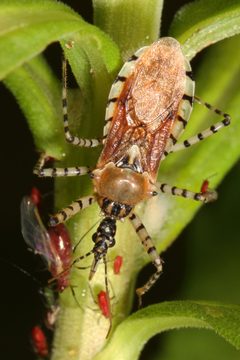
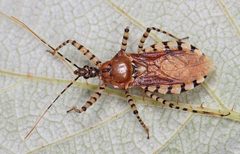
Pselliopus cinctus is a of assassin bug in the Reduviidae, commonly known as the Ringed Assassin Bug. It is found in North America and is a predatory true that hunts other insects. The species has been documented in ambush , including stalking bees and other prey on flowers.
Pronunciation
How to pronounce Pselliopus cinctus: //səˈlaɪ.əˌpʊs ˈsɪŋk.təs//
These audio files are automatically generated. While they are not always 100% accurate, they are a good starting point.
Identification
Distinguished from other assassin bugs by the combination of long legs, ringed or banded color pattern, and -specific . Separated from the similar orange assassin bug (Pselliopus barberi) by color pattern details—P. cinctus has ringed markings while P. barberi has orange with black jailhouse stripes. Distinguished from Zelus (milkweed assassin bugs) by lack of sticky forelegs. Separated from wheel bugs (Arilus cristatus) by smaller size and lack of the distinctive wheel-like pronotal structure.
Images
Habitat
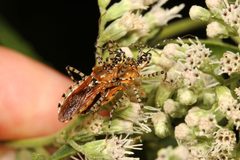
Found in meadows, gardens, and areas with flowering plants where prey insects are abundant. Observed on spent flowers and blossoms where it ambushes visiting and other insects.
Distribution
North America; confirmed present in the United States including Vermont and other regions.
Diet
Predatory; feeds on other insects. Documented prey includes bees, aphids, leafhoppers, lacewings, lygus bugs, and caterpillars. Uses ambush hunting strategy on flowers to capture and other visiting insects.
Behavior
Ambush that stalks prey on flowers. Has been observed waiting on spent flowers for such as leafcutter bees (Megachile), then attempting to stab them with its beak to inject venom and consume liquefied body contents. Hunting attempts may last approximately one minute before prey either escapes or is captured.
Ecological Role
Human Relevance
Beneficial as a natural agent for garden and agricultural pests. No documented negative impacts on humans; not known to be a significant biting pest to humans.
Similar Taxa
- Pselliopus barberiSimilar orange and black coloration, but P. barberi has distinct black jailhouse stripes rather than ringed pattern; both are in Pselliopus with similar body form and hunting .
- Zelus longipesBoth are assassin bugs with similar predatory habits, but Z. longipes has sticky forelegs for prey capture and lacks the ringed color pattern of P. cinctus.
- Arilus cristatusBoth are North American assassin bugs and , but wheel bugs are much larger with a distinctive wheel-like pronotal structure and different coloration.
More Details
Hunting behavior documentation
A detailed observation in a Vacaville garden documented P. cinctus stalking a male leafcutter bee (Megachile) on a spent flower. The assassin bug approached stealthily but the detected danger and escaped. This matches the typical ambush strategy of the .
Taxonomic placement
Member of the tribe Harpactorini within Harpactorinae, a diverse group of predatory true bugs. The Pselliopus contains multiple North American with similar ecologies but distinguishable by color pattern and minor morphological differences.
Sources and further reading
- BugGuide
- Wikipedia
- GBIF taxonomy match
- iNaturalist taxon
- NCBI Taxonomy
- Catalogue of Life
- A Good Morning for a Bee | Bug Squad
- Bring on the Tourists! | Bug Squad
- Archive — Bug of the Week
- Bugs in orange and black: Three assassins - milkweed assassin bug, Zelus longipes; orange assassin bug, Pselliopus barberi; and wheel bug, Arilus cristatus — Bug of the Week
- Rosie defoliators: Roseslug sawfly, Endelomyia aethiops, Curled rose sawfly, Allantus cinctus, and Bristley rose sawfly, Cladius pectinicornis — Bug of the Week
- Bugs in orange and black – Three spooky assassins: milkweed assassin bug, Zelus longipes; orange assassin bug, Pselliopus barberi; and wheel bug, Arilus cristatus — Bug of the Week