
Scaphinotus interruptus
(Ménétriés, 1843)
Ménétriés' snail-eating beetle, Menetries' Snail-eating Beetle
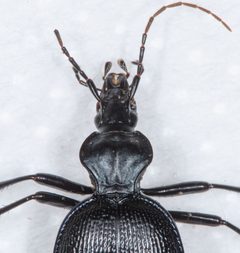
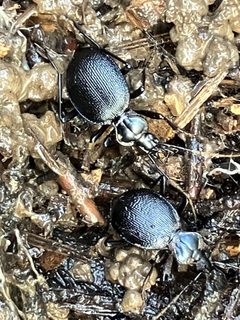
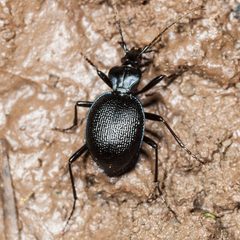
Scaphinotus interruptus is a of ground beetle in the tribe Cychrini, commonly known as Ménétriés' snail-eating . are flightless due to reduced wings (brachyptery) and are specialized of terrestrial snails. The species is to mountainous regions of the western United States, specifically California and Oregon.
Pronunciation
How to pronounce Scaphinotus interruptus: /ˌskæfɪˈnoʊtəs ɪnˈtʌrʌptəs/
These audio files are automatically generated. While they are not always 100% accurate, they are a good starting point.
Identification
Distinguished from other Scaphinotus by the combination of: brachypterous condition (shared with several ), uniformly black coloration without elytral modifications, and the specific body proportions of narrow with wide, rounded . S. interruptus overlaps geographically with S. angusticollis in parts of its range; the latter typically has more elongate, parallel-sided elytra. Accurate identification to species within the S. angusticollis species group often requires examination of male genitalia.
Images
Habitat
Montane and foothill environments, including mixed coniferous forests, oak woodlands, and riparian zones in mountainous terrain. Associated with moist microhabitats where terrestrial snails are abundant: under rocks and logs, in leaf litter, and along stream margins. Elevation range spans from foothill elevations to higher montane zones.
Distribution
to western North America. Documented from mountains and foothills of California and Oregon. GBIF records indicate presence in Alaska, though this may represent misidentifications or vagrant specimens; the core range is the Sierra Nevada, Coast Ranges, and Cascade foothills of California and Oregon.
Diet
Specialized of terrestrial snails (pulmonate gastropods). Uses elongated, slender to extract snails from shells.
Life Cycle
Complete with four stages: , larva, pupa, . Larvae are also predatory on snails. Detailed data specific to this are limited.
Behavior
are slow-moving, ground-dwelling beetles active during or periods. Flightless due to brachyptery; occurs by . When disturbed, may release defensive secretions typical of carabid beetles. Observed to be methodical hunters, tracking snail mucus trails to locate prey.
Ecological Role
regulating of terrestrial snails in montane forest . Contributes to nutrient cycling through on gastropods. As a flightless with limited ability, populations may serve as indicators of continuity and forest ecosystem integrity.
Human Relevance
No direct economic importance. Occasionally encountered by hikers and naturalists in montane regions of California and Oregon. Of interest to coleopterists studying carabid diversity and snail specialization.
Similar Taxa
- Scaphinotus angusticollisOverlaps in range and shares brachypterous condition; differs in more elongate, parallel-sided and often more northern distribution
- Scaphinotus elevatusAnother black, brachypterous Scaphinotus from western mountains; requires examination of genitalia for reliable separation
More Details
Taxonomic History
Described by Édouard Ménétriés in 1843. The specific epithet 'interruptus' refers to the discontinuous or modified elytral characteristic of the , though this feature is subtle in this compared to some .
Conservation Status
Not formally assessed; likely secure given relatively broad distribution within montane California and Oregon, though fragmentation in lower elevation foothill zones may impact some .