
Scaphinotus guyotii
(LeConte, 1863)
Guyot's Snail-eating Beetle
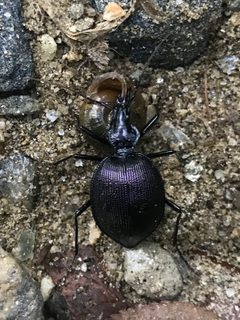
Scaphinotus guyotii is a of ground beetle in the Carabidae, commonly known as Guyot's Snail-eating . It is a specialized snail found in the Appalachian region of eastern North America, inhabiting montane coniferous and mixed deciduous forests. are brachypterous (short-winged) and , reflecting adaptations to their forest floor and predatory lifestyle. The species is named in honor of Arnold Henry Guyot, a 19th-century geographer and geologist.
Pronunciation
How to pronounce Scaphinotus guyotii: /ˌskæfɪˈnoʊtəs ɡaɪˈoʊtiː/
These audio files are automatically generated. While they are not always 100% accurate, they are a good starting point.
Identification
Members of Scaphinotus are recognized by their large size (typically 15–25 mm), elongate body form, and prominent, forward-projecting adapted for extracting snails from their shells. S. guyotii can be distinguished from by its geographic distribution in the southern Appalachians and associated preferences. have reduced wings (brachypterous condition) that limit . The is closely related to the snail-hunting beetles Cychrus and is placed in tribe Cychrini.
Images
Habitat
Inhabits coniferous forests at higher elevations and mixed deciduous forests at lower elevations in the Appalachian Mountains. The is associated with forest floor where terrestrial snails are abundant, particularly in moist, shaded environments with abundant leaf litter and woody debris.
Distribution
to the Appalachian region of eastern North America. Documented from North Carolina, Tennessee, Virginia, and West Virginia in the United States.
Diet
Preys on terrestrial snails (Gastropoda). The prominent are specialized for extracting soft body tissue from gastropod shells.
Behavior
are strictly , foraging on the forest floor for snails under cover of darkness. The brachypterous condition renders adults flightless, restricting movement to . This combination of traits reflects to stable forest with reliable prey resources.
Ecological Role
of terrestrial gastropods in Appalachian forest . As a specialized snail predator, it contributes to regulation of snail and may influence nutrient cycling through consumption of detritivorous mollusks.
Similar Taxa
- Scaphinotus angusticollisOverlaps in geographic range in the Appalachians; distinguished by more northern distribution and subtle differences in body proportions and elytral .
- Scaphinotus marginatusOccurs in similar montane ; S. guyotii distinguished by geographic isolation in the southern Appalachians.
- Cychrus speciesRelated snail-hunting beetles in tribe Cychrini; Cychrus typically have more rounded, compact body form and different geographic distributions.