
Calosoma macrum
LeConte, 1853
long caterpillar hunter
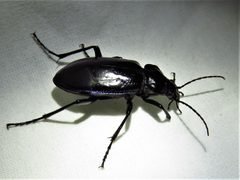
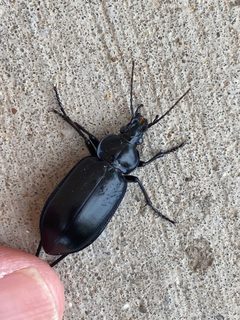
Calosoma macrum is a large ground beetle in the Carabidae, commonly known as the long caterpillar hunter. It was described by John Lawrence LeConte in 1853. The is found in the southwestern United States and northern Mexico, where it inhabits mid-elevation open areas. are active that hunt caterpillars, including arboreal species.
Pronunciation
How to pronounce Calosoma macrum: /kæloʊˈsoʊmə ˈmækrəm/
These audio files are automatically generated. While they are not always 100% accurate, they are a good starting point.
Identification
Distinguished from other Calosoma by its uniformly black coloration (lacking metallic or colored markings present in many ), large size (24–30 mm), and geographic range. The related Calosoma sayi (black caterpillar hunter) is similar in color but occurs in different regions; C. scrutator (fiery searcher) and C. wilcoxi have distinctive metallic green or purple coloration. The species name 'macrum' (meaning 'long') refers to its relatively elongated body form compared to some congeners.
Images
Appearance
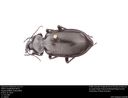
are uniformly black with a robust, elongated body. Length ranges from 24–30 mm. The are prominent, forward-directed, and sculptured. have segments longer than wide, appearing filamentous rather than bead-like. The overall build is characteristic of large Calosoma .
Habitat
Mid-elevation open areas, including grasslands and open woodlands. Occurs at elevations of 1,000–1,600 meters. Prefers with exposed soil surfaces and sparse vegetation.
Distribution
Mexico (Coahuila, Tamaulipas) and the United States (Arizona, Louisiana, New Mexico, Oklahoma, Texas). The spans the Chihuahuan Desert and adjacent regions, with disjunct in Louisiana and Oklahoma suggesting broader historical range or specificity.
Diet
Active specializing on caterpillars. are known to ascend trees to hunt arboreal caterpillars, a characteristic of the Calosoma. Specific prey records for this are limited, but related species consume fall cankerworms, spring cankerworms, gypsy moth larvae, and eastern tent caterpillars.
Behavior
are fast-running, and . When disturbed, individuals may release defensive chemicals including methacrylic acid and salicylaldehyde, as documented in . The is capable of and has been observed at ultraviolet lights. Arboreal foraging —climbing trees to hunt caterpillars—is inferred from -level traits and has been explicitly documented in related Calosoma species.
Ecological Role
of caterpillars, including potential pest . May contribute to of defoliating insects in forest and woodland . fluctuations may follow caterpillar cycles.
Human Relevance
Beneficial insect for agriculture and forestry due to on caterpillar pests. No significant negative impacts documented. Defensive secretions can cause temporary skin irritation if handled.
Similar Taxa
- Calosoma sayiSimilar uniformly black coloration and 'black caterpillar hunter', but C. sayi occurs primarily in eastern and central North America with range overlap limited; C. macrum is slightly larger on average and restricted to southwestern US and Mexico
- Calosoma scrutatorShares large size and arboreal caterpillar-hunting , but C. scrutator has distinctive metallic green to purple coloration with coppery reflections, especially on the pronotum
- Calosoma wilcoxiSimilar and , but C. wilcoxi is smaller (approximately one-third the size), has metallic coloration, and occurs in more eastern and northern regions
Sources and further reading
- BugGuide
- Wikipedia
- GBIF taxonomy match
- iNaturalist taxon
- NCBI Taxonomy
- Ground beetles up in the air: Calosoma wilcoxi and Calosoma scrutator — Bug of the Week
- Feasting on the bounty | Beetles In The Bush
- May | 2011 | Beetles In The Bush | Page 2
- Best of BitB 2012 | Beetles In The Bush
- Bug Eric: ID Tip: Ground Beetle or Darkling Beetle?
- November | 2012 | Beetles In The Bush | Page 2