
Chaetophiloscia
Verhoeff, 1908
Species Guides
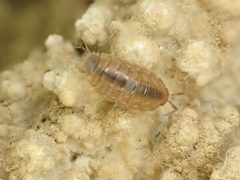
1Chaetophiloscia is a of small terrestrial isopods in the Philosciidae, established by Verhoeff in 1908. The genus is native to the northern Mediterranean region, with at least two documented: C. sicula, which has become in North America and parts of Europe, and C. elongata, studied in North African coastal . Species in this genus are characterized by their association with moist, anthropogenic, and coastal environments, and their capacity for rapid range expansion through human-mediated transport.
Pronunciation
How to pronounce Chaetophiloscia: //ˌkiːtoʊfaɪˈlɒʃə//
These audio files are automatically generated. While they are not always 100% accurate, they are a good starting point.
Identification
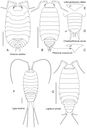
-level identification requires examination of pleopodal and uropodal characteristic of Philosciidae. within Chaetophiloscia are distinguished by detailed examination of male sexual characteristics, particularly the structure of the first and second pleopods. C. sicula is a small isopod, approximately 6 mm in length. Distinguishing Chaetophiloscia from other philosciid genera requires taxonomic knowledge of oniscidean morphology.
Images
Habitat
in this occupy anthropogenic including gardens, public parks, and urban forests with open ; coastal habitats such as upper sandy beaches under driftwood and debris, jetties, and riparian areas. Strong preference for anthropogenic (56% of observations for C. sicula) and coastal (34%) environments. Rare in closed forests (9%, limited to urban forests near streams). Absent from open landscapes and caves. Requires humid conditions; some species tolerate salt spray.
Distribution
Native to the northern Mediterranean region from northeastern Spain to Greece. C. sicula has been introduced to North America (first recorded 2000 in Baltimore, Maryland; now present in Maryland, Virginia, Texas, Tennessee, New Jersey, California, North Carolina, Alabama, Pennsylvania, and Washington D.C.), and is expanding in Europe outside its native range (Spain, France, Romania, Crimea, Great Britain in heated greenhouses). C. elongata occurs in coastal lagoons of Northeast Tunisia.
Diet
Detritivorous; leaf litter consumer (documented for C. elongata). Specific dietary details for other in the are not well documented.
Behavior
C. sicula has been observed in high abundances (tens of individuals per litter ) and frequently co-occurs with other isopod including Armadillidium nasatum, Philoscia muscorum, Hyloniscus riparius, Armadillidium vulgare, and Haplophthalmus danicus. Stream banks may serve as natural corridors for active . C. elongata exhibits avoidance toward zinc-contaminated litter, indicating behavioral plasticity in response to heavy metal . Locomotor behavior patterns have been studied in C. elongata in comparison with sympatric species.
Ecological Role
Decomposer in leaf litter systems; potential bioindicator for metal (documented for C. elongata). C. sicula has potential to alter soil-microbial structure, understory vegetation, and decomposition and nutrient cycling in invaded wildland , though this is inferred from comparison to other soil rather than direct evidence.
Human Relevance
C. sicula is an in North America, spreading rapidly since its introduction around 2000. Its affinity for urban environments facilitates spread through residential areas and urban parks. The pet trade and hobbyist trading of isopods may contribute to establishing core in urban centers. The is likely to continue expanding in the United States in the coming decade.
Similar Taxa
- PhilosciaBoth belong to Philosciidae and share similar body plans; Chaetophiloscia is distinguished by specific pleopodal characteristics and male sexual structures
- ArmadillidiumFrequently co-occurs with C. sicula in urban ; distinguished by ability to conglobate (roll into ball) and different body shape
More Details
Taxonomic note
The contains at least two well-documented : C. sicula Verhoeff, 1908 and C. elongata. C. sicula is the most extensively studied due to its status; C. elongata has been studied for behavioral in North African coastal systems.
Invasion biology
C. sicula represents a case study in rapid urban invasion, with spread facilitated by anthropogenic preference, moisture requirements that align with irrigated urban landscapes, and potential human-mediated transport through horticulture and pet trade.
Sources and further reading
- BugGuide
- GBIF taxonomy match
- iNaturalist taxon
- NCBI Taxonomy
- Catalogue of Life
- Chaetophiloscia sicula Verhoeff, 1908 (Isopoda, Oniscidea), an invasive isopod currently spreading in North America
- Behavioral responses of two sympatric species Armadillo officinalis and Chaetophiloscia elongata (Crustacea, Oniscidae) towards zinc contaminated litter
- Locomotor behaviour of three sympatric speciesLigia italica, Armadillo officinalisandChaetophiloscia elongata(Crustacea, Oniscidea) from Ghar El Melh lagoon (Northeast Tunisia)
- Figure 2 from: Szlavecz K, Jones NT, Noël F, Boeraeve P, De Smedt P (2025) Chaetophiloscia sicula Verhoeff, 1908 (Isopoda, Oniscidea), an invasive isopod currently spreading in North America. In: Tuf IH, Tajovský K, Taiti S (Eds) The Biology of Terrestrial Isopods, XII. ZooKeys 1225: 65-75. https://doi.org/10.3897/zookeys.1225.120937
- Supplementary material 1 from: Szlavecz K, Jones NT, Noël F, Boeraeve P, De Smedt P (2025) Chaetophiloscia sicula Verhoeff, 1908 (Isopoda, Oniscidea), an invasive isopod currently spreading in North America. In: Tuf IH, Tajovský K, Taiti S (Eds) The Biology of Terrestrial Isopods, XII. ZooKeys 1225: 65-75. https://doi.org/10.3897/zookeys.1225.120937
- Figure 3 from: Szlavecz K, Jones NT, Noël F, Boeraeve P, De Smedt P (2025) Chaetophiloscia sicula Verhoeff, 1908 (Isopoda, Oniscidea), an invasive isopod currently spreading in North America. In: Tuf IH, Tajovský K, Taiti S (Eds) The Biology of Terrestrial Isopods, XII. ZooKeys 1225: 65-75. https://doi.org/10.3897/zookeys.1225.120937
- Figure 1 from: Szlavecz K, Jones NT, Noël F, Boeraeve P, De Smedt P (2025) Chaetophiloscia sicula Verhoeff, 1908 (Isopoda, Oniscidea), an invasive isopod currently spreading in North America. In: Tuf IH, Tajovský K, Taiti S (Eds) The Biology of Terrestrial Isopods, XII. ZooKeys 1225: 65-75. https://doi.org/10.3897/zookeys.1225.120937