
Hyloniscus riparius
(C. Koch, 1838)
Riparian Woodlouse
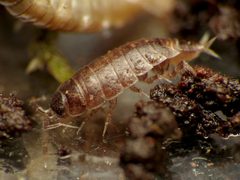
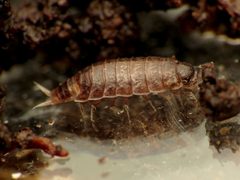
A small native to Central and Eastern Europe that has established in North America since 1951 and is expanding eastward across Russia. It thrives in floodplain environments and can survive prolonged submersion. In invaded regions, it reaches high densities and may dominate local woodlice , potentially displacing native .
Pronunciation
How to pronounce Hyloniscus riparius: //haɪloʊˈnɪskəs rɪˈpɛəriəs//
These audio files are automatically generated. While they are not always 100% accurate, they are a good starting point.
Images
Habitat
Strongly associated with flood plains and riparian zones. Capable of tolerating up to eight weeks of submersion in water.
Distribution
Native to Central and Eastern Europe. Introduced to North America: first recorded at St. John's, Newfoundland in 1951, subsequently found in New York, New Jersey, Pennsylvania, and North Carolina. In Russia, spreading eastward from Kyiv since the 1990s with almost ubiquitous distribution in studied Central Russian territories.
Behavior
Has been observed to survive prolonged flooding through physiological to submersion.
Ecological Role
in North America and Russia. In Central Russia, reaches densities up to 54 individuals per square meter and up to 99% of total woodlice abundance in some . Potential to displace woodlice with possible long-term consequences for soil biodiversity and stability.
Human Relevance
Unintentionally introduced to new continents, where it has become established in urban and natural .
More Details
Invasion History
First North American record from St. John's, Newfoundland in 1951. Russian expansion documented from eight registrations since the 1990s, all east of previous findings.
Population Impact
In Central Russian woodlice , has been observed at densities reaching 54 ind./m² and comprising up to 99% of total woodlice abundance.
Sources and further reading
- BugGuide
- Wikipedia
- GBIF taxonomy match
- iNaturalist taxon
- NCBI Taxonomy
- Catalogue of Life
- The Distribution and General Biology of Hyloniscus Riparius (Koch) (Isopoda, Oniscoidea) in North America
- Distribution and ecology of the invasive species of woodlice Hyloniscus riparius (C. Koch, 1838) (Isopoda, Oniscidea, Trichoniscidae) in Russia