
Trichoniscidae
Genus Guides
6- Androniscus
- Brackenridgia(woodlice)
- Haplophthalmus
- Hyloniscus
- Miktoniscus
- Trichoniscus(pygmy woodlice)
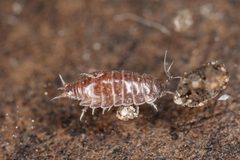
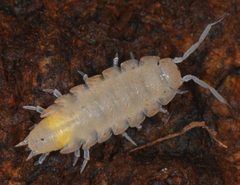
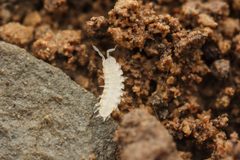
Trichoniscidae is a of terrestrial isopods (woodlice) notable for containing the most abundant British , *Trichoniscus pusillus*. The family exhibits exceptional ecological diversity, with many occupying subterranean in karst regions across Europe, while others have secondarily adapted to aquatic or amphibious lifestyles. Multiple contain troglobiotic (obligate cave-dwelling) species, particularly in the Dinaric Karst, which harbors significant diversity of this family. Some species demonstrate unique morphological adaptations for cave life, including elongated appendages and modified mouthparts.
Pronunciation
How to pronounce Trichoniscidae: //ˌtrɪkoʊˈnɪsɪdiː//
These audio files are automatically generated. While they are not always 100% accurate, they are a good starting point.
Identification
Members of Trichoniscidae are distinguished from other woodlice primarily by the structure of the male pleopods, particularly the endopod of pleopod I, which exhibits -specific modifications used in taxonomic keys. Troglobiotic species often display troglomorphic traits: elongated pereopods with dactylus and unguis, reduced or absent , and depigmented bodies. Epigean species typically possess a granulated . The family contains multiple including the Thaumatoniscellinae, defined by unique genital structures. Male tergal glands, when present, are taxonomically variable and not diagnostic at the generic level.
Images
Habitat
span three distinct ecological zones: (1) epigean environments including leaf litter and soil in temperate forests, (2) subterranean karst systems including caves and pits—particularly in the Dinaric Karst, Iberian Peninsula, and Balkan regions, and (3) aquatic or amphibious habitats including streams and semiaquatic zones, a secondary unique among woodlice . Some are higropetric (inhabiting wet rock surfaces in caves). The family shows a pronounced association with limestone karst formations across Mediterranean and temperate European regions.
Distribution
Primarily Palearctic distribution centered on Europe, with significant diversity in: British Isles (*Trichoniscus pusillus* being the most abundant British ), Iberian Peninsula (39 of 58 *Trichoniscoides* ), Dinaric Karst (high troglobiotic diversity in *Alpioniscus* and related ), Balkan Peninsula (*Troglocyphoniscus* in Serbia, *Thaumatoniscellus* in Croatia), Romania, and southwestern Asia. Disjunct occur in North America (*Brackenridgia* in Texas). Introduced populations established in Russia (*Hyloniscus riparius*).
Behavior
Troglobiotic exhibit behavioral adaptations to subterranean life including reduced and restricted movement patterns within cave systems. Aquatic and amphibious species in such as *Titanethes*, *Cyphonethes*, and *Alpioniscus* demonstrate unique water-uptake mechanisms, with some species absorbing water through specialized on the surface of the frontal pereionite for the water-conducting system. Many cave-dwelling species show high site fidelity to specific microhabitats within cave systems.
Ecological Role
As decomposers in forest floor and cave , processing decaying organic matter. Troglobiotic contribute to nutrient cycling in energy-limited subterranean , likely functioning as both and prey for cave-adapted . In karst ecosystems, they serve as indicators of connectivity and groundwater quality. The 's invasion of aquatic habitats represents a unique ecological expansion within terrestrial isopods.
Human Relevance
*Trichoniscus pusillus* serves as a common subject in British ecological education and research due to its abundance. Several are of conservation concern due to restricted ranges in vulnerable karst systems threatened by quarrying, pollution, and hydrological disruption. The includes (*Hyloniscus riparius* in Russia) with documented ecological impacts. Troglobiotic species are used as flagship for cave conservation prioritization in Europe.
Similar Taxa
- BuddelundiellidaePreviously treated as a separate but now synonymized with Trichoniscidae; distinction was based on subtle differences in pleopod structure and geographic distribution, but molecular and morphological analyses support subsuming these within Trichoniscidae.
- ArmadillidiidaeBoth contain common European woodlice, but Armadillidiidae (pill bugs) possess the ability to conglobate (roll into a ball) and have different male pleopod structures; Trichoniscidae cannot conglobate and typically have more elongate body forms.
- OniscidaeSimilar preferences in some , but Oniscidae generally lack the specialized subterranean adaptations seen in many Trichoniscidae and have different tergite structure and pleopod .
More Details
Subfamily classification
The contains multiple including Trichoniscinae, Titanethinae, and the Thaumatoniscellinae, reflecting substantial morphological and ecological diversification.
Taxonomic instability
Generic boundaries within Trichoniscidae have undergone significant revision, with such as *Titanethes* and *Cyphonethes* recently redefined based on molecular and morphological analyses; *Microtitanethes* has been synonymized.
Evolutionary significance
The 's repeated evolution of aquatic/amphibious lifestyles and troglobiotic adaptations makes it a significant model for studying and to extreme environments in crustaceans.
Sources and further reading
- BugGuide
- Wikipedia
- GBIF taxonomy match
- iNaturalist taxon
- NCBI Taxonomy
- Brackenridgia Ashleyi (Isopoda: Trichoniscidae): Range Extension with Notes on Ecology
- Thaumatoniscellus speluncae n. sp. (Isopoda: Oniscidea: Trichoniscidae), a new troglobitic oniscid species from Croatia
- Molecular and taxonomic analyses in troglobiotic Alpioniscus (Illyrionethes) species from the Dinaric Karst (Isopoda: Trichoniscidae)
- The genus Trichoniscoides Sars, 1899 (Isopoda: Oniscidea: Trichoniscidae) from Portugal, with descriptions of three new species
- A new species of the subterranean genus Troglocyphoniscus Strouhal, 1939 (Isopoda: Oniscidea: Trichoniscidae) from the Tara Mountain, Serbia
- Revision of the genera Cyphonethes Verhoeff, 1926 and Titanethes Schioedte, 1849 (Isopoda: Oniscoidea: Trichoniscidae) with a description of a new genus and three new taxa
- Figure 6 from: Bedek J, Gottstein S, Taiti S (2019) A new species of Alpioniscus (Illyrionethes) from the Dinaric Karst (Isopoda, Oniscidea, Trichoniscidae). Subterranean Biology 32: 33-42. https://doi.org/10.3897/subtbiol.32.37509
- Figure 1 from: Bedek J, Gottstein S, Taiti S (2019) A new species of Alpioniscus (Illyrionethes) from the Dinaric Karst (Isopoda, Oniscidea, Trichoniscidae). Subterranean Biology 32: 33-42. https://doi.org/10.3897/subtbiol.32.37509
- Trichoniscoides mladeni n. sp. and Androniscus roseus transsylvanicus Radu, 1960 (Isopoda, Oniscidea, Trichoniscidae) two interesting species in the fauna of Serbia, Yugoslavia
- Distribution and ecology of the invasive species of woodlice Hyloniscus riparius (C. Koch, 1838) (Isopoda, Oniscidea, Trichoniscidae) in Russia
- Figure 3 from: Bedek J, Gottstein S, Taiti S (2019) A new species of Alpioniscus (Illyrionethes) from the Dinaric Karst (Isopoda, Oniscidea, Trichoniscidae). Subterranean Biology 32: 33-42. https://doi.org/10.3897/subtbiol.32.37509