
Hyloniscus
Verhoeff, 1908
Species Guides
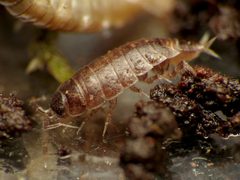
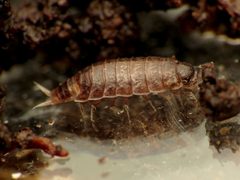
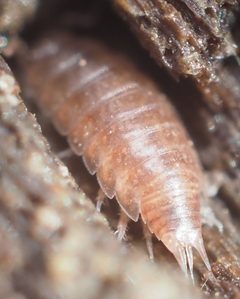
1- Hyloniscus riparius(Riparian Woodlouse)
Hyloniscus is a of small woodlice in the Trichoniscidae, distributed across Europe and North America. Members are typically hygrophilic, inhabiting moist forest microhabitats with thick litter and humus layers. The genus includes at least 24 described , with some showing tendencies. Individual species exhibit specialized preferences, including peat bog edges, cave entrance zones, and riparian areas.
Pronunciation
How to pronounce Hyloniscus: //haɪloʊˈnɪskəs//
These audio files are automatically generated. While they are not always 100% accurate, they are a good starting point.
Identification
Members of Hyloniscus can be distinguished from other Trichoniscidae by their small body size and association with the -level characteristics of Trichoniscidae, including reduced or absent pleopodal lungs and typically unpigmented or lightly pigmented bodies. -level identification requires examination of male genitalia and pereiopod . Hyloniscus riparius has been noted as in Russia, reaching densities up to 54 individuals per square meter and comprising up to 99% of local woodlice abundance.
Images
Habitat
Forest with thick litter and humus layers, particularly in colline and montane belts (130–980 m elevation). Specific microhabitats include peat bog edges, adjacent forests with decaying wood, and cave entrance zones. Requires humid, shaded conditions; avoids open bog habitats due to extreme moisture, low pH, and low nutrient availability. Some show trogloxenous , using caves temporarily for favorable microclimate.
Distribution
Europe and North America. Specific records from Croatia (Hrvatsko zagorje, Medvednica Mountain, Papuk Mountain, Banija region), Austria, Bosnia and Herzegovina, northeast Italy, Slovenia, and Russia ( range expansion eastward from Kyiv since 1990s). Distribution records also from Denmark, Norway, and Sweden.
Behavior
Highly hygrophilic; seldom leaves shelter. Cryptozoic involving seeking optimal microclimatic conditions. Some are tyrphoxenous (avoiding open bog due to extreme environmental conditions including high water table, low pH, low nutrients, and sphagnum moss polyphenols). Temporary cave dwelling (trogloxeny) observed, using entrance zones for favorable humidity and temperature.
Ecological Role
Soil macrofauna component contributing to decomposition in forest litter and humus layers. Hyloniscus riparius has been observed at high densities in invaded areas, with potential for displacement of woodlice and possible long-term impacts on soil biodiversity and stability.
Human Relevance
Hyloniscus riparius recognized as in Russia, with range expansion documented since the 1990s. Potential concern for soil impacts in invaded regions.
Similar Taxa
- TrichoniscusBoth belong to Trichoniscidae; differentiation requires examination of pleon structure and male genitalia
- HaplophthalmusAnother trichoniscid with overlapping preferences; distinguished by body shape and antennal segmentation
More Details
Invasion biology
Hyloniscus riparius demonstrates capacity in Russia, with documented spread eastward from Kyiv. The achieves densities up to 54 individuals per square meter and can dominate local woodlice .
Habitat specialization
Hyloniscus adonis exemplifies -level preferences: tyrphoxenous at peat bog edges (using favorable edge conditions while avoiding open bog extremes) and trogloxenous in cave entrance zones.
Sources and further reading
- BugGuide
- Wikipedia
- GBIF taxonomy match
- iNaturalist taxon
- NCBI Taxonomy
- Catalogue of Life
- The distribution of terrestrial isopod Hyloniscus adonis (Verhoeff, 1927) (Isopoda: Oniscidea) in Croatia
- The Distribution and General Biology of Hyloniscus Riparius (Koch) (Isopoda, Oniscoidea) in North America
- Distribution and ecology of the invasive species of woodlice Hyloniscus riparius (C. Koch, 1838) (Isopoda, Oniscidea, Trichoniscidae) in Russia