
Philoscia
Latreille, 1804
Species Guides
1- Philoscia muscorum(Common Striped Woodlouse)
Philoscia is a of terrestrial isopods (woodlice) in the Philosciidae, containing over 80 described . Members of this genus are small to medium-sized found in moist terrestrial across various regions. The genus is notable for including Philoscia muscorum, a species exhibiting year class splitting—a strategy where offspring from the same reproductive season mature in either one or two years depending on growth rates and environmental conditions.
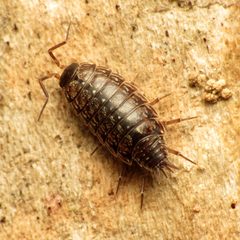
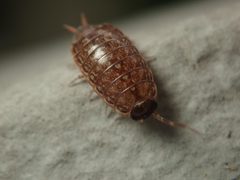
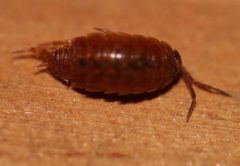
Pronunciation
How to pronounce Philoscia: /fəˈlɒskiə/
These audio files are automatically generated. While they are not always 100% accurate, they are a good starting point.
Images
Habitat
Moist terrestrial environments including meadows, open grasslands, and light forests. such as Philoscia muscorum have been observed living under stones, within mosses, in grass tussocks, and in leaf litter.
Life Cycle
At least one , Philoscia muscorum, exhibits year class splitting: individuals born in the same season differentiate into two forms, with some reaching maturity in one year and others in two years. Growth rate is positively related to temperature and daylight regime, and larger produce more offspring. is lower than adult survivorship, particularly under less favorable temperature and light conditions.
Similar Taxa
- Oniscus asellusPhiloscia muscorum was historically misclassified as closely related to tropical Philosciidae; phylogenetic analysis places it instead in an evolutionary lineage with Oniscus asellus and higher crinocheten Oniscidea.
- Philoscia affinisSimilar in appearance to Philoscia muscorum; morphological details are required for reliable separation between these .
Misconceptions
Philoscia muscorum was long assumed to be closely related to tropical and subtropical members of Philosciidae; molecular and morphological evidence shows it belongs to a separate evolutionary lineage including Oniscus asellus and higher crinocheten Oniscidea.
More Details
Taxonomic Note
The Philoscia was established by Latreille in 1804 and currently contains more than 80 described . The type species and phylogenetic relationships within the genus remain subjects of ongoing research.