
Philoscia muscorum
(Scopoli, 1763)
Common Striped Woodlouse, Fast Woodlouse
Philoscia muscorum is a common European notable for its rapid movement and distinctive appearance. It exhibits a unique strategy called year class splitting, where individuals from the same reproductive cohort diverge into two developmental : faster-growing individuals mature and reproduce in their first year, while slower-growing individuals delay maturation until their second year. This has successfully established introduced in eastern North America, including New England, the mid-Atlantic states, and the Pacific Northwest.

Pronunciation
How to pronounce Philoscia muscorum: //fɪˈlɒskiə ˌmʌsˈkɔːrəm//
These audio files are automatically generated. While they are not always 100% accurate, they are a good starting point.
Identification
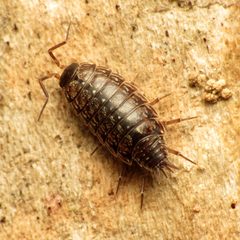
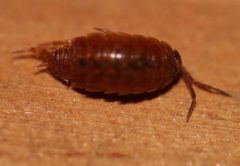
Distinguished from similar woodlice by its faster, more agile movement and elevated body posture. The consistently dark contrasts with the paler, mottled body. Separated from Philoscia affinis by detailed morphological characters requiring close examination. The combination of small size (to 11 mm), shiny surface, and dark head is diagnostic in most of its range.
Images
Appearance
Body reaches up to 11 mm in length. surface is shiny and mottled greyish-brown in color, though variable may show yellow, red, or orange coloration. The is consistently very dark. The body is raised higher off the ground than other common woodlouse , an associated with faster locomotion.
Habitat
Occupies moist open including meadows and light woodlands. Typically found concealed under stones, within moss clumps, grass tussocks, or leaf litter. Associated with fixed dune grasslands in some .
Distribution
Native to Europe from southern Scandinavia to Ukraine and Greece, including the British Isles. Introduced to North America: established in Washington state, New England states (multiple), Pennsylvania, New Jersey, and Nova Scotia.
Life Cycle
Exhibits year class splitting: individuals born in one season differentiate into two developmental forms. Faster-growing individuals reach maturity and reproduce in one year; slower-growing individuals require two years to mature. This creates two distinct year classes from a single reproductive cohort. Growth rate is positively related to ambient temperature and day length. Parental size positively affects offspring number.
Behavior
Moves more rapidly than other common woodlouse , earning the 'fast .'
Similar Taxa
- Philoscia affinisMorphologically similar; requires detailed examination to distinguish. The redescription of P. muscorum was partly motivated by the need to clarify separation from this .
- Oniscus asellusShares preferences and general appearance, but P. muscorum is smaller, faster-moving, and has a more elevated body posture.
More Details
Evolutionary relationships
Contrary to previous assumptions, P. muscorum is not closely related to tropical and subtropical members of Philosciidae. Instead, it belongs to an evolutionary lineage that includes Oniscus asellus and higher crinochete Oniscidea.
Subspecies
Twelve are currently recognized, though details are not provided in available sources.
Sources and further reading
- BugGuide
- Wikipedia
- GBIF taxonomy match
- iNaturalist taxon
- NCBI Taxonomy
- Catalogue of Life
- Life on Mars? Lichens survive Martian simulation
- wenig bekannte Landassel unserer Fauna: Philoscia muscorum (Scopoli, 1793)
- Year class splitting in the woodlouse Philoscia muscorum explained through studies of growth and survivorship