Chaetophiloscia sicula
Verhoeff, 1908
Chaetophiloscia sicula is a small (~6 mm) terrestrial isopod native to the northern Mediterranean region. First recorded in North America in 2000 in Baltimore, Maryland, it has since spread to at least nine U.S. states and Washington D.C., primarily through human-aided associated with urban environments. The exhibits strong preferences for anthropogenic settings such as gardens and urban parks, as well as coastal areas including upper sandy beaches and jetties. Its rapid expansion across North America and Europe is facilitated by affinity to moist, disturbed habitats and potential transport via the pet trade and potted plants.
Pronunciation
How to pronounce Chaetophiloscia sicula: //ˌkiː.toʊ.faɪˈlɒ.ski.ə ˈsɪ.kjʊ.lə//
These audio files are automatically generated. While they are not always 100% accurate, they are a good starting point.
Identification
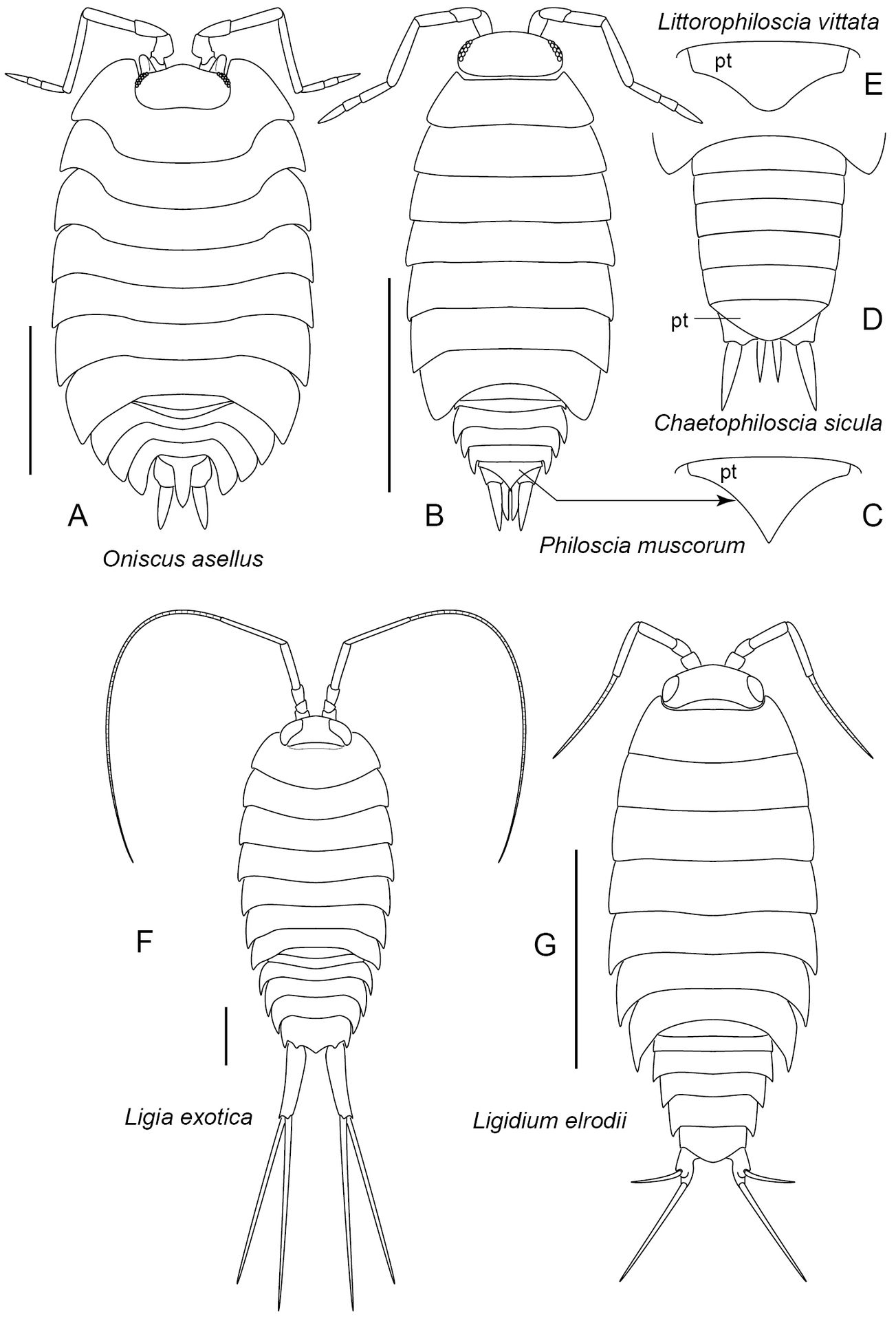
Identification to level requires examination of male genitalia; the first pleopod endopodite is diagnostic for Chaetophiloscia sicula. Citizen science observations require expert validation through photo examination or specimen dissection due to potential for misidentification with other small philosciid isopods.
Images
Appearance
Small terrestrial isopod, approximately 6 mm in length. Detailed morphological description not provided in available sources.
Habitat
Strongly associated with anthropogenic including residential gardens, public parks with open or no cover, and landscaped areas. Also frequent in coastal habitats, particularly upper sandy beaches under driftwood and debris, and on jetties. Rare in forested areas, limited to urban forests with ≤75% canopy cover near streams. Absent from open landscapes and caves. Coastal in North America restricted to Chesapeake Bay rather than Atlantic Ocean coast.
Distribution
Native to northern Mediterranean region from northeastern Spain to Greece. In North America: first recorded 2000 in Baltimore, Maryland; subsequently documented in Washington D.C., Virginia, Texas, Tennessee, New Jersey, California, North Carolina, Alabama, and Pennsylvania. Most abundant around Baltimore. In Europe: expanding southward in Spain to Madrid, westward and northeastward in France to Atlantic coast and Paris/Dijon/Châlons-en-Champagne, eastward to Romania and Crimean Peninsula. Restricted to heated greenhouses in Great Britain.
Behavior
Frequently occurs in high abundances, with tens of individuals per litter in preferred . Tolerates salt spray well. Likely drought-sensitive, dependent on moist conditions for survival and spread. Stream banks may function as natural corridors for active . Often collected syntopically with other isopod including Armadillidium nasatum, Philoscia muscorum, Hyloniscus riparius, Armadillidium vulgare, and Haplophthalmus danicus.
Human Relevance
Considered an in North America and parts of Europe outside its native range. Rapid spread facilitated by human activity, particularly through affinity to urban environments. Pet keeping and trading among hobbyists may contribute to establishing core in urban centers. Transport via potted plants and landscaping materials likely aids long-distance . Expected to continue expanding throughout the United States in the coming decade.
Similar Taxa
- Other Philosciidae speciesSmall size and general overlap with other philosciid isopods; requires male genitalia examination for definitive identification
- Cosmopolitan isopods (Armadillidium vulgare, Armadillidium nasatum, Philoscia muscorum)Frequently collected together in same ; distinguished by size, habitat preference patterns, and diagnostic morphological features
More Details
Sex ratio
Among 214 specimens collected in standardized surveys, 33.2% were male.
Survey methodology
preference data based on structured surveys of 374 locations in Maryland and Washington D.C. using standardized collecting techniques; detected at 8.5% of all locations.
Habitat occupancy rates
Found at 13.6% of sampled anthropogenic locations, 20.8% of coastal locations, and only 2.2% of forest locations.
Sources and further reading
- BugGuide
- GBIF taxonomy match
- iNaturalist taxon
- NCBI Taxonomy
- Catalogue of Life
- Chaetophiloscia sicula Verhoeff, 1908 (Isopoda, Oniscidea), an invasive isopod currently spreading in North America
- Supplementary material 1 from: Szlavecz K, Jones NT, Noël F, Boeraeve P, De Smedt P (2025) Chaetophiloscia sicula Verhoeff, 1908 (Isopoda, Oniscidea), an invasive isopod currently spreading in North America. In: Tuf IH, Tajovský K, Taiti S (Eds) The Biology of Terrestrial Isopods, XII. ZooKeys 1225: 65-75. https://doi.org/10.3897/zookeys.1225.120937
- Figure 2 from: Szlavecz K, Jones NT, Noël F, Boeraeve P, De Smedt P (2025) Chaetophiloscia sicula Verhoeff, 1908 (Isopoda, Oniscidea), an invasive isopod currently spreading in North America. In: Tuf IH, Tajovský K, Taiti S (Eds) The Biology of Terrestrial Isopods, XII. ZooKeys 1225: 65-75. https://doi.org/10.3897/zookeys.1225.120937
- Figure 3 from: Szlavecz K, Jones NT, Noël F, Boeraeve P, De Smedt P (2025) Chaetophiloscia sicula Verhoeff, 1908 (Isopoda, Oniscidea), an invasive isopod currently spreading in North America. In: Tuf IH, Tajovský K, Taiti S (Eds) The Biology of Terrestrial Isopods, XII. ZooKeys 1225: 65-75. https://doi.org/10.3897/zookeys.1225.120937
- Figure 1 from: Szlavecz K, Jones NT, Noël F, Boeraeve P, De Smedt P (2025) Chaetophiloscia sicula Verhoeff, 1908 (Isopoda, Oniscidea), an invasive isopod currently spreading in North America. In: Tuf IH, Tajovský K, Taiti S (Eds) The Biology of Terrestrial Isopods, XII. ZooKeys 1225: 65-75. https://doi.org/10.3897/zookeys.1225.120937