
Onychopoda
Family Guides
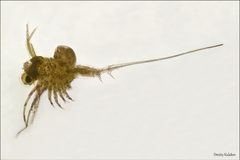
3Onychopoda is a specialized order of predatory branchiopod crustaceans within the Cladocera, distinguished by having only four pairs of legs (compared to five or six in related orders) and segmented appendages used for grasping prey. The order comprises three (Cercopagididae, Podonidae, Polyphemidae), ten , and approximately 33 described . Most species are to the Ponto-Caspian basin, though some occur in freshwater and marine worldwide. Onychopoda exhibits one of the most distinctive morphological and ecological radiations among cladocerans, having evolved as a novel feeding strategy and colonized habitats across a broad salinity range.
Pronunciation
How to pronounce Onychopoda: /ˌɒnɪˈkɒpədə/
These audio files are automatically generated. While they are not always 100% accurate, they are a good starting point.
Identification
Distinguished from other Cladocera by: (1) four pairs of legs versus five or six in Ctenopoda and Anomopoda; (2) presence of segmented, grasping appendages; (3) pouch for embryo protection. Within Onychopoda, separable by and : Cercopagididae (Ponto-Caspian, elongated caudal process); Podonidae (marine and Ponto-Caspian, short ); Polyphemidae (freshwater, single Polyphemus). Genera distinguished by thoracopod spine patterns, shape, and caudal process morphology.
Images
Appearance
Morphologically distinctive among cladocerans, with four pairs of thoracic legs (reduced from five or six pairs in Ctenopoda and Anomopoda). Possesses segmented, appendages used for grasping prey—a trait shared only with Haplopoda among branchiopods. Features a pouch for embryo protection and nutrient secretion. Some exhibit highly derived predatory adaptations including bilobed , spinose mandibular processes, and specialized thoracopod modifications. Body form ranges from compact (Podonidae, Polyphemidae) to elongated with prominent caudal processes (Cercopagididae).
Habitat
Native range centered on Ponto-Caspian basin (Caspian Sea, Aral Sea, Black Sea including Sea of Azov). Marine occur in coastal and oceanic surface waters; freshwater species in lakes and . Invaded established in Baltic Sea pelagic , North American Great Lakes, and other temperate water bodies via shipping corridors.
Distribution
Primary center of diversity and in Ponto-Caspian basin. Marine widely distributed in cold, temperate, and tropical oceans including Baltic Sea, Mediterranean, North Pacific, Inland Sea of Japan, Narragansett Bay, and coastal Brazil. Introduced in Baltic Sea (eastern Gulf of Finland) and North American Great Lakes (Cercopagis pengoi).
Seasonality
Temperate marine exhibit spring-summer abundance peaks; in Guanabara Bay, Brazil collapsed in fall-winter due to temperature decline and reproductive mode switch. time and development temperature-dependent (2.27–3.28 days at 21–27°C).
Diet
Predatory. Specific prey items not comprehensively documented for order; inferred from -level studies. Cercopagididae and Podonidae consume zooplankton prey. Molecular gut content analysis applied to Bythotrephes for dietary assessment.
Host Associations
- chaetognaths - pressure contributes to collapse in Pseudevadne tergestina
- mysids (Mysis mixta, Mysis relicta) - Native mysids consume Cercopagis pengoi in Baltic Sea
- planktivorous fish - Documented as of onychopods
- ctenophores - Documented as of onychopods
Life Cycle
Resting hatch to initiate ; embryonic development time temperature-dependent. Exhibits in some (development of parthenogenic eggs in chambers of embryos before parental release). Adaptive with early switch to gamogenetic , particularly in . Gamogenic females and males produced seasonally.
Behavior
Rapid increase via parthenogenic accelerated by . Horizontal transport by tidal currents affects distribution. Some exhibit diel vertical patterns related to avoidance.
Ecological Role
Secondary but significant component of marine and freshwater zooplankton when abundant. Important prey item for planktivorous fish, chaetognaths, ctenophores, and mysids. Together with Penilia avirostris and Pleopis polyphemoides, contributes to marine organic matter production. Ponto-Caspian considered high-risk for impacts in recipient communities.
Human Relevance
Accidental introduction to areas outside native range via shipping corridors, particularly Volga-Baltic waterway. Cercopagis pengoi established in North American Great Lakes as . Considered high-risk with potential for range expansion and disruption. Subject of molecular dietary studies using -specific primers.
Similar Taxa
- HaplopodaShares presence of segmented appendages with Onychopoda, but distinguished by different body plan and appendage structure; only other branchiopod group with segmented limbs
- CtenopodaHas five or six pairs of legs versus four in Onychopoda; lacks segmented grasping appendages; primarily filter-feeding rather than predatory
- AnomopodaHas five or six pairs of legs versus four in Onychopoda; lacks segmented grasping appendages; much larger and more diverse order with different feeding mechanisms
More Details
Evolutionary history
Molecular phylogenetic studies support monophyly of Onychopoda and each of its three . Adaptive radiation associated with Ponto-Caspian basin geological history from Miocene to Pleistocene, with two pulses of diversification. Predatory feeding strategy and broad salinity represent key innovations. Hypothesized origin in pre-Pleistocene Ponto-Caspian basin with intensive radiation of ancestral forms.
Reproductive biology
pouch structure convergent with Penilia avirostris (only other marine cladoceran), possibly facilitating oceanic . Pouch secretes nutrients to aid embryo development. documented in Pseudevadne tergestina—parthenogenic develop in brood chambers of embryos before release, accelerating growth.
Invasion biology
Ponto-Caspian possess adaptive traits for invasion success: early gamogenetic , broad temperature and salinity , resting production. Climate change and intensive shipping facilitate spread. Cercopagis pengoi, Evadne anonyx, Podonevadne trigona, and Cornigerius species established in Baltic Sea; C. pengoi alone colonized Great Lakes.
Sources and further reading
- BugGuide
- Wikipedia
- iNaturalist taxon
- NCBI Taxonomy
- Catalogue of Life
- Invasion biology of Ponto-Caspian onychopod cladocerans (Crustacea: Cladocera: Onychopoda)
- The external morphology of the onychopod ‘cladoceran’ genus Bythotrephes (Crustacea, Branchiopoda, Onychopoda, Cercopagididae), with notes on the morphology and phylogeny of the order Onychopoda
- Population dynamics of Pseudevadne tergestina (Branchiopoda: Onychopoda) in Guanabara Bay, Brazil
- Phylogeny and adaptive radiation in the Onychopoda (Crustacea, Cladocera): evidence from multiple gene sequences
- Description of a new species in the genus Bythotrephes Leydig, 1860 (Crustacea: Cladocera: Onychopoda), supplements to selected species, and concluding remarks on the genus
- The Regularities of Reproduction of Cladocera of the Freshwater Shoals (Polyphemus pediculus L., Onychopoda)
- Life cycle and reproductive traits of marine podonids (Cladocera, Onychopoda) in a coastal subtropical area
- Further expansion of the genus Cercopagis (Crustacea, Branchiopoda, Onychopoda) in the Baltic Sea, with notes on the taxa present and their ecology
- Partial revision of the genus Cercopagis Sars, 1897 (Crustacea: Cladocera: Onychopoda), with the redescription of two species and comments on morphology, taxonomy, reproduction, species richness, zoogeography, and origin
- Life history characteristics and distribution of Bythotrephes longimanus Leydig (Crustacea, Onychopoda) in the Biesbosch reservoirs
- Life history characteristics and distribution of Bythotrephes longimanus Leydig (Crustacea, Onychopoda) in the Biesbosch reservoirs
- A combined approach to understand trophic interactions between Cercopagis pengoi (Cladocera: Onychopoda) and mysids in the Gulf of Finland
- Application of species-specific primers to estimate the in situ diet of Bythotrephes [Cladocera, Onychopoda] in its native European range via molecular gut content analysis.