
Ctenopoda
Latreille, 1829
Family Guides
2Ctenopoda is an order of small crustaceans within the Diplostraca, comprising three : Holopediidae, Pseudopenilidae, and Sididae. Members are commonly known as water fleas and are predominantly freshwater inhabitants, though the Penilia is marine. The order is characterized by specialized swimming and a body plan that reflects functional separation between locomotion and feeding appendages. Ctenopoda have been documented across diverse aquatic including lakes, , wetlands, and coastal marine systems, with some species introduced to areas outside their native ranges by human activity.
Pronunciation
How to pronounce Ctenopoda: /ktɛˈnɒpədə/
These audio files are automatically generated. While they are not always 100% accurate, they are a good starting point.
Identification
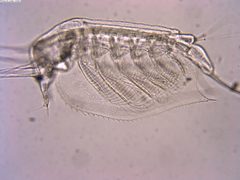
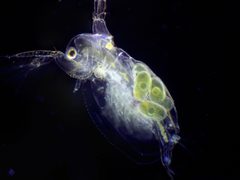
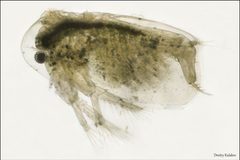
Ctenopoda can be distinguished from the related order Anomopoda by features of the trunk limbs and antennal . Members typically possess six pairs of serially similar trunk limbs and well-developed swimming . The order includes with distinct body forms: Sididae (including Diaphanosoma) are generally elongate and transparent; Holopediidae (including Holopedium) often have a gelatinous or hump-backed appearance; Pseudopenilidae are less commonly encountered. Identification to level requires examination of antennal segmentation, trunk limb structure, and body shape, with regional keys available for Brazil and other areas.
Images
Habitat
Predominantly freshwater including lakes, , ponds, wetlands, and rivers. Some are limnetic (open water), while others occur in associated with aquatic vegetation. The Penilia is exceptional in occupying marine coastal environments. Species have been recorded from tropical to temperate regions, including Amazonian floodplain lakes, Brazilian Cerrado wetlands, and Palearctic water bodies. Habitat preference varies by genus: Diaphanosoma species are typically limnetic; Holopedium species often occur in vegetation zones; Sida species may be found in both open water and vegetated areas.
Distribution
Global distribution with strong representation in the Neotropical region. Documented from South America (Brazil, Venezuela, Colombia, Amazon basin), North America (Mexico), and the Palearctic. In Brazil, occur across all hydrographic regions with 12 species recorded, including endemics Holopedium amazonicum and Sarsilantona behningi. Venezuelan records include 112 species of Ctenopoda and Anomopoda combined, representing approximately 30% of world described species for these orders. The marine Penilia occurs in tropical coastal waters including Guanabara Bay, Brazil. Some species have been introduced to areas outside native ranges.
Behavior
Swimming is accomplished primarily by , which are functionally separated from the trunk limbs used for feeding and filtration. This functional separation between locomotory and filtratory systems is considered a key enabling cladoceran success in diverse aquatic . Some show seasonal variations in suggesting reproductive seasonality. Many species exhibit habitat specificity, with some restricted to particular water bodies or vegetation types.
Ecological Role
Component of zooplankton in freshwater and marine systems. with higher macrophyte diversity support greater cladoceran richness and diversity than areas with low macrophyte diversity. In Amazonian systems, such as Holopedium amazonicum show strong specificity to blackwater (Negro River) environments. Serve as prey for fish and other aquatic .
Human Relevance
Some have been accidentally introduced by humans to areas outside their native range. Subject of ecological monitoring in and lake systems due to sensitivity to eutrophication and alteration. Used as indicator organisms in water quality assessment.
Similar Taxa
- AnomopodaRelated order within Diplostraca; distinguished by differences in trunk limb structure and antennal . Anomopoda includes Daphnia and related , while Ctenopoda includes Diaphanosoma, Holopedium, and Sida.
- CyclestheridaSister group to Cladocera (which includes Ctenopoda); Cyclestheria hislopi retains more plesiomorphic traits including more serially similar appendages and lacks the functional separation of swimming and feeding systems seen in Ctenopoda.
More Details
Taxonomic composition
Three recognized: Holopediidae (Holopedium, Pseudoholopedium), Pseudopenilidae (Pseudopenilia, Latonopsis), and Sididae (Sida, Diaphanosoma, Pseudosida, Sarsilantona, Penilia). Brazilian fauna includes 12 with two endemics.
Functional morphology
Musculature of trunk limbs comprises similar muscle groups in corresponding arrangements across , with differences from ancestral forms including fewer trunk limbs and antennal segments that may reflect progenetic origin of the group.
Sources and further reading
- BugGuide
- Wikipedia
- GBIF taxonomy match
- iNaturalist taxon
- NCBI Taxonomy
- Catalogue of Life
- Biology and Ecology of Holopedium gibberum (Branchiopoda: Cladocera: Ctenopoda) in the Palearctic
- An updated checklist of inland Cladocera (Crustacea: Orders Ctenopoda and Anomopoda) from Venezuela
- Penilia avirostris (Crustacea, Ctenopoda) in a tropical bay: variations in density and aspects of reproduction
- Identification key of Ctenopoda (Cladocera, Holopedidae, Sididae) taxa from Brazil with remarks on taxonomy and geographic distribution
- THE FRESHWATER CLADOCERA (ORDERS CTENOPODA AND ANOMOPODA) OF MEXICO, WITH COMMENTS ON SELECTED TAXA
- Cladocerans (Crustacea, Anomopoda and Ctenopoda) from Cerrado of Central Brazil: Inventory of phytophilous community in natural wetlands
- PRESENCE OF DIAPHANOSOMA SPINULOSUM HERBST, 1975 (CRUSTACEA: CLADOCERA: CTENOPODA, SIDIDAE) IN A COASTAL SYSTEM OF NORTHERN COLOMBIA, WITH COMMENTS ON D. BIRGEI KOŘÍNEK, 1981
- Pelagic and littoral cladocerans (Crustacea, Anomopoda and Ctenopoda) from reservoirs of the Northwest of São Paulo State, Brazil
- Transitions in functional morphology from “large branchiopods” to Cladocera: Video and confocal microscopic studies of Cyclestheria hislopi (Cyclestherida) and Sida crystallina (Cladocera: Ctenopoda)
- Riqueza e Composição de Cladóceros (Crustacea: Ctenopoda e Anomopoda) Associados à Eichornia azurea na Área do Complexo do Lago Catalão, Amazonas, Brasil