
Anomopoda
water fleas
Family Guides
5Anomopoda is a group of small aquatic crustaceans commonly known as water fleas, classified within Branchiopoda and Diplostraca. The group includes several of ecological and scientific importance, with some widely used as model organisms in evolutionary , , and toxicology. Anomopods exhibit remarkable reproductive flexibility, alternating between parthenogenetic and . They occupy diverse freshwater across the globe and serve as critical components of aquatic .
Pronunciation
How to pronounce Anomopoda: /ˌænəˈmɒpədə/
These audio files are automatically generated. While they are not always 100% accurate, they are a good starting point.
Identification
Distinguished from other cladoceran groups by the gradual merging of with trunk rather than a sharp demarcation, and by the typical possession of five (sometimes six) pairs of thoracic limbs. The -trunk boundary is indistinct. Within Anomopoda, are distinguished by shape, structure, thoracic limb , and postabdominal features. For example, Macrothricidae exhibit substrate-associated adaptations including modified valve margins and burrowing spines, while Daphniidae are generally more pelagic with streamlined carapaces.
Images
Appearance
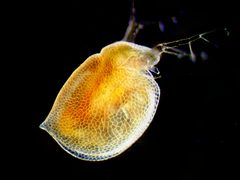
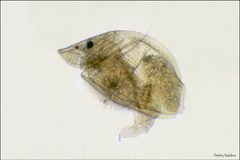
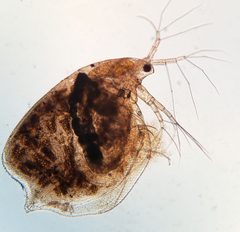
Small crustaceans with body length typically under 6 mm. The lacks clear separation from the trunk, with the gradually merging into the trunk rather than forming a distinct region. Thoracic limbs number five pairs typically, occasionally six pairs. Body enclosed within a bivalve derived from the shell gland. are well-developed and used for locomotion; some lineages possess specialized structures such as burrowing spines on antenna II.
Habitat
Freshwater continental waters including lakes, ponds, rivers, temporary pools, and wetlands. Specific occupy distinct : Daphniidae and Bosminidae are predominantly pelagic or planktonic; Chydoridae and Macrothricidae are frequently littoral or benthic, associated with substrates including sediments, vegetation, and detritus. Some inhabit extreme environments such as saline lakes or ephemeral pools.
Distribution
distribution with records from all continents except Antarctica. Widespread in the Northern Hemisphere temperate zones of Eurasia and North America. Distinct genetic lineages documented in East Eurasia and Alaska. Present in South Africa with elements. Diversity hotspots include ancient lake systems and isolated water bodies.
Seasonality
Activity patterns vary by climate and permanence. In temperate regions, active peak during spring and summer when temperatures favor parthenogenetic . Sexual phases (gamogenesis) often triggered by environmental cues including , temperature decline, or crowding. Some produce resting that survive desiccation or freezing, allowing persistence in temporary habitats and seasonal re-.
Life Cycle
primarily parthenogenetic, with females producing that develop directly into genetically identical offspring. (gamogenesis) occurs periodically, producing haploid eggs that require by males. Fertilized eggs are enclosed in ephippia—, desiccation-tolerant structures that sink to sediments or disperse. Ephippial eggs may remain for extended periods, hatching when conditions become favorable. Development is direct without larval stages; resemble miniature .
Behavior
Most swim using in characteristic jerking movements. Benthic lineages within Macrothricidae and related exhibit substrate-associated including crawling, attachment to surfaces using modified valve margins and thoracic limbs, and burrowing into sediments. Some species undergo diel vertical in lakes. Swimming behavior varies from continuous to intermittent depending on risk and food availability.
Ecological Role
Critical primary consumers in freshwater , filtering , bacteria, and detritus. Serve as prey for fish, amphibians, and , forming a central trophic link between and higher consumers. Nutrient cycling through and egestion. Some are keystone grazers that structure phytoplankton . Resting banks in sediments contribute to genetic diversity storage and .
Human Relevance
Daphnia magna and related are standard organisms in aquatic toxicology and water quality assessment. Used extensively in evolutionary research due to their reproductive mode, cyclic , and ecological responsiveness. Some species are cultivated as live food for fish in aquaculture. Serve as indicators of environmental change and health in biomonitoring programs.
Similar Taxa
- CtenopodaAnother cladoceran infraorder distinguished by six pairs of thoracic limbs (vs. five typically in Anomopoda), distinct -trunk separation, and generally more elongated body form with less enveloping .
- OnychopodaCladoceran infraorder with reduced exposing most of the body, four pairs of thoracic limbs, and often predatory habits; lacks the gradual -trunk fusion characteristic of Anomopoda.
- Haplopoda cladoceran infraorder containing only Leptodora kindtii, a large transparent predatory with six pairs of limbs and distinct body regions, unlike typical anomopods.
More Details
Taxonomic status
Anomopoda has been treated as order, suborder, or infraorder in different classifications. Current phylogenomic studies generally place it as infraorder within Diplostraca (or Cladocera when that rank is used). The group contains approximately 11 recognized with ongoing revisionary work, particularly in Macrothricidae and Chydoridae.
Research importance
The Daphnia within Anomopoda has become a premier model system for studying the evolutionary of sex, - , and responses to environmental change. sequencing of multiple Daphnia has enabled genomic and functional genomic studies unparalleled among crustaceans.