
Daphniidae
water fleas
Genus Guides
2- Daphnia(water fleas)
- Simocephalus(water flea)
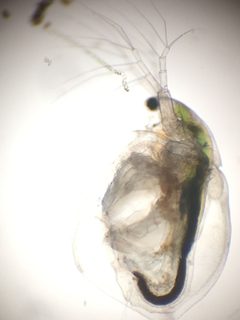
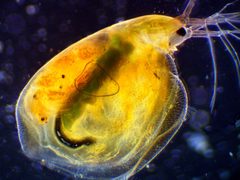
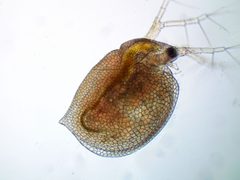
Daphniidae is a of small freshwater crustaceans in the order Anomopoda, commonly known as water fleas. The family contains approximately 121 across five : Ceriodaphnia, Daphnia, Megafenestra, Scapholeberis, and Simocephalus. Daphniidae species are important model organisms in , toxicology, and evolutionary , particularly the genus Daphnia. Many species have been accidentally introduced to regions outside their native ranges through human activity.
Pronunciation
How to pronounce Daphniidae: //dæfˈnaɪɪdiː//
These audio files are automatically generated. While they are not always 100% accurate, they are a good starting point.
Identification
Females can be distinguished from similar diplostracan (Macrotrichidae and Moinidae) by their short, immobile . The family exhibits considerable morphological diversity adapted to different : Scapholeberis and Megafenestra are adapted to life at the water surface film; Simocephalus species possess adaptations for clinging to objects while filter feeding; pelagic forms lack such clinging structures. Species-level identification within Daphnia often requires examination of diagnostic morphological characters and is complicated by cryptic diversity revealed through genetic methods.
Images
Habitat
Freshwater aquatic environments including lakes, ponds, and temporary water bodies. occupy diverse : surface film (Scapholeberis, Megafenestra), with vegetation or other substrates for clinging (Simocephalus), and open pelagic waters. The has been observed in cold temperate through tropical zones across multiple continents.
Distribution
Worldwide distribution across five latitudinal zones: southern cold, southern temperate, tropical, northern temperate, and northern cold. Within the Daphnia, subgenus Daphnia s.str. shows antipolar (dissymmetric hemispheric) distribution while subgenus Ctenodaphnia shows bipolar (sub-symmetric) distribution. Fossil records from the Jurassic/Cretaceous boundary in Mongolia indicate ancient Pangaean differentiation of these lineages. Specific regional records include the Altay-Sayan mountain region (southern Siberia and Mongolia), Scandinavia (Denmark, Norway, Sweden), and North America (Vermont, USA). Many have been accidentally introduced to areas outside their native ranges through human activity.
Diet
Filter feeding on suspended particles in the water column. The feeding mechanism differs from the scraping of Macrotrichidae, allowing ingestion of suspended food rather than requiring attachment to surfaces for scraping.
Life Cycle
involves allocation of energy resources to reproductive output, with documented trade-offs under environmental stress conditions such as hexavalent chromium exposure.
Behavior
Different exhibit distinct behavioral adaptations: Scapholeberis and Megafenestra are adapted to living at the water surface film; Simocephalus species cling to objects while filter feeding; pelagic forms have developed open-water lifestyles without clinging .
Ecological Role
Important primary consumers in freshwater , transferring energy from phytoplankton and suspended detritus to higher . Their filter-feeding activity influences water clarity and algal structure. Serve as key indicator organisms for water quality assessment and environmental monitoring due to their sensitivity to pollutants.
Human Relevance
Extensively used as model organisms in biological research, particularly in , evolution, toxicology, and genetics. Employed in standardized testing for water quality assessment (e.g., Ceriodaphnia dubia and Daphnia pulex in whole effluent toxicity tests). Many have been accidentally introduced to new regions through human activity, sometimes becoming .
Similar Taxa
- MacrotrichidaeSimilar diplostracan but distinguished by scraping feeding mechanism versus filter feeding in Daphniidae, and by female that are not short and immobile
- MoinidaeMorphologically similar diplostracans that may be placed within Daphniidae by some authors; distinguished by female and potentially by reproductive and ecological traits
Sources and further reading
- BugGuide
- Wikipedia
- GBIF taxonomy match
- iNaturalist taxon
- NCBI Taxonomy
- Redescription of Daphnia turbinata Sars, 1903 (Crustacea: Cladocera: Daphniidae)
- Latitudinal patterns in the diversity of two subgenera of the genus Daphnia O.F. Müller (Crustacea: Cladocera: Daphniidae)
- Energy resource reallocation in Daphnia schodleri (Anomopoda: Daphniidae) reproduction induced by exposure to hexavalent chromium