
Daphnia
O.F.Müller, 1785
water fleas, water-fleas
Species Guides
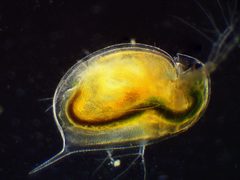
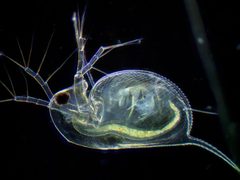
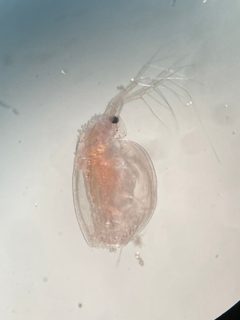
1- Daphnia galeata(water flea)
Daphnia is a of small planktonic crustaceans (0.2–6.0 mm) in the order Anomopoda, commonly called water fleas due to their saltatory swimming style. The genus comprises over 200 distributed across diverse freshwater worldwide. Daphnia exhibits cyclical , alternating between and , and serves as a keystone organism in freshwater . Several species, particularly D. magna and D. pulex, are extensively used as model organisms in , toxicology, and evolutionary research.
Pronunciation
How to pronounce Daphnia: //ˈdæfniə//
These audio files are automatically generated. While they are not always 100% accurate, they are a good starting point.
Identification
Distinguished from related Moina by larger size (Moina roughly half the maximum length of D. pulex). D. pulex and D. pulicaria are often confused due to similar appearances and hybridization capability. D. magna is notably larger than D. pulex. D. lumholtzi possesses permanent spines and long hooks on the body, unlike native North American that develop temporary helmet-like structures and spines only in response to . D. longicephala exhibits distinctive with elongated helmet structures.
Images
Appearance
Body typically 0.2–6.0 mm in length, with most 1–5 mm. Body divided into segments with bent downward toward the body, separated by a visible notch. covers most of the body with a gap through which five or six pairs of legs extend. Most prominent features are large , long second , and a pair of abdominal setae. Carapace is translucent or nearly transparent in many species, allowing observation of internal organs including the beating . Heart located dorsally at the top of the back, just behind the head, with average rate of approximately 180 beats per minute under normal conditions. Second antennae larger than first pair and responsible for the characteristic jumping motion.
Habitat
Freshwater aquatic environments including lakes, ponds, streams, rivers, acidic swamps, and temporary pools. Some inhabit hypersaline lake environments. Found across altitudinal gradients from lowland water bodies to high-mountain lakes. Occurs in water bodies ranging from small temporary pools to large permanent lakes, with varying degrees of mineralization from freshwater to hyperhaline.
Distribution
distribution across all continents including Antarctica. Documented in North America, Europe, Asia, Africa, Australia, and South America. Specific distribution varies by : D. pulex is widespread and common; D. magna has broader distribution in larger water bodies; D. lumholtzi native to east Africa, Indian subcontinent, and east Australia, in North America; D. galeata common in Palearctic region.
Seasonality
Active year-round in permanent water bodies; strongly influenced by temperature and . shifts from parthenogenetic to sexual as day length shortens and temperatures decline toward end of growing season. Resting (ephippia) withstand extreme cold, drought, or poor food availability, hatching when conditions improve. In temperate regions, active may decline or persist as resting stages during winter.
Diet
consuming primarily unicellular , organic detritus, protists, and bacteria. Food particles trapped by second and third pairs of legs, which exclude large unabsorbable particles while other leg pairs create water current through . Trapped particles formed into food bolus and moved through digestive tract.
Life Cycle
Cyclical : females reproduce asexually for most of growth season, producing of at each . Brood size varies from 1–2 eggs in smaller (e.g., D. cucullata) to over 100 in larger species (e.g., D. magna). Eggs hatch after approximately one day, remain in brood pouch ~3 days at 20°C, then released. Offspring pass through 4–6 instars over 5–10 days before reaching reproductive maturity. offspring typically female. As environmental conditions deteriorate (crowding, cooling, shorter day length), some offspring develop into males; females produce haploid sexual eggs fertilized by males. Resting eggs enclosed in hardened ephippium (two chitinous plates), cast off at female's next molt. Ephippia withstand extreme conditions, hatching into females when conditions improve. Lifespan 13–14 months in cold, oligotrophic, fish-free lakes; typically 5–6 months under normal conditions.
Behavior
Exhibits phenotypic plasticity in response to : develops morphological defenses including larger size at hatching, increased bulkiness, and "neck-teeth" at back of in presence of Chaoborus kairomones. Response differs based on predator type—fish kairomones reduce size at first , while Chaoborus kairomones increase size. Saltatory swimming powered by second produces characteristic jumping motion. Tolerant of handling for microscopic observation without apparent harm. rate responds to chemical stimuli including alcohol, caffeine, nicotine, and adrenaline, making them useful for physiological studies.
Ecological Role
Central link in freshwater : consumes phytoplankton and bacteria, regulating algal bloom intensity and maintaining water transparency; serves as crucial food source for fish fry and predatory insect larvae. Acts as sanitizer by filtering fine organic debris and bacteria. Sensitivity to environmental changes makes them valuable indicators for water quality monitoring and environmental toxicology.
Human Relevance
Extensively used as model organism in scientific research including , evolution, toxicology, and climate change studies. Standard test organism for water quality biotesting and environmental toxicology (e.g., OECD Test No. 211). Used to study effects of temperature, drugs, and pollutants on physiology due to transparent and visible internal organs. Popular live food in aquaculture and fish keeping, fed to tadpoles and small amphibians. Some (e.g., D. lumholtzi in North America), causing nuisance by entangling in fishing gear and potentially outcompeting native species.
Similar Taxa
- MoinaRelated in order Cladocera but Moinidae; much smaller than D. pulex (roughly half maximum length)
- CeriodaphniaSmaller cladoceran with similar body form but distinct chamber and typically shorter
- BosminaCladoceran with more elongated body form and different antennal structure, often found in same
Misconceptions
Despite "water flea," Daphnia are crustaceans unrelated to true fleas (Insecta: Siphonaptera). The jumping motion results from -powered swimming rather than leg-based jumping. Not all Daphnia reproduce exclusively asexually—cyclical involves regular sexual phases.
Sources and further reading
- BugGuide
- Wikipedia
- GBIF taxonomy match
- iNaturalist taxon
- NCBI Taxonomy
- Catalogue of Life
- Three decades of research on cladocerans in Tyva, a unique Asian region | Blog
- Uncategorized | Blog - Part 40
- Pensoft blog - Part 145
- How can the Convention on the Conservation of Migratory Species help reverse invertebrate declines? - Buglife Blog - Buglife
- crustaceans | Blog
- LC-MS/MS-based proteome profiling in Daphnia pulex and Daphnia longicephala: the Daphnia pulex genome database as a key for high throughput proteomics in Daphnia
- Reproducibility of short-term and reproduction toxicity experiments with Daphnia magna and comparison of the sensitivity of Daphnia magna with Daphnia pulex and Daphnia cucullata in short-term experiments
- Morphology of the Daphnia nervous system: A comparative study on Daphnia pulex, Daphnia lumholtzi, and Daphnia longicephala
- Transitions between reproductive systems in Daphnia
- Test No. 211: Daphnia magna Reproduction Test
- Interclonal differences in incipient limiting level (ILL) in Daphnia magna.