
Bosmina
Baird, 1845
water flea
Species Guides
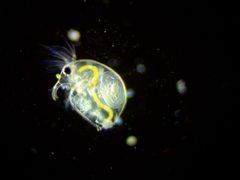
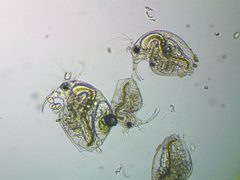
1Bosmina is a of small cladoceran crustaceans commonly known as water fleas. Members are distinguished from the related genus Bosminopsis by having that are separated at their bases rather than . Bosmina are that consume and protozoans approximately 1–3 μm in size, using a dual feeding mechanism involving mesh-like setules on the second and third legs for filtering while the first leg grasps particles. The genus exhibits notable morphological plasticity, particularly in mucrones and antennules, which vary in response to pressure. Some Bosmina species have become outside their native ranges, posing threats to aquatic .
Pronunciation
How to pronounce Bosmina: //bɒsˈmiːnə//
These audio files are automatically generated. While they are not always 100% accurate, they are a good starting point.
Identification
Distinguished from Bosminopsis, the only other in Bosminidae, by the separation of the at their bases; in Bosminopsis, antennae are at their bases. within Bosmina show high morphological variability in body size and shape, particularly in mucrones and antennules, which can range from short-featured to long-featured . Morphological features such as mucro length, antennule length, and length can show significant plastic responses to environmental conditions.
Images
Habitat
Freshwater continental water bodies including lakes, ponds, rivers, swamps, ditches, puddles, and temporary pools. Some occur in slightly saline and saline water bodies. In lakes, occupies pelagic zones with distribution influenced by regimes and food availability.
Distribution
distribution across all continents including Antarctica. Documented from North America, South America, Europe, Asia, and Australia. Specific distribution records include: Republic of Tyva (Russia), Lake Constance (Central Europe), Tripura (India), Colombia, Denmark, Norway, Sweden, and the Great Lakes region of North America. Some are non-native and in certain regions, including Bosmina (Eubosmina) coregoni on the Pacific coast of North America.
Diet
consuming and protozoans approximately 1–3 μm in length. Feeds on phytoplankton, bacteria, and organic particles. Laboratory studies use Chlorella sp. as food source. Unlike Daphnia, Bosmina has lower phosphorus content in body tissue and is less susceptible to phosphorus mineral limitation from food.
Life Cycle
Parthenogenetic under favorable conditions, with females producing without male participation. Some show 3 preadult instars and 10 instar stages with total lifespan approximately 25 days and age at first reproduction around 3.65 days. Maximum 10 clutches per female with approximately 22 total per lifespan and ~89% hatching success. Gestation period approximately 2.03 days with 12 embryonic developmental stages in pouch. Under adverse conditions (cooling, shorter daylight, drying water bodies), produces resting eggs (ephippia) that can withstand drying, frost, and persist in sediments for decades.
Behavior
Exhibits phenotypic plasticity and developmental responses to pressure. Morphological features including mucro length, antennule length, and length increase in response to exposure to copepod such as Epischura. Shows both selective responses (differential mortality) and chemical induction (developmental plasticity) during predator interactions. Diel vertical patterns may be influenced by antennule length affecting buoyancy.
Ecological Role
Central link in freshwater , regulating algal blooms and maintaining water transparency through continuous filtering. Serves as crucial food source for fry of most freshwater fish and predatory insect larvae. Acts as sanitizer by filtering fine organic debris and bacteria. Sensitive to environmental changes, making it valuable for water quality biotesting and environmental monitoring.
Human Relevance
Used as a model organism in ecological and toxicological research due to rapid , ease of , and sensitivity to environmental changes. Some are and pose threats to aquatic outside their native ranges. Valuable for studying past climatic conditions through resting archives in sediments.
Similar Taxa
- BosminopsisOnly other in Bosminidae; distinguished by bases versus separated antennae in Bosmina
- DaphniaCommon cladoceran with higher body phosphorus content; Bosmina has lower phosphorus requirements and different nutritional
Sources and further reading
- BugGuide
- Wikipedia
- GBIF taxonomy match
- iNaturalist taxon
- NCBI Taxonomy
- Catalogue of Life
- Three decades of research on cladocerans in Tyva, a unique Asian region | Blog
- Pensoft Editorial Team | Blog - Part 6
- Life Cycle of a New Bosminid Cladocera: Bosmina (Bosmina) tripurae (Korinek, Saha, and Bhattacharya, 1999)
- Seasonal Divergence of Bosmina Morphs
- Translocation Experiments: Bosmina Responses to Copepod Predation
- Phytoplankton phosphorus limitation and food quality for Bosmina
- Experimental Study On the Ecology of Bosmina Longirostris (O. F. Müller) (Cladocera)
- Effects of Water pH on Life History Parameters of a New Bosminid Cladocera: Bosmina (Bosmina) Tripurae (Korinek, Saha and Bhattachaya, 1999) in Laboratory Condition
- Sedimentary evidence of invasive cladoceran Bosmina (Eubosmina) coregoni presence on the Pacific coast of North America over four decades before first detection.