
Holopediidae
Genus Guides
1- Holopedium(water flea)
Holopediidae is a of small freshwater crustaceans in the order Ctenopoda. The family contains a single , Holopedium, with approximately seven described . Members are planktonic water fleas found in temperate lakes and ponds.
Pronunciation
How to pronounce Holopediidae: //hɒl.oʊˈpiː.di.aɪˌdiː//
These audio files are automatically generated. While they are not always 100% accurate, they are a good starting point.
Identification
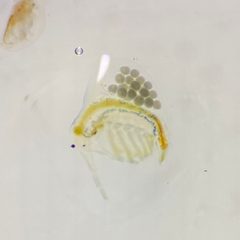
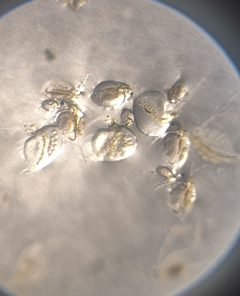
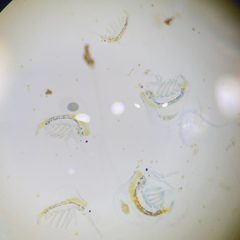
The complete gelatinous mantle enclosing the body separates Holopediidae from all other cladoceran . The Holopedium can be distinguished from the superficially similar genus Leptodora (family Leptodoridae) by its smaller size, rounded body shape within the mantle, and the presence of a fully enclosing gelatinous covering rather than a loose, incomplete . The are relatively shorter compared to body size than in most other ctenopods.
Images
Appearance
Members possess a distinctive gelatinous mantle that completely encloses the body, giving them a transparent, spherical appearance. The mantle is secreted by specialized glands and can be twice the diameter of the animal itself. The body within retains the typical cladoceran form with biramous used for swimming, five pairs of thoracic limbs, and a postabdomen with terminal claws. The gelatinous covering distinguishes them from all other cladoceran .
Habitat
Planktonic in freshwater lakes and ponds. Occurs in the open water zone (limnetic zone) rather than near shore. Favors mesotrophic to oligotrophic waters with low to moderate nutrient levels. Has been observed in both small ponds and large lakes.
Distribution
Temperate regions of the Northern Hemisphere. Documented from Scandinavia (Denmark, Sweden), northeastern North America (Vermont, United States), and broader regions of the United States. Distribution appears fragmented with concentrated in glacial lake regions.
Seasonality
Active during the ice-free season in temperate lakes. peaks typically occur in summer. occurs as resting (ephippia) in lake sediments.
Life Cycle
is primarily parthenogenetic during favorable conditions, with females producing that develop directly in the chamber. occurs seasonally, producing resting eggs enclosed in ephippia that sink to sediments. The resting eggs require a period of before hatching. Development is direct without larval stages; juveniles are released as miniature versions of .
Behavior
Swims using the in a characteristic jerky motion. The gelatinous mantle provides buoyancy regulation and may serve as protection against small . Vertical patterns have been observed, with movement toward surface waters at night and deeper waters during day, though specific depth ranges are not well documented.
Ecological Role
Functions as a primary consumer in freshwater plankton . The gelatinous mantle makes them less palatable to many planktivorous fish and compared to naked cladocerans, potentially altering predator-prey dynamics in lakes where they are abundant.
Human Relevance
Used as an in paleolimnological studies; ephippia and remains in lake sediments provide historical records of past environmental conditions. Occasionally referenced in studies of freshwater response to climate change and acidification.
Similar Taxa
- LeptodoridaeLeptodora also possesses a gelatinous , but it is loose and incomplete, not forming a complete enclosing mantle as in Holopedium. Leptodora is also substantially larger (up to 18 mm) and has a more elongate body form.
- SididaeOther in Ctenopoda lack any gelatinous covering and have exposed bodies with more prominent structures.
More Details
Gelatinous mantle function
The gelatinous mantle is secreted continuously and can be shed and regenerated. Its exact functional significance remains partially unresolved; proposed functions include buoyancy control, deterrence, and protection from ultraviolet radiation.
Taxonomic history
The has long been recognized as distinct due to its unique , though the number of valid within Holopedium has been revised multiple times. Some authors have historically included additional now placed elsewhere.