
Leptodoridae
Genus Guides
1- Leptodora(Invisible Water Flea)
Leptodoridae is a of large predatory water fleas containing the single Leptodora. Members are among the largest cladocerans, reaching up to 18 mm in length. They are transparent, pelagic found in temperate lakes. The family is distinguished by its unique body plan and reduced , representing a distinct lineage within the order Diplostraca.
Pronunciation
How to pronounce Leptodoridae: /lɛptəˈdɔrɪdi/
These audio files are automatically generated. While they are not always 100% accurate, they are a good starting point.
Identification
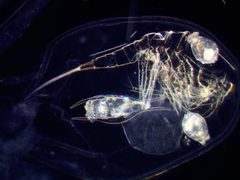
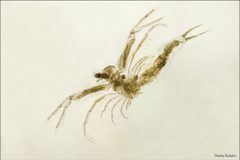
Distinguished from all other cladoceran by the greatly reduced that does not enclose the body, and by the large size (exceeding 10 mm when mature). The combination of transparent, elongate body, large , and reduced second separates Leptodoridae from Polyphemidae and other predatory cladocerans. The uniramous, non-swimming second antennae are unique among cladocerans. In preserved specimens, the exposed trunk segmentation and pouch position are diagnostic.
Images
Appearance
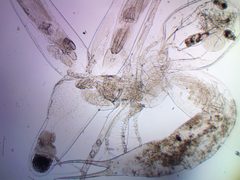
Body large and elongate, reaching 6–18 mm in length. reduced to a small pouch covering only the portion of the trunk; most of the body is exposed and transparent. large, rounded, with well-developed . Antennules long and uniramous. Second reduced, uniramous, and non-functional for swimming. Trunk segments distinct, with six pairs of thoracic limbs adapted for prey capture. Postabdomen slender with paired claws. Body lacks pigmentation, appearing glass-like in life.
Habitat
Pelagic zone of large, deep, temperate lakes. Occurs in open water from the surface to depths exceeding 100 meters. Requires oligotrophic to mesotrophic conditions with low turbidity. Strongly associated with cold, well-oxygenated water. Avoids and shallow eutrophic waters.
Distribution
Holarctic distribution. Recorded from northern Europe (Denmark, Norway, Sweden), northern United States (Vermont), and Russia. Disjunct suggest broader range in and temperate regions of North America and Eurasia.
Seasonality
Active throughout the ice-free season in temperate lakes. peak in late summer and autumn. Undergoes diel vertical , occurring deeper during daylight hours and nearer the surface at night.
Diet
Life Cycle
is parthenogenetic during favorable conditions, with and resting production triggered by environmental cues. Resting eggs are released into the water column and sink to the sediment. Development includes direct embryonic development within the pouch; no free-living nauplius stage. time varies with temperature, typically 2–4 weeks.
Behavior
Exhibits pronounced diel vertical , descending to deeper, darker waters during daylight to avoid visual and ascending at night to feed in productive surface layers. Swimming is accomplished primarily by trunk limb movements and occasional action, rather than the typical cladoceran second-antennae beating. Transparent body provides camouflage in open water.
Ecological Role
Top in the pelagic zones of oligotrophic lakes. Regulates of smaller zooplankton through direct . Serves as important prey for planktivorous fish, particularly coregonids and salmonids. Energy transfer link between primary consumers and higher in deep lake .
Human Relevance
for oligotrophic lake conditions; presence suggests high water quality and minimal eutrophication. Occasionally studied in limnological research for its unique and predatory . No direct economic importance.
Similar Taxa
- PolyphemidaeShares predatory habit and large size, but Polyphemidae has a complete enclosing the body, biramous second used for swimming, and a more compact body form.
- CercopagidaeAlso contains large predatory cladocerans, but Cercopagidae possess a complete and distinctive caudal process; body plan is fundamentally different from the exposed-trunk of Leptodoridae.
More Details
Taxonomic uniqueness
Leptodoridae is the sole in the suborder Haplopoda, reflecting its isolated phylogenetic position within Diplostraca. The suborder name refers to the single (uniramous) second , a derived trait unique among cladocerans.
Rarity and detection
Despite large size, Leptodora is often overlooked in routine zooplankton sampling due to fragility and net avoidance. Specimens are easily damaged by standard collection methods, leading to underreporting in many lake systems.