
Mysidae
Haworth, 1825
mysids, opossum shrimp, opossum shrimps
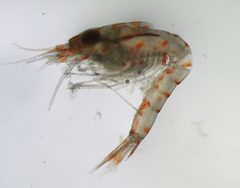
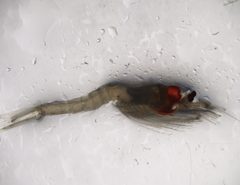
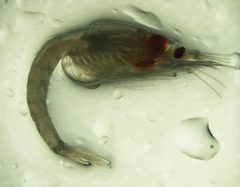
Mysidae is the largest of crustaceans in the order Mysida, containing over 1000 in approximately 170 . Members are commonly known as mysids or opossum shrimps. They are distinguished from other mysid families by several morphological features including a well-developed exopod on the first pereopod, subdivided carpopropodus on endopods of pereopods 3-8, and statocysts on uropod endopods. The family exhibits remarkable ecological diversity, with species inhabiting marine, brackish, and freshwater environments worldwide, including specialized burrowing forms and symbiotic associations.
Pronunciation
How to pronounce Mysidae: //mɪˈsɪd.i.aɪ//
These audio files are automatically generated. While they are not always 100% accurate, they are a good starting point.
Identification
Mysidae can be distinguished from other mysid by three key morphological characters: (1) the first pereopod possesses a well-developed exopod (outer branch); (2) the carpopropodus of the endopod (inner branch) of the third to eighth pereopods is divided into sub-segments; and (3) statocysts are present on the endopod of the uropods ( appendages). Female members (except Boreomysinae) have two or three oostegites forming the base of the marsupium; Boreomysinae females have seven pairs of oostegites.
Images
Habitat
Ecologically diverse: includes marine coastal and oceanic , estuarine forms, freshwater inhabitants, and specialized burrowing species in sandy substrates. Some species occupy the hyperbenthic zone (near-bottom waters), while others are pelagic or associated with specific such as ascidians. Freshwater and oligohaline species are documented from Mediterranean water bodies, Ponto-Caspian regions, and Amazonian river systems.
Distribution
Worldwide distribution across marine, brackish, and freshwater systems. Documented from Arctic to tropical waters, including the Bering Sea, eastern Pacific (Alaska to Peru), western Mexico, Caribbean, Atlantic coast of the United States, Brazil, Mediterranean basin, Adriatic Sea, Black Sea, Marmora Sea, and Southern Ocean (Macquarie Island region). Specific distribution varies by and .
Life Cycle
Females possess a marsupium ( pouch) under the formed by oostegites, where embryos develop. Developmental patterns vary: some exhibit distinct morphological changes in male third pleopods between (subterminal) and ultimate (terminal) forms. range from to multivoltine in estuarine species, with breeding periods typically spanning multiple months.
Behavior
Many exhibit diel vertical . Burrowing species (psammobionts) display tidal and diel migration patterns associated with sandy beach . Hyperbenthic species aggregate near the benthic-pelagic interface. Some species show spatial segregation along salinity gradients in estuaries. One documented species exhibits obligate endocommensal , living within the branchial sacs of ascidians.
Ecological Role
Important components of aquatic , particularly in estuarine and coastal where they form a substantial proportion of hyperbenthic . Serve as prey for higher . Link benthic and pelagic food webs in near-bottom . Component of sandy-shore macrofaunal and estuarine . Some are wide-range invaders that have expanded into new freshwater and brackish water systems.
Human Relevance
Some Ponto-Caspian have become in European fresh and brackish waters, with documented expansion into the northwestern Mediterranean. Serve as for environmental conditions in some aquatic systems. Research organisms for studies of crustacean development, , and .
Similar Taxa
- other mysid families (e.g., Petalophthalmidae)Mysidae is distinguished by the combination of a well-developed exopod on the first pereopod, subdivided carpopropodus on pereopods 3-8, and statocysts on uropod endopods; other lack this specific character combination
More Details
Taxonomic complexity
The contains numerous with complicated taxonomic histories. The genus Bowmaniella underwent major revision, with discovery that nine nominal were junior synonyms based on misinterpretation of male pleopod development. Two new genera were erected to accommodate previously confused species.
Statolith composition
Statolith mineral composition varies among and has biogeographic significance. Most Mediterranean freshwater and oligohaline species have statoliths composed of vaterite (CaCO3), while others contain fluorite (CaF2). This difference supports hypotheses about origins from the Paratethys versus Tethyan seas.
Symbiotic associations
Corellamysis eltanina represents the first documented mysid-ascidian , living obligately within the branchial sacs of the tunicate Corella brewinae in the Southern Ocean. This discovery expanded known mysid ecological strategies.
Sources and further reading
- BugGuide
- Wikipedia
- GBIF taxonomy match
- iNaturalist taxon
- NCBI Taxonomy
- Catalogue of Life
- Life histories of two hyperbenthic mysids (Mysidacea: Mysidae) in an open estuary
- The genus Boreomysis G.O. Sars, 1869 (Peracarida, Mysida, Mysidae) in western Mexico
- Revision of Bowmaniella sensu Băcescu, 1968 (Crustacea: Mysida: Mysidae: Gastrosaccinae): a taxonomic conundrum
- New Records of Taphromysis Louisianae Banner, 1953 (Mysidae) With Notes On Its Ecology
- The ascidian-associated mysid Corellamysis eltanina gen.nov., sp.nov. (Mysida, Mysidae, Heteromysinae): a new symbiotic relationship from the Southern Ocean
- Diamysis cymodoceae sp. nov. from the Mediterranean, Marmora, and Black Sea basins, with notes on geographical distribution and ecology of the genus (Mysida, Mysidae)
- The genus Surinamysis (Mysida, Mysidae, Diamysini) from Amazonia and the coast of Brazil, with descriptions of two new species
- The Mysidae (Crustacea: Peracarida: Mysida) in fresh and oligohaline waters of the Mediterranean. Taxonomy, biogeography, and bioinvasion