
Penilia avirostris
Dana, 1849
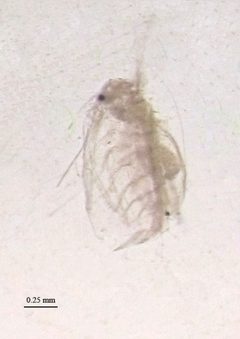
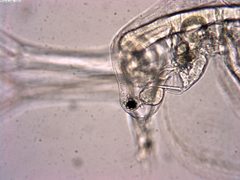
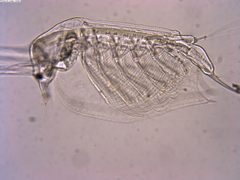
Penilia avirostris is a marine cladoceran crustacean in the Sididae, distributed across temperate and tropical coastal waters worldwide. It is a holoplanktonic that exhibits cyclical , with shifting between and in response to environmental cues. The species has been observed to undergo diel vertical and shows strong sensitivity to temperature, with optimal growth around 18°C but ranging from 12°C to 30°C. are closely tied to seasonal temperature fluctuations, with dramatic increases reported in warming waters.
Pronunciation
How to pronounce Penilia avirostris: /pɛˈnɪliə ˌævɪˈrɒstrɪs/
These audio files are automatically generated. While they are not always 100% accurate, they are a good starting point.
Images
Habitat
Marine coastal and shelf waters, including bays, estuaries, and open coastal environments. Occurs in tropical to temperate regions with surface temperatures ranging from 12°C to 30°C, optimally around 18°C. Found in waters with salinity between approximately 33–36 PSU and dissolved oxygen levels of 2.9–6.6 mg L⁻¹.
Distribution
Temperate Asia, Europe, New Zealand, Indian Ocean, southwest Gulf of Mexico, western Atlantic (US Northeast Shelf), Mediterranean Sea (Catalan Sea), and tropical Atlantic (Guanabara Bay, Brazil). GBIF records indicate presence in Antarctic, Australasian, Afrotropical, Nearctic, and Neotropical regions.
Seasonality
Seasonal abundance patterns vary by region. In temperate waters, typically decline or disappear in winter, preceded by reduced sizes in parthenogenetic females and appearance of gamogenetic (sexual) individuals. In tropical and subtropical regions, gamogenesis appears less crucial for population maintenance. Peak densities observed in spring through autumn in temperate zones; year-round presence possible in tropical waters with temperature-dependant fluctuations.
Diet
Feeds on phytoplankton and small particulate organic matter. Prey selectivity and daily ration have been quantified in feeding studies, though specific prey are not detailed in available sources.
Life Cycle
Exhibits cyclical : parthenogenetic females produce of 2–7 embryos asexually under favorable conditions, with body length correlating positively with embryo number. Gamogenetic individuals (males and sexual females) appear seasonally, particularly preceding declines. Four developmental stages have been identified. Parthenogenetic females reach approximately 773 μm in length. Males have been documented in some populations.
Behavior
Performs diel vertical , moving through the water column on a daily cycle. follows diel patterns, with timing varying between coastal environments.
Ecological Role
Important component of marine zooplankton in coastal and shelf . Serves as prey for higher . can reach thousands of individuals per 100 m³, with recorded maxima of 2200–5980 ind 100 m⁻³ in productive coastal waters. Contributes to energy transfer from to higher consumers.
Human Relevance
Serves as an for monitoring marine responses to climate change, particularly temperature shifts. increases in warming waters (e.g., North Sea in 2002–2003) demonstrate its value for tracking thermal regime changes. Studied in fisheries ecosystem research on the US Northeast Shelf.
Similar Taxa
- Pseudevadne tergestinaCo-occurs in marine plankton and shares similar preferences, diel vertical , and cyclical parthenogenetic . Distinguished by smaller parthenogenetic female size (~638 μm vs. ~773 μm) and size of 2–8 embryos. Males present in August and October in studied , with five instar stages identified versus four in P. avirostris.
Sources and further reading
- BugGuide
- Wikipedia
- GBIF taxonomy match
- iNaturalist taxon
- NCBI Taxonomy
- Catalogue of Life
- Penilia avirostris DANA in the Indian Ocean (Cladocera)
- Penilia avirostris (Crustacea, Ctenopoda) in a tropical bay: variations in density and aspects of reproduction
- ON THE DISTRIBUTION OF A MARINE CLADOCERAN, PENILIA AVIROSTRIS DANA (CRUSTACEA, BRANCHIOPODA), WITH A NOTE ON ITS REPORTED BIOLUMINESCENCE
- Reproductive aspects of marine cladocerans Penilia avirostris and Pseudevadne tergestina (Crustacea, Branchiopoda) in the outer part of Guanabara Bay, Brazil
- Feeding ecology of the marine cladoceran Penilia avirostris: natural diet, prey selectivity and daily ration
- Ecological success of the cladoceran Penilia avirostris in the marine environment: feeding performance, gross growth efficiencies and life history
- Long-Term Abundance and Distribution Trends of the Cladoceran Penilia avirostris in the US Northeast Shelf Ecosystem
- Life history and population dynamics of the marine cladoceran Penilia avirostris (Branchiopoda: Cladocera) in the Catalan Sea (NW Mediterranean)
- Diel reproduction and vertical distributions of the marine cladocerans, Evadne tergestina and Penilia avirostris, in contrasting coastal environments
- Diel cycles of reproduction and vertical migration in the marine cladocerans Pseudevadne tergestina and Penilia avirostris
- Population dynamics of Penilia avirostris and Pseudevadne tergestina (Diplostraca) in the Veracruz Reef System National Park, southwest Gulf of Mexico