
Mastigoproctus tohono
Barrales-Alcalá, Francke & Prendini, 2018
Tohono whipscorpion, Tohono vinegaroon
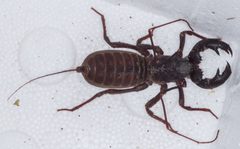
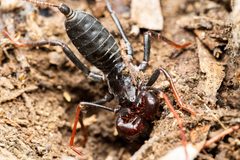
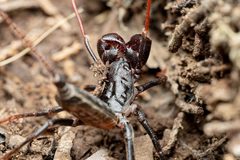
Mastigoproctus tohono is a of whip scorpion (order Uropygi) described in 2018 from previously attributed to Mastigoproctus giganteus. It is distinguished by specific setal patterns and epistoma positioning. The species produces acetic acid spray as a chemical defense, creating a vinegar-like odor. It inhabits arid regions of the southwestern United States and northern Mexico.
Pronunciation
How to pronounce Mastigoproctus tohono: /ˌmæstɪgoʊˈproʊktəs toʊˈhoʊnoʊ/
These audio files are automatically generated. While they are not always 100% accurate, they are a good starting point.
Identification
Distinguished from the similar Mastigoproctus giganteus by differing areas of setae frequency and epistoma positioning. The only reliable identification requires close examination of these morphological characters. Most sightings in the Chiricahua and Huachuca Mountains of Arizona were previously attributed to M. giganteus.
Images
Habitat
Arid and semi-arid environments of the Sonoran Desert region. Found in rocky areas, under debris, and in soil burrows. Observed in urban settings near building foundations.
Distribution
Native range extends from northern Sonora, Mexico to southern Arizona and western New Mexico, USA. Majority of records from the Chiricahua and Huachuca Mountains of Cochise County, Arizona.
Diet
. Captures and crushes prey using modified . Observed feeding on crickets in captivity.
Life Cycle
Develops through , post-embryonic stages, and . Specific details of developmental stages and duration not documented in available sources.
Behavior
Primarily . Relies on antenniform front legs, tail, and for navigation and sensing due to extremely poor vision. When threatened, sprays acetic acid from glands at the base of the tail; this chemical defense can injure and irritate vertebrate and nose.
Ecological Role
in arid . Specific ecological interactions not well documented.
Human Relevance
Defensive spray can cause irritation to human and nose but is not dangerous. Occasionally encountered in urban areas. Kept in captivity by arachnid enthusiasts.
Similar Taxa
- Mastigoproctus giganteusPreviously confused with M. tohono; distinguished by setae frequency and epistoma positioning.
More Details
Etymology
name from Greek 'μαστίγιο' (whip/scourge) and 'πρωκτός' (/), referring to the defensive tail. Specific epithet honors the Tohono O'odham people native to the ' range in southern Arizona and northern Sonora.
Taxonomic history
Described in 2018 after recognition that certain formerly identified as M. giganteus represented a distinct .
Sources and further reading
- BugGuide
- Wikipedia
- GBIF taxonomy match
- iNaturalist taxon
- NCBI Taxonomy
- Catalogue of Life
- An Arachnid Kind of Day | Bug Squad
- Tarantulas to Grab the Spotlight at UC Davis Seminar on April 21 | Bug Squad
- Bug Eric: Wasp Wednesday: Western Cicada Killer
- Bug Eric: New Mexico Dragonfly Blitz - Day 1
- Bug Eric: Wasp Wednesday: Pepsis grossa
- Bug Eric: May 2011
- Reproduction and life history of the vinegaroon Mastigoproctus tohono