
Antrodiaetidae
Gertsch, 1940
folding-door spiders, folding trapdoor spiders, turret spiders
Genus Guides
4- Aliatypus
- Antrodiaetus(folding trapdoor spiders)
- Atypoides(folding trapdoor spiders)
- Hexura
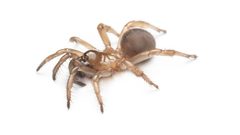
Antrodiaetidae is a small of mygalomorph spiders comprising four and approximately 37 . Members are commonly known as folding-door spiders or folding trapdoor spiders due to their distinctive burrow architecture: they construct silk-lined burrows with hinged, collapsible doors that fold or unfold to seal the entrance. The family is primarily distributed in the western and midwestern United States, with two relict species to Japan. Antrodiaetidae are closely related to Atypidae (atypical tarantulas) and share the characteristic low ability typical of mygalomorph spiders.

Pronunciation
How to pronounce Antrodiaetidae: //ˌæn.trəʊ.daɪˈiː.təˌdiː//
These audio files are automatically generated. While they are not always 100% accurate, they are a good starting point.
Identification
Distinguished from other mygalomorph by the folding (collapsible) burrow door, which differs from the rigid, hinged trapdoors of Ctenizidae and the turret-like structures without doors of some other families. Distinguished from Atypidae (atypical tarantulas) by burrow architecture and geographic distribution. -level identification is challenging due to morphological conservatism; genetic data (COI, 28S, RADseq) are often required to delimit species boundaries. The Antrodiaetus unicolor complex in particular requires integrative taxonomic approaches combining , phylogenomics, and ecological modeling for accurate identification.
Images
Appearance
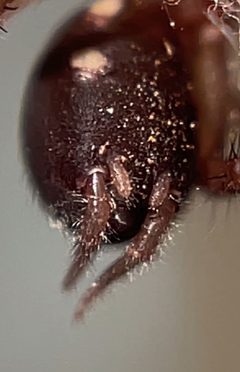
Medium-sized mygalomorph spiders with robust bodies and legs adapted for life. The exhibits morphological conservatism, with many showing minimal morphological differentiation despite substantial genetic divergence. are prominent and oriented parallel to the body axis (orthognath), typical of mygalomorphs. The burrow door, when present, is constructed from silk and soil particles, forming a flexible, hinged structure that collapses inward rather than swinging on a hinge like the rigid doors of some other trapdoor spider families.
Habitat
Mesic woodland and forest . occupy silk-lined burrows in soil, often in areas with suitable moisture and soil composition for burrow construction. The Antrodiaetus unicolor complex in the southern Appalachians is associated with mesic forest habitats linked to Pleistocene climatic refugia. Antrodiaetus riversi is specialized to mesic woodlands of northern and central California.
Distribution
Western and midwestern United States, from California to Washington and eastward to the Appalachian Mountains. Two relict occur in Japan: Antrodiaetus roretzi and Antrodiaetus yesoensis, likely resulting from separate vicariance events. Within California, species show disjunct distributions between the Coast Ranges and Sierra Nevada, separated by the Central Valley biogeographic barrier.
Behavior
Construct and maintain silk-lined burrows with folding doors that seal the entrance. The door is opened by unfolding and closed by folding, providing protection from and environmental extremes. Females are sedentary, remaining in their burrows throughout their lives. Males depart their burrows to search for females, representing the primary phase. Low vagility and strong site fidelity result in pronounced genetic structure.
Ecological Role
As sit-and-wait , they likely contribute to soil regulation. Their burrowing activity may influence soil structure and microhabitat conditions. The extreme subdivision and deep phylogeographic structuring observed in California suggests long-term persistence in localized , potentially serving as indicators of landscape stability and historical habitat continuity.
Human Relevance
Research subjects for studies of speciation, cryptic diversity, and phylogeography due to their low ability and pronounced genetic structuring. The folding-door mechanism and burrow architecture are of interest for understanding spider behavioral evolution. No documented medical or economic significance; venom composition and properties have not been prominently studied in available sources.
Similar Taxa
- Atypidae (atypical tarantulas)Closely related with similar mygalomorph body plan, but differs in burrow architecture and geographic distribution; Atypidae construct silk-lined burrows with a turret-like collar rather than a folding door.
- Ctenizidae (cork-lid trapdoor spiders)Construct trapdoor burrows, but with rigid, hinged doors that swing open rather than folding collapsible doors; also differ in geographic distribution and morphological details.
- EuctenizidaeAnother of trapdoor spiders with superficially similar burrow-dwelling habits, but differing in burrow door mechanism and morphological characters.
More Details
Species delimitation challenges
Antrodiaetidae exemplifies the difficulty of identification based solely on . The Antrodiaetus unicolor complex and A. riversi complex each contain multiple cryptic species that are morphologically indistinguishable but deeply divergent genetically. Integrative approaches combining RADseq data, species distribution modeling, and morphological analysis have been essential for recognizing this hidden diversity.
Biogeographic significance
The has contributed important insights into North American , including the discovery of previously unrecognized trans-valley connections between the California Coast Ranges and Sierra Nevada. The low ability of mygalomorph spiders preserves historical biogeographic signals that are often erased in more mobile .
Taxonomic history
The has undergone recent taxonomic revision, with the number of recognized and increasing as molecular data reveal cryptic lineages. As of January 2026, the family includes four genera (Aliatypus, Antrodiaetus, and two others not explicitly named in sources) and 37 species.
Sources and further reading
- BugGuide
- Wikipedia
- GBIF taxonomy match
- iNaturalist taxon
- NCBI Taxonomy
- Catalogue of Life
- From Students to University Professionals: A Gathering of Arachnologists at UC Davis | Bug Squad
- Jill Oberski: Why Museum Collections Matter | Bug Squad
- Integrative species delimitation reveals cryptic diversity in the southern Appalachian Antrodiaetus unicolor (Araneae: Antrodiaetidae) species complex
- Multilocus genealogies reveal multiple cryptic species and biogeographical complexity in the California turret spiderAntrodiaetus riversi(Mygalomorphae, Antrodiaetidae)
- Crossing the uncrossable: novel trans‐valley biogeographic patterns revealed in the genetic history of low‐dispersal mygalomorph spiders (Antrodiaetidae,Antrodiaetus) from California
- Female genital system of the folding-trapdoor spiderAntrodiaetus unicolor (Hentz, 1842) (Antrodiaetidae, Araneae): Ultrastructural study of form and function with notes on reproductive biology of spiders