
Atypidae
Thorell, 1870
purseweb spiders, atypical tarantulas
Genus Guides
2Atypidae is a of mygalomorph spiders commonly known as purseweb spiders or atypical tarantulas. The family contains only three and represents one of the most archaic spider lineages. Members are obligate burrowers that construct distinctive sock-like, silken tubes extending from underground burrows up vertical surfaces. They are ambush that rarely leave their retreats, instead detecting and capturing prey from within their webs. The family has a disjunct distribution across Eurasia, northern Africa, and North America, with most in the genus Atypus.
Pronunciation
How to pronounce Atypidae: //əˈtɪpɪˌdiː//
These audio files are automatically generated. While they are not always 100% accurate, they are a good starting point.
Identification
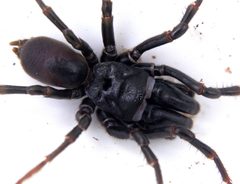
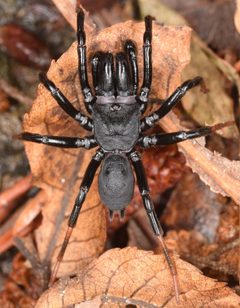
Purseweb spiders are distinguished by their unique web architecture: a silk tube attached vertically to tree bases, fence posts, or walls, extending underground into a burrow. The above-ground portion is often camouflaged with debris such as bark, soil, or plant material. The spiders themselves are rarely seen without excavation. They possess large, forward-directed with prominent fangs typical of mygalomorphs. Males may be distinguished from females by in size and ; males of some develop textures on chelicerae and front legs, presumably a stridulatory apparatus.
Images
Habitat
Found in diverse from deciduous and mixed forests to suburban shrubbery and gardens. Webs are typically constructed at the base of woody vegetation, fences, or walls in areas with suitable soil for burrowing. In central Europe, occupy very narrow environmental with specific soil and vegetation requirements. Soil humidity and physical parameters vary widely across occupied sites.
Distribution
Native range includes Eurasia and northern Africa. The Atypus occurs across this range, with highest diversity in East Asia. A single introduced of Atypus karschi (formerly recognized as A. snetsingeri) is established in southeastern Pennsylvania, USA, representing the first known case of an introduced purseweb spider. GBIF records document presence in Denmark and Sweden.
Seasonality
and nymphs remain active year-round, including during winter months. Activity has been confirmed through frequency data in winter.
Diet
Prey includes millipedes, snails, woodlice, carabid beetles, and earthworms. Prey are captured when they walk upon the external web surface; the spider strikes through the silk from inside the tube, then drags the prey inside to consume.
Life Cycle
Development is slow and extended. In Atypus karschi, males require 3 years from to adulthood with 8-9 after emerging from the maternal web; females require 3-4 years with 9-11 molts. females live 3 or more years with post-adult molts and continued growth. counts in excavated female webs range from 70 to over 200 individuals. Web diameter increases substantially during nymphal development, from approximately 2.3 mm to 13-14 mm, with adult female webs reaching 15.9 mm or larger.
Behavior
Purseweb spiders are highly sedentary, spending nearly their entire lives within their silken retreats. They construct and maintain their distinctive tube webs throughout their lives, with females continuing to enlarge their webs for multiple years. The web serves as both shelter and hunting platform. Spiders detect prey through vibrations on the web surface. They exhibit low capacity, with limited movement between patches.
Ecological Role
As long-lived, sedentary , purseweb spiders function as stable components of soil and litter . Their extended and high suggest they may represent significant in suitable . Their specialized microhabitat requirements make them sensitive indicators of habitat continuity and soil conditions.
Human Relevance
Rarely encountered due to cryptic habits, but occasionally noted in citizen science projects. The introduced Pennsylvania of Atypus karschi has been the focus of sustained citizen-science monitoring ("Map the Spider" initiative). Some are of conservation concern in Europe due to fragmentation and narrow requirements.
Similar Taxa
- SphodrosAlso Atypidae with similar purseweb architecture, but distinguished by distribution (Americas vs. Eurasia/Africa for Atypus) and specific web characteristics
- CalommataThird Atypidae , distinguished by morphological features of genitalia and web structure; less well-known than Atypus
- Other mygalomorph familiesMany are burrowers, but Atypidae are unique in constructing the above-ground silken tube component; other lack this distinctive 'purseweb' structure
Sources and further reading
- BugGuide
- GBIF taxonomy match
- iNaturalist taxon
- NCBI Taxonomy
- Catalogue of Life
- Building a Web of Connection: Spiders, Citizens, and Scientists
- A synopsis of the genus Atypus (Araneae, Atypidae)
- Postembryonic Development and Life Cycle of Atypus karschi DOENITZ (Araneae: Atypidae).
- Distribution and Natural History of Purseweb Spiders, Sphodros spp. (Araneae: Mygalomorphae: Atypidae), in Florida, Georgia, and Alabama
- Conservation genetics of peripheral populations of the mygalomorph spider Atypus affinis (Atypidae) in northern Europe
- Atypus karschi Dönitz, 1887 (Araneae: Atypidae): an Asian purse-web spider established in Pennsylvania, USA
- Habitat selection by threatened burrowing spiders (Araneae: Atypidae, Eresidae) of central Europe: evidence base for conservation management
- New Species of the Purse-Web Spider Genus Atypus Latreille, 1804 from Southern China (Araneae, Atypidae), with the General Natural History of Atypus Spiders.
- Two new species of the purse-web spider genus Atypus Latreille, 1804 from China (Araneae, Atypidae).