
Sphodros
Walckenaer, 1835
purseweb spiders
Species Guides
6- Sphodros abboti(purseweb spider)
- Sphodros atlanticus(Atlantic Purseweb Spider)
- Sphodros fitchi
- Sphodros niger(Black purse-web spider)
- Sphodros paisano
- Sphodros rufipes(Red-legged Purseweb Spider)
Sphodros is a of mygalomorph spiders in the Atypidae, native to North America. The genus was reinstated in 1980 after being treated as a synonym of Atypus for over a century. Seven are recognized, distributed across the United States, Canada, and Mexico. These spiders are known for constructing distinctive purse-shaped webs attached to tree trunks and root systems.
Pronunciation
How to pronounce Sphodros: //ˈsfɒd.rəs//
These audio files are automatically generated. While they are not always 100% accurate, they are a good starting point.
Identification
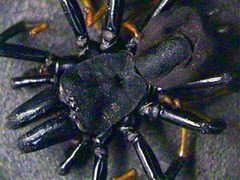
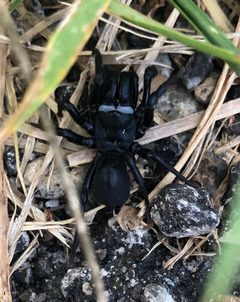
Sphodros possess large, forward-projecting and exhibit dark coloration ranging from black to dark reddish-brown. Legs are relatively short and stubby, colored brown to black. These features distinguish them from other Atypidae, though species-level identification requires examination of genitalia and other morphological details.
Images
Habitat
occupy dry sandy or rocky woodland areas. Pursewebs are constructed at the base of trees and shrubs, with silk tubes attached to trunks and root systems serving as both retreat and prey capture structure.
Distribution
Eastern and central North America, with ranging from Canada through the United States to Mexico. Sphodros niger occurs in the northeastern United States and Canada; S. atlanticus is widespread in the eastern and central United States; S. rufipes is found in the southeastern United States; S. abboti is restricted to southern Georgia and northern Florida; S. coylei occurs in South Carolina and Virginia; S. fitchi ranges through the central United States (Nebraska, Kansas, Oklahoma, Arkansas, Iowa); and S. paisano is found in southeastern Texas and Mexico.
Seasonality
Males wander in search of females during summer months, primarily June through August. Spiderlings disperse during suitable periods via phoretic transport.
Host Associations
- Passalidae - phoretic Spiderlings attach to bess beetles for
Life Cycle
Spiderlings disperse via phoretic attachment to beetles. Males mature and leave their pursewebs to wander in search of females during summer. Females remain within their pursewebs throughout their lives.
Behavior
Constructs purse-shaped silk tubes attached to woody substrates. Spiderlings exhibit phoretic , attaching to beetles for transport. males display wandering behavior during breeding season, leaving their webs to locate females.
Human Relevance
Sphodros niger is ranked as vulnerable in Virginia, reflecting conservation concern for this poorly-documented . The cryptic nature and specificity of these spiders make them difficult to detect, contributing to their status as data-deficient .
Similar Taxa
More Details
Taxonomic history
Originally described by Walckenaer in 1835, Sphodros was treated as a synonym of Atypus until 1980, when Gertsch and Platnick reinstated it as a valid based on distinct morphological characteristics.
Conservation status
Sphodros niger is listed as vulnerable in Virginia. The as a whole is considered poorly-documented, with distribution models for S. niger representing the first predictive efforts for any in the genus.
Sources and further reading
- BugGuide
- Wikipedia
- GBIF taxonomy match
- iNaturalist taxon
- NCBI Taxonomy
- Catalogue of Life
- Distribution and Natural History of Purseweb Spiders, Sphodros spp. (Araneae: Mygalomorphae: Atypidae), in Florida, Georgia, and Alabama
- Predicting the distribution of poorly-documented species, Northern black widow (Latrodectus variolus) and Black purse-web spider (Sphodros niger), using museum specimens and citizen science data