
Atypoides
O. Pickard-Cambridge, 1883
folding trapdoor spiders, California turret spiders
Species Guides
2- Atypoides gertschi
- Atypoides riversi(California Turret Spider)
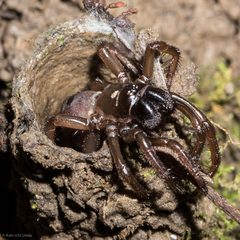
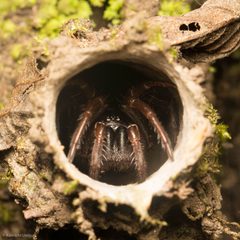
Atypoides is a of mygalomorph spiders in the Antrodiaetidae, to the United States. First described by O. Pickard-Cambridge in 1883, it was synonymized with Antrodiaetus in 2007 but restored to independent status in 2019. The genus includes three as of 2026, most notably Atypoides riversi, commonly known as the California turret spider. These spiders construct distinctive turret-like structures at the entrance of their burrows.
Pronunciation
How to pronounce Atypoides: //əˈtaɪpɔɪˌdiːz//
These audio files are automatically generated. While they are not always 100% accurate, they are a good starting point.
Identification
Distinguished from Antrodiaetus by morphological characters that supported its restoration to generic status in 2019. Atypoides riversi can be identified by its turret-building , constructing a collar-like structure of debris and silk around the burrow entrance. Morphological studies of A. riversi have examined somatic characters including dimensions and leg length to evaluate divergence.
Images
Habitat
Found in northern and central California. of Atypoides riversi occur in multiple parapatric and distributions, suggesting specificity across geographic boundaries.
Distribution
to the United States, specifically documented in northern and central California. The has not been found outside this region.
Behavior
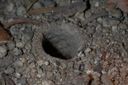
Constructs turret-like structures at burrow entrances using debris and silk. The turret structure is a distinctive behavioral trait of at least Atypoides riversi.
Human Relevance
Subject of phylogeographic and morphological research due to its potential as a . Atypoides riversi serves as a model for studying speciation dynamics and structure in mygalomorph spiders.
Similar Taxa
- AntrodiaetusAtypoides was synonymized with this from 2007 to 2019, and the two share -level characteristics in the Antrodiaetidae. Distinguishing features involve subtle morphological differences that justified generic separation.
- AptostichusBoth are mygalomorph trapdoor spiders in related (Antrodiaetidae and Euctenizidae, respectively), with similar burrow-building but differing in burrow architecture and geographic distribution.
More Details
Taxonomic History
The has undergone significant taxonomic revision. Originally described in 1883, it was synonymized with Antrodiaetus in 2007 based on morphological analysis, then restored to full generic status in 2019 following further study. This history reflects ongoing debate about boundaries in mygalomorph spiders.
Research Significance
Atypoides riversi has been studied extensively for its structure, with research indicating it comprises multiple spatially isolated populations that may represent cryptic . The flightless nature of females (a trait shared with related mygalomorphs) contributes to geographic isolation and potential speciation.