
Aptostichus
Simon, 1891
Species Guides
7- Aptostichus atomarius(San Bernardino hills trapdoor spider)
- Aptostichus chemehuevi(Chemehuevi Desert Trapdoor Spider)
- Aptostichus miwok(Miwok Trapdoor Spider)
- Aptostichus sarlacc(Sarlacc Trapdoor Spider)
- Aptostichus simus(Southern Coastal Dune Trapdoor Spider)
- Aptostichus stanfordianus(Stanford Hills trapdoor spider)
- Aptostichus stephencolberti(Stephen Colbert's Trapdoor Spider)
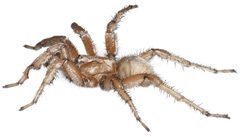
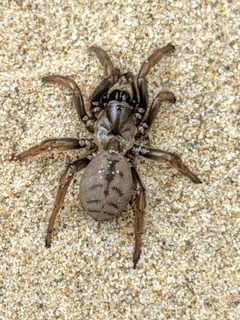
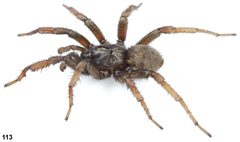
Aptostichus is a of mygalomorph trapdoor spiders in the Euctenizidae, described by Eugène Simon in 1891. The genus contains 41 described distributed primarily in southern California, with some species extending into northern California, Mexico, and the Channel Islands. These spiders are notable for constructing silk-lined burrows with thin wafer-like trapdoors, though unlike some related genera, they do not seal side chambers with additional trapdoors. Several species have been named after prominent figures, reflecting both scientific interest and public engagement in arachnology.
Pronunciation
How to pronounce Aptostichus: //ˌæptəˈstɪkəs//
These audio files are automatically generated. While they are not always 100% accurate, they are a good starting point.
Identification
Aptostichus are distinguished from other Euctenizidae by their burrow architecture: they construct tunnels with side chambers that remain open, lacking the secondary trapdoors found in related such as Promyrmekiaphila. Species-level identification typically requires molecular data due to morphological homogeneity across the genus; cryptic species are common and have been documented using ultraconserved element (UCE) genomic sequencing.
Images
Habitat
Primary include coastal sand dunes, chaparral, coastal sage scrub, oak woodlands, and coniferous forests. The coastal dune Aptostichus simus inhabits primary and secondary dune crests with native vegetation, where vegetation structure and microclimate are relatively stable and flood risk is minimized. Other occupy montane and foothill habitats: A. icenoglei occurs in Transverse Ranges chaparral and coniferous forest, A. barackobamai in northern California mixed redwood and coniferous forests, and A. isabella in southern Sierran foothills.
Distribution
to western North America, with the majority of restricted to California. The ranges from Baja California, Mexico to northern California, with on the Northern California Channel Islands (Santa Rosa Island). Distribution is highly structured geographically, with many species showing narrow and significant population structuring at small spatial due to limited capabilities.
Life Cycle
Long-lived mygalomorph with extended lifespans; the oldest known individual of a related trapdoor spider was documented at 40 years. Limited capabilities, particularly in females, contribute to pronounced genetic structuring. Juveniles, females, and males have been documented in studies.
Behavior
Constructs silk-lined subterranean burrows with thin wafer trapdoors composed of silk and surrounding substrate, often camouflaged with sand or plant material. Burrows include side chambers that are not sealed with additional trapdoors, distinguishing the from related . Extremely sensitive to degradation, particularly in coastal dune systems where habitat specificity is high.
Human Relevance
Subject of extensive research on speciation, phylogeography, and cryptic , particularly by the Bond laboratory at UC Davis. Several named after public figures (Angelina Jolie, Barack Obama, Stephen Colbert, Bono) have generated significant media coverage and public engagement in arachnology. Coastal dune species are of conservation concern due to loss and degradation.
Similar Taxa
- PromyrmekiaphilaAlso constructs wafer trapdoor burrows in California, but differs in sealing side chambers with additional trapdoors; found primarily in the southern San Francisco Bay Area.
- AtypoidesCalifornia turret spiders construct turret-like structures above ground rather than subterranean trapdoors; formerly confused with Aptostichus but now recognized as distinct .
- AntrodiaetusRelated mygalomorph with folding-door burrow architecture; some show similar patterns of cryptic diversity and limited in California.
More Details
Cryptic Species Diversity
Molecular studies using ultraconserved elements (UCEs) have revealed extensive cryptic diversity within Aptostichus. The A. icenoglei complex and A. simus have been shown to contain multiple genetically distinct lineages that are morphologically indistinguishable, with divergence dating to 2-3 million years ago in some cases.
Conservation Concerns
Coastal dune endemics such as A. simus and the newly described A. ramirezae threats from degradation, , and sea level rise. Their extreme habitat specificity and limited make vulnerable to local extinction.
Sources and further reading
- BugGuide
- Wikipedia
- GBIF taxonomy match
- iNaturalist taxon
- NCBI Taxonomy
- Catalogue of Life
- For the Love of Spiders and Research | Bug Squad
- Name That Spider Species | Bug Squad
- Arachnids: Close Encounters of the Best Kind | Bug Squad
- Congrats to Jason Bond, Executive Associate Dean, UC Davis College of Agricultural and Environmental Sciences | Bug Squad
- From Students to University Professionals: A Gathering of Arachnologists at UC Davis | Bug Squad
- When the Bond Lab Went to Salt Lake City | Bug Squad
- Speciation Pattern and Process in the California Coastal Dune Endemic Trapdoor Spider Aptostichus simus (Mygalomorphae: Euctenizidae) and Description of a New Cryptic Species.
- Phylogeography and cohesion species delimitation of California endemic trapdoor spiders within the Aptostichus icenoglei sibling species complex (Araneae: Mygalomorphae: Euctenizidae).