
Antrodiaetus
Ausserer, 1871
folding trapdoor spiders, turret spiders
Species Guides
7- Antrodiaetus hageni
- Antrodiaetus lincolnianus(Lincoln's folding-door spider)
- Antrodiaetus microunicolor
- Antrodiaetus montanus(Mountain Folding-Door Spider)
- Antrodiaetus pacificus(Pacific Foldingdoor Spider)
- Antrodiaetus pugnax(folding-door spider)
- Antrodiaetus unicolor(folding-door spider)
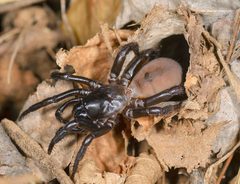
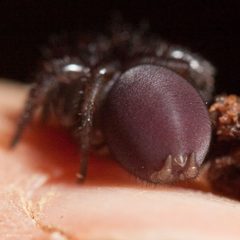
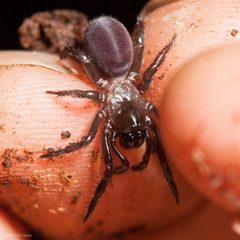
Antrodiaetus is a of mygalomorph spiders in the Antrodiaetidae, first described by Anton Ausserer in 1871. The genus includes found in the United States and Japan, with the name derived from Greek roots meaning 'cave-dwelling.' These spiders are commonly known as folding trapdoor spiders or turret spiders due to their distinctive burrow architecture. Research on Antrodiaetus has been significant in arachnological studies of species delimitation, particularly using molecular approaches to reveal cryptic diversity in morphologically similar .
Pronunciation
How to pronounce Antrodiaetus: /ˌæntrədaɪˈeɪtəs/
These audio files are automatically generated. While they are not always 100% accurate, they are a good starting point.
Images
Distribution
United States and Japan
Behavior
Low-; constructs burrows with turret-like entrance structures (folding trapdoors)
More Details
Etymology
The name Antrodiaetus combines the Greek 'antrodiaitos' (αντροδιαιτος), meaning 'living in caves,' from 'antron' (αντρον), 'cave,' and 'diaita' (διαιτα), 'way of life, dwelling.'
Research significance
Antrodiaetus has served as a model system for studies of cryptic delimitation using integrative approaches combining molecular data (RADseq, 3RAD), , and modeling. The A. unicolor and A. riversi have been particularly important in demonstrating how low- mygalomorph spiders can harbor substantial unrecognized .
Sources and further reading
- BugGuide
- Wikipedia
- GBIF taxonomy match
- iNaturalist taxon
- NCBI Taxonomy
- Catalogue of Life
- From Students to University Professionals: A Gathering of Arachnologists at UC Davis | Bug Squad
- Congrats to UC Davis Doctoral Students Who Study Spiders: AAS Awards | Bug Squad
- Jill Oberski: Why Museum Collections Matter | Bug Squad
- Integrative species delimitation reveals cryptic diversity in the southern Appalachian Antrodiaetus unicolor (Araneae: Antrodiaetidae) species complex
- Multilocus genealogies reveal multiple cryptic species and biogeographical complexity in the California turret spiderAntrodiaetus riversi(Mygalomorphae, Antrodiaetidae)
- Crossing the uncrossable: novel trans‐valley biogeographic patterns revealed in the genetic history of low‐dispersal mygalomorph spiders (Antrodiaetidae,Antrodiaetus) from California