
Ummidia
Thorell, 1875
trapdoor spider
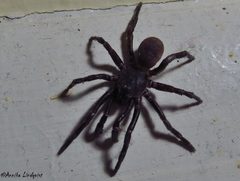
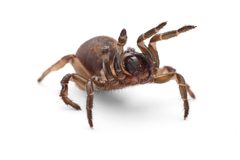
Ummidia is a of mygalomorph trapdoor spiders in the Halonoproctidae, first described by Tamerlan Thorell in 1875. The genus contains approximately 56 with a distribution spanning the Mediterranean region, North and South America, and the Caribbean. Ummidia species construct silk-lined burrows with cork-type trapdoors and are notable for exhibiting ballooning —rare among mygalomorph spiders—which facilitates long-distance to islands. The genus is taxonomically challenging due to cryptic and morphological stasis, with species often distinguished by male palpal and female spermathecal characters.
Pronunciation
How to pronounce Ummidia: /ʊˈmɪdiə/
These audio files are automatically generated. While they are not always 100% accurate, they are a good starting point.
Identification
-level identification relies heavily on male palpal and female spermathecal structure; females are often difficult to identify without associated males or molecular data. The is characterized by the construction of silk-lined burrows with cork-type trapdoors. is present, with males typically possessing more diagnostic morphological characters than females.
Images
Habitat
Constructs silk-lined burrows with cork-type doors, often concealed in leaf litter. Documented from diverse including coastal areas, pine rocklands, mountains, and tropical rainforests. Burrows are cryptic and difficult to locate, contributing to undercollection in field surveys.
Distribution
distribution encompassing the Mediterranean region (Iberian Peninsula, northern Africa), North America (eastern United States west to Arizona), Mexico, Central America, South America (Brazil, Venezuela, Colombia), and the Caribbean (Greater Antilles including Jamaica, Cuba, Hispaniola, St. Vincent, and possibly Bermuda).
Life Cycle
Females are long-lived and remain in their natal burrows for decades if undisturbed. Males mature at 5–7 years of age and emerge to search for females, representing the primary period when individuals are encountered above ground. Young disperse from maternal burrows to construct their own.
Behavior
Exhibits ballooning —rare among mygalomorph spiders—where individuals ascend vegetation and release silk to be carried by wind. This behavior facilitates long-distance over geographic barriers and has enabled of Caribbean islands including volcanic St. Vincent and possibly Bermuda. First documented by Baerg (1928) and subsequently observed by multiple researchers.
Human Relevance
Several named after cultural figures to increase public engagement with biodiversity, including U. neilgaimani (author Neil Gaiman), U. gabrieli (musician Peter Gabriel), and U. brandicarlileae (singer-songwriter Brandi Carlile). The Pine Rockland trapdoor spider (U. pines) is named after its critically endangered Florida , highlighting conservation concerns. Research on Ummidia has emphasized the importance of natural history collections for documenting undocumented biodiversity.
Sources and further reading
- BugGuide
- Wikipedia
- GBIF taxonomy match
- iNaturalist taxon
- NCBI Taxonomy
- Catalogue of Life
- Congrats to UC Davis Doctoral Students Who Study Spiders: AAS Awards | Bug Squad
- Trapdoor spiders named after Neil Gaiman, Peter Gabriel and Brandi Carlile among 33 new to science species | Blog
- Four new tarantula species from Colombian biodiversity hotspot
- Ummidia insularis new species, first record of the family Halonoproctidae (Araneae: Mygalomorphae) for Hispaniola
- Taxonomic revision of the New World members of the trapdoor spider genus Ummidia Thorell (Araneae, Mygalomorphae, Halonoproctidae)
- Uncovering the role of the Western Mediterranean tectonics in shaping the diversity and distribution of the trap‐door spider genus Ummidia (Araneae, Ctenizidae)