
Aliatypus
Smith, 1908
Species Guides
3- Aliatypus californicus(California folding-door spider)
- Aliatypus coylei
- Aliatypus gulosus
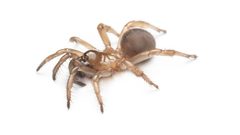
Aliatypus is a of North American folding trapdoor spiders in the Antrodiaetidae. First described by C.P. Smith in 1908, these spiders are most closely related to Antrodiaetus, though they have convergently evolved trapdoor-building similar to Ctenizidae. They are notable for building wafer-like trapdoor burrows in hot, dry where their collar-door relatives cannot survive. The genus contains fourteen as of 2026, with distributions concentrated in the western United States, particularly California. Their sedentary lifestyle and limited make them valuable subjects for biogeographic studies.


Pronunciation
How to pronounce Aliatypus: //əˈlaɪətɪpəs//
These audio files are automatically generated. While they are not always 100% accurate, they are a good starting point.
Identification
Aliatypus can be distinguished from the related Antrodiaetus by its trapdoor burrow construction versus the collar doors built by Antrodiaetus. They resemble members of Ctenizidae in general and , but this similarity is due to rather than close relationship. -level identification within the genus requires detailed examination and has been the subject of molecular phylogenetic studies due to morphological conservation across species.
Images
Habitat
Found in hot, dry conditions where related cannot survive. Burrows are constructed perpendicular to the surface, often in roadside banks or ravines. Burrows are frequently clustered together, sometimes densely in favorable positions.
Distribution
Native to the western United States. are limited to small, isolated regions due to the complex landscape creating pockets of . Particularly abundant in California.
Behavior
Builds burrows with wafer-like trapdoor entrances to capture prey. Burrows are often clustered together, sometimes quite densely in favorable locations. Exhibits a sedentary lifestyle with limited ability.
Human Relevance
Studied for biogeographic research due to sedentary lifestyle and limited , which may benefit understanding of California's . Featured in educational outreach at the Bohart Museum of Entomology, including live specimens and merchandise.
Similar Taxa
- AntrodiaetusMost closely related , distinguished by building collar doors rather than trapdoors
- CtenizidaeSimilar and trapdoor-building , but relationship is convergent rather than direct; -level distinction based on phylogenetic placement in Antrodiaetidae
More Details
Evolutionary significance
The shift from collar doors to trapdoors is hypothesized to have allowed survival in hot, dry conditions where closest relatives could not persist.
Research importance
As one of the most abundant trapdoor spider in California, their limited makes them useful for studying regional and speciation patterns.
Species diversity
Fourteen recognized as of January 2026, with species delimitation complicated by morphological conservation; molecular methods have been employed to resolve species boundaries.