
Aliatypus californicus
(Banks, 1896)
California folding-door spider, California folding trapdoor spider
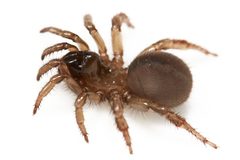
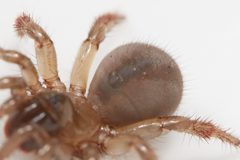
Aliatypus californicus is a of folding-door spider in the Antrodiaetidae. It is found in the United States, specifically in California. The species constructs burrows with a hinged, folding trapdoor made of silk and soil debris. It is one of several species in the Aliatypus studied for its burrow architecture and mygalomorph spider .

Pronunciation
How to pronounce Aliatypus californicus: /ˌæliˈætipəs ˌkælɪˈfɔrnɪkəs/
These audio files are automatically generated. While they are not always 100% accurate, they are a good starting point.
Identification
Aliatypus californicus can be distinguished from other mygalomorph spiders by its burrow structure: a silk-hinged, folding trapdoor that opens flat against the ground rather than being lifted vertically. The spider itself has the robust build typical of Antrodiaetidae, with stout legs and a stocky . -level identification requires examination of genitalia and other morphological features.
Images
Habitat
Found in mesic including coastal and montane areas of California. Constructs burrows in soil, often in areas with sufficient moisture to maintain burrow integrity.
Distribution
United States: California.
Behavior
Constructs and maintains a burrow with a hinged trapdoor made of silk and soil. The door lies flat and is pulled open from below by the spider. Remains in burrow for most of its life, emerging primarily to capture prey that walks near the burrow entrance.
Ecological Role
; likely contributes to soil aeration and nutrient cycling through burrowing activity.
Human Relevance
Featured on educational materials including a glow-in-the-dark T-shirt designed by Francisco Basso and Fran Keller for the Bohart Museum of Entomology. Studied by arachnologists including Jason Bond at UC Davis for and burrow evolution.
Similar Taxa
- Antrodiaetus spp.Also in Antrodiaetidae with folding trapdoors; distinguished by burrow and genital
- Atypoides spp.Related mygalomorphs with different burrow architectures; A. californicus has the diagnostic flat-hinged door of Aliatypus
Sources and further reading
- BugGuide
- Wikipedia
- GBIF taxonomy match
- iNaturalist taxon
- NCBI Taxonomy
- Catalogue of Life
- Got Legs? Eight of Them? | Bug Squad
- Of Butterflies and Hornets and Spiders and Millipedes | Bug Squad
- Encyrtid Holdings | Entomology Research Museum
- California Has No State Bee--Yet! | Bug Squad
- Bohart Museum: Learn about California's State Insect on UC Davis Picnic Day | Bug Squad
- Grasshoppers of Colorado