
Atypoides riversi
O. Pickard-Cambridge, 1883
California Turret Spider, turret spider
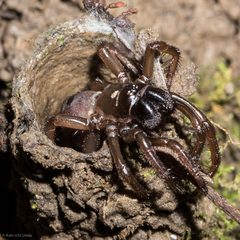
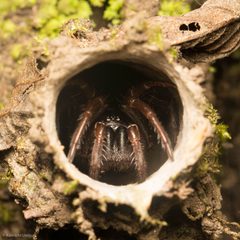
Atypoides riversi, commonly known as the California turret spider, is a medium-sized mygalomorph spider to northern and central California. It constructs distinctive burrows topped with a turret-like structure made of soil, vegetation, and silk. Females are larger than males, with body lengths ranging from 13 to 18 millimeters. Research indicates this represents a , with multiple genetically distinct separated by geographic barriers.
Pronunciation
How to pronounce Atypoides riversi: /əˈtaɪpoʊˌaɪdiz ˈrɪvərsi/
These audio files are automatically generated. While they are not always 100% accurate, they are a good starting point.
Identification
Distinguished from other mygalomorph spiders by its distinctive turret-topped burrow, constructed from soil, vegetation, and silk. The turret structure differs from the cork-like trapdoors of related trapdoor spiders. to California, which helps separate it from other Atypoides with more restricted ranges. Morphological identification requires examination of somatic characters such as dimensions and leg length, with females showing measurable variation across different .
Images
Appearance
Medium-sized mygalomorph spider with body length of 13–18 mm. Females are larger than males. As a mygalomorph, possesses robust with fangs that strike vertically rather than horizontally. Specific coloration and detailed morphological features are not well documented in available sources.
Habitat
Found in terrestrial in northern and central California. Specific microhabitat preferences are not well documented, but burrow construction suggests well-drained soils suitable for excavation.
Distribution
to northern and central California, USA. are separated into multiple parapatric and allopatrically distributed groups, indicating significant geographic structure across the range.
Life Cycle
As a mygalomorph spider, has a relatively long lifespan compared to araneomorph spiders, though specific details are not documented. Females are likely sedentary, remaining in their burrows, while males presumably wander to seek mates.
Behavior
Constructs and occupies a burrow topped with a distinctive turret made of soil, vegetation, and silk. The turret structure is a key behavioral trait. Likely an ambush that waits at the burrow entrance for prey.
Ecological Role
As a burrowing , likely contributes to soil aeration and regulates of ground-dwelling . The nature and population structure make it a subject of interest for studies of California biodiversity and speciation.
Human Relevance
Subject of ongoing research into delimitation and phylogeography. Has been featured in undergraduate research programs and scientific presentations. No documented negative impacts on humans; not known to be medically significant.
Similar Taxa
- Other AntrodiaetidaeRelated trapdoor spiders construct burrows with different door structures (cork-like trapdoors rather than turrets) and occur in different geographic ranges
- Other Atypoides speciesOther in the have more restricted distributions; A. riversi is distinguished by its specific range in northern and central California and its turret construction
More Details
Species Complex Status
Phylogeographic studies indicate Atypoides riversi is separated into multiple genetically distinct , suggesting it represents a rather than a single cohesive . This research is ongoing, with morphological data being evaluated alongside genetic data to assess species boundaries.
Research Significance
The has been used as a model for studying morphological variation and structure in mygalomorph spiders, with research involving principal component analysis of continuous morphological variables from female specimens across different populations.
Sources and further reading
- BugGuide
- Wikipedia
- GBIF taxonomy match
- iNaturalist taxon
- NCBI Taxonomy
- Catalogue of Life
- UC Davis Research Scholars Program in Insect Biology: Meet Kaitai Liu | Bug Squad
- When the Bond Lab Went to Salt Lake City | Bug Squad
- Image by UC Davis Alumnus Ian Wright Appears in ESA World Calendar | Bug Squad
- These Microscopic Parasitic Nematodes or Round Worms Spit Venom | Bug Squad
- When Bruce Hammock's Cockroaches Achieved Stardom | Bug Squad
- Congrats to All the Entomology Award Winners! | Bug Squad