
Phrynus
Lamarck, 1801
whip spiders, tailless whip scorpions
Species Guides
2- Phrynus marginemaculatus(spotted tailless whip scorpion)
- Phrynus operculatus(tailless whipscorpion)
Phrynus is a of whip spiders (order Amblypygi) comprising approximately 40 described , primarily distributed in tropical and subtropical regions of the New World. The genus is characterized by dorsoventrally flattened bodies, extraordinarily elongated antenniform front legs used for sensory detection, and for prey capture. Most species inhabit forested environments where they shelter in crevices, under rocks, or in tree holes during daylight hours and emerge nocturnally to hunt. Several species exhibit notable behavioral complexity including territoriality, , maternal care of offspring, and sophisticated navigational abilities using multisensory cues.
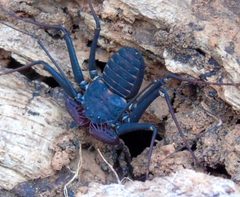
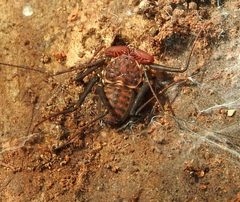
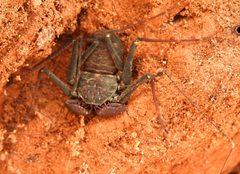
Pronunciation
How to pronounce Phrynus: /ˈfrɪnəs/
These audio files are automatically generated. While they are not always 100% accurate, they are a good starting point.
Identification
The Phrynus is distinguished from other amblypygid genera by the presence of five spines on the tibia, with the middle (third) spine distinctly shorter than the second and fourth. This contrasts with related genera such as Damon, which typically have fewer spines or different spine arrangements. -level identification within Phrynus requires examination of male and female genital , including patterns in female and ornamental structures in males. The genus Paraphrynus, which overlaps geographically in some regions, differs in pedipalp spine configuration and other subtle morphological characters.
Images
Habitat
Primarily tropical and subtropical forests, including rainforest understory, limestone karst formations with caves and cenotes, and coastal scrub. occupy structurally complex microhabitats: rock crevices, cavities beneath bark, hollows in tree trunks, and cave entrances. Some species, notably Phrynus marginemaculatus in southern Florida, inhabit coastal environments where they shelter under coral stones and rocks subject to periodic flooding. Cave-dwelling of Phrynus longipes show behavioral divergence from surface-dwelling conspecifics.
Distribution
New World distribution ranging from the southern United States (southern Florida) through Mexico, Central America, and the Caribbean to northern South America. Mexico harbors the highest . The sole documented exception to this New World distribution is Phrynus exsul from Indonesia, representing an isolated occurrence whose biogeographic origin remains unclear. Within the United States, Phrynus marginemaculatus is restricted to southern Florida and the Florida Keys archipelago.
Seasonality
activity year-round in tropical ; breeding season in at least some concentrated in October–January (documented for Phrynus parvulus in Rica). Seasonal patterns of microhabitat selection occur in subtropical (e.g., Phrynus longipes in Puerto Rico).
Diet
Active feeding on arthropods including crickets, , spiders, and ; larger individuals have been observed to capture small lizards and fish. Prey is detected using the elongated sensory front legs, captured with a rapid strike of the spined , and processed by grinding with digestive added to liquefy tissues for ingestion.
Life Cycle
Development includes stage carried by female, hatching into first-instar nymphs that remain clustered on the mother's , followed by successive through second instar and beyond. First-instar nymphs are soft and pale, often sea-green in color. Females continue to molt and grow throughout life; sexual maturity is reached after multiple instars over approximately 12–15 months in related . Lifespan in captivity can exceed 10 years for .
Behavior
sit-and-wait that ambush prey from sheltered positions. Remarkable navigational abilities: individuals can locate home after displacement of more than 30 feet using multisensory configural learning integrating olfactory and tactile cues. Maternal care includes carrying hatched young on the back for several weeks; in Phrynus marginemaculatus, extended post- interaction occurs with mothers moving between offspring clusters and engaging in mutual leg-stroking. Territoriality documented in Phrynus longipes, with atypical size-symmetric occurring between similar-sized individuals during territory contests. Some show subsocial of kin.
Ecological Role
Predatory controlling of insects and other small ; serves as prey for vertebrate . Contributes to nutrient cycling in forest floor and cave . Population genetic structure in insular (e.g., Florida Keys) indicates sensitivity to habitat fragmentation and potential role as for conservation monitoring.
Human Relevance
Occasionally kept in captivity by arachnid enthusiasts; non-venomous and generally calm around humans despite formidable appearance. Subject of scientific research on sensory systems, navigation, and social . destruction and urban development threaten , particularly in restricted-range such as Phrynus marginemaculatus.
Similar Taxa
- DamonOverlaps in general body plan and usage; distinguished by spine count (typically two spines on in D. diadema versus five tibial spines in Phrynus) and Old World distribution.
- ParaphrynusSympatric in some Central American regions; differs in spine configuration and subtle morphological characters, though field identification requires close examination.
- AcanthophrynusLarger Central and South American amblypygid with greater maximum size (up to 10 inch leg span); distinguished by and less of captive conditions.
Misconceptions
More Details
Sensory Biology
The extraordinarily large mushroom bodies in the brain and giant are hypothesized to support complex integration of multisensory information for navigation and foraging, functionally convergent with vertebrate hippocampal processing.
Conservation Concern
Phrynus marginemaculatus in the Florida Keys exhibits clear genetic structure between island , with highest suitability and genetic isolation in the Lower Keys. Urban development has eliminated most historical habitat; remaining suitable areas are largely restricted to parks and protected areas.
Cave Adaptation
Phrynus longipes in Caribbean caves show behavioral divergence from surface populations, including differences in activity levels, vigilance, and aggression, suggesting incipient cave .
Sources and further reading
- BugGuide
- Wikipedia
- GBIF taxonomy match
- iNaturalist taxon
- NCBI Taxonomy
- Catalogue of Life
- An Arachnid Kind of Day | Bug Squad
- Wicked spines and long legs spell trouble at night for creatures in the rainforest: Whip spider, Paraphrynus spp. — Bug of the Week
- Eight weird and wonderful species to celebrate World Animal Day
- Amblipygi | Beetles In The Bush
- Whips in Xibalba: Whip spiders, Amblypygi — Bug of the Week
- At night in the rainforest: Whip spiders, Amblypygi — Bug of the Week
- Territoriality mediates atypical size‐symmetric cannibalism in the Amblypygi Phrynus longipes
- Four new species of Phrynus, Lamarck (Arachnida: Amblypygi) from Mexico
- CANNIBALISM IN WHIP SPIDERS OF THE GENUS PHRYNUS SP. (ARACHNIDA: AMBLYPYGI) IN PANAMA
- Multisensory Configural Learning of a Home Refuge in the Whip Spider Phrynus marginemaculatus
- Seasonal patterns of microhabitat selection by a sub-tropical whip spider,Phrynus longipes, in the Luquillo Experimental Forest, Puerto Rico
- Relating the unique sensory system of amblypygids to the ecology and behavior ofPhrynus parvulusfrom Costa Rica (Arachnida, Amblypygi)
- Notes on the reproductive biology of Phrynus exsul Harvey, 2002 (Arachnida: Amblypygi: Phrynidae)
- Cave-epigean behavioral variation of the whip spiderPhrynus longipes(Arachnida: Amblypygi) evidenced by activity, vigilance, and aggression
- Cave-epigean behavioral variation of the whip spiderPhrynus longipes(Arachnida: Amblypygi) evidenced by activity, vigilance, and aggression
- Description and First Record ofPhrynus tessellatus(Pocock, 1894) (Arachnida: Amblypygi: Phrynidae) from Northwestern Trinidad, with the Description of Its Mating Behaviour
- Island biogeography and ecological modeling of the amblypygid Phrynus marginemaculatus in the Florida Keys archipelago