
Phryninae
Blanchard, 1852
Genus Guides
2- Paraphrynus(whip spider)
- Phrynus(whip spiders)
Phryninae is a of tailless whip scorpions (order Amblypygi) within the Phrynidae. Members are characterized by elongated, and a flattened body adapted for living in narrow crevices. The subfamily was established by Blanchard in 1852 and contains several distributed primarily in tropical and subtropical regions of the Americas. These arachnids are that rely on their modified first pair of legs as sensory .
Pronunciation
How to pronounce Phryninae: /ˈfrɪnɪniː/
These audio files are automatically generated. While they are not always 100% accurate, they are a good starting point.
Identification
Distinguished from other amblypygi by the combination of: extremely elongated antenniform legs (first pair of legs) with numerous segments; with distinct spination patterns; and specific arrangements of (sensory hairs) on pedipalps. Differs from Charininae by generally larger body size and more robust pedipalp spination. Differs from Charontinae by geographic distribution (Phryninae primarily New World, Charontinae Old World) and subtle differences in pedipalp segment proportions. -level identification requires examination of structure in males and spermathecal in females.
Images
Appearance
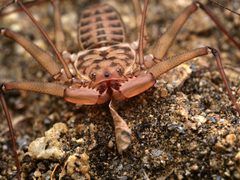
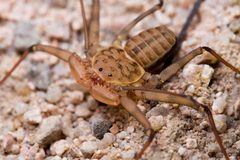
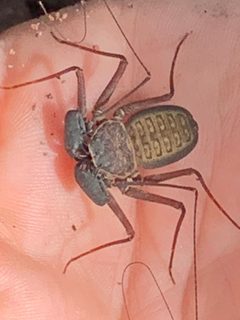
elongated and , armed with spines for capturing prey. First pair of legs modified into extremely long, slender sensory appendages (antenniform legs) that can be several times the body length. Body dorsoventrally flattened, allowing entry into narrow rock crevices and bark fissures. Prosoma () shield-shaped with a distinct ocular bearing . Opisthosoma () segmented and flexible. Size varies by , with leg spans ranging from approximately 10 to 40 cm in some . Coloration generally cryptic: brown, tan, or gray tones matching substrate.
Habitat
Tropical and subtropical forests, savannas, and arid regions. Occupies microhabitats including: rock crevices, cave entrances and twilight zones, under loose bark, within hollow logs, and in leaf litter accumulations. Requires humid microenvironments to prevent desiccation. Often found in limestone karst formations and volcanic rock fields where deep crevices provide daytime .
Distribution
New World distribution: southern United States (Texas, Florida) through Mexico, Central America, Caribbean islands, and South America to northern Argentina. Absent from Chile and most of temperate South America. Greatest diversity in Mexico and Central America.
Diet
Active . Prey includes: insects (crickets, , ), other arthropods (spiders, scorpions, millipedes), and occasionally small vertebrates. Hunting strategy involves ambush from crevice retreats or slow pursuit using antenniform legs for tactile and chemosensory detection of prey. seize and manipulate prey, which is then macerated by and digestive fluids applied externally.
Life Cycle
Development incomplete: hatch into post-embryonic stages () that are carried on the mother's back. Protonymphs into deutonymphs, then tritonymphs, with successive molts increasing size and leg span. Sexual maturity reached after final molt; do not molt further. Females deposit eggs in a secure retreat and guard them until hatching. Maternal care extends through early post-embryonic stages.
Behavior
Strictly ; remains in crevice retreats during daylight hours. Emerges after dark to forage and seek mates. Locomotion: slow, deliberate with antenniform legs extended forward and laterally, tapping substrate for sensory information. Defensive : rapid retreat into crevices; threat display with raised and opened; cannot sting or produce venom. Social behavior generally solitary except during courtship and mating. Courtship involves male depositing and guiding female over it using pedipalps.
Ecological Role
Mesopredator in . Regulates of insects and other small arthropods. Serves as prey for vertebrates including bats, birds, reptiles, and small mammals. Contributes to nutrient cycling through and decomposition of prey remains. for intact cave and karst due to specific microhabitat requirements.
Human Relevance
Occasionally kept in captivity by arachnid enthusiasts; requires specialized humidity and hiding space. Bites are rare and not medically significant; can deliver pinching injury if handled. Subject of scientific research on sensory , particularly mechanoreception and chemoreception via antenniform legs. Some threatened by destruction in cave and karst systems. No commercial or agricultural value.
Similar Taxa
- CharontinaeOverlaps in general amblypygi but distinguished by Old World distribution (Africa, Asia, Australia), generally smaller body size, and subtle differences in segment proportions and trichobothrial patterns.
- CharininaeShares elongated antenniform legs but typically smaller, more gracile build with reduced spination; primarily Old World distribution with some New World representatives.
- PhrynichinaeAnother within Phrynidae; distinguished by differences in tarsal segmentation of legs and male structure; primarily African and Asian distribution.
More Details
Taxonomic history
Blanchard's 1852 establishment of Phryninae predated modern phylogenetic methods; the has been revised multiple times with transferred in and out based on morphological and molecular data. Recent phylogenomic studies support Phryninae as monophyletic with respect to Charontinae.
Sensory biology
Antenniform legs possess thousands of mechanosensory and chemosensory structures; research on Phrynus marginemaculatus and related has established these appendages as model systems for studying sensory .