
Phrynidae
Blanchard, 1852
Phrynid Tailless Whipscorpions, whip spiders, tailless whip scorpions
Subfamily Guides
1Phrynidae is a of amblypygid arachnids found in tropical and subtropical regions of North and South America. The family includes approximately 65 described across five extant : Acanthophrynus, Heterophrynus, Paraphrynus, Phrynus, and the extinct genus †Britopygus. Species occupy diverse including forests, caves, and subterranean environments. All species are . Genetic studies indicate substantial cryptic diversity, with some nominal species likely comprising dozens of distinct lineages.
Pronunciation
How to pronounce Phrynidae: //ˈfrɪnɪˌdiː//
These audio files are automatically generated. While they are not always 100% accurate, they are a good starting point.
Identification
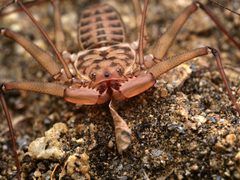
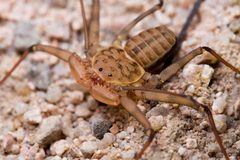
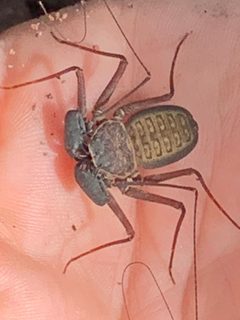
Phrynidae can be distinguished from other amblypygid primarily by and trichobothrial patterns on legs. Members possess the characteristic amblypygid body plan: flattened body, , and elongated first pair of legs modified as sensory "whips." -level identification relies on pedipalp spine counts, trichobothrial counts on leg IV, and male gonopod structure. Secondary spine counts of pedipalps and trichobothrial counts show more variation than previously recognized and should be used cautiously for species delimitation.
Images
Habitat
Tropical and subtropical forests, including both epigean and subterranean environments. Some are exclusively cave-dwelling; others occupy surface . Heterophrynus boterorum occurs in humid Andean forests at elevations of 591–1935 m, where precipitation and temperature (especially during the driest season) strongly influence distribution. Heterophrynus longicornis inhabits ferriferous caves in the Brazilian Amazon. Species generally require humid conditions and climatic stability.
Distribution
North, Central, and South America, strictly in tropical and subtropical regions. Documented from the southwestern United States (Arizona, California) through Mexico, Central America (Guatemala, Honduras), the Caribbean (including numerous oceanic and cave islands), and South America (Colombia, Venezuela, Brazil, Peru, and elsewhere). Heterophrynus armiger recorded from Isla Gorgona, Colombia. Paraphrynus maya known from Guatemala and Honduras.
Diet
Primarily predatory, feeding on arthropods. Heterophrynus longicornis preys mainly on crickets (Phalangopsidae) in Brazilian Amazon caves. Necrophagy on vertebrate carrion has been observed: H. longicornis documented feeding on bat carcasses, and Paraphrynus raptator observed feeding on carrion associated with woolly false vampire bat (Chrotopterus auritus) feeding remains. These represent opportunistic in resource-limited environments, particularly caves.
Behavior
All are strictly . At least some species hold and defend territories from conspecifics. Mating involves complex courtship and transfer; spermatophore varies among species and has taxonomic relevance. Individuals show low vagility and continuous growth throughout life. Heterophrynus longicornis exhibits bold feeding behavior, continuing to feed on carrion despite disturbance from light sources.
Ecological Role
in tropical and subtropical , including as top predators in cave . In ferriferous caves of the Brazilian Amazon, Heterophrynus longicornis is among the main predators. Necrophagic may contribute to nutrient cycling in subterranean environments where trophic resources are scarce.
Human Relevance
Subject of taxonomic research revealing extensive cryptic diversity. Some have restricted distributions with conservation concerns: Heterophrynus boterorum has only one known within a protected area in Colombia. Observed and photographed by naturalists; 15,968 iNaturalist observations recorded for the .
Similar Taxa
More Details
Cryptic diversity
Molecular studies indicate massive underestimation of . The 12 named Caribbean Phrynus and Paraphrynus may harbor 66–114+ cryptic species, with most putative species restricted to single localities or small cave systems. Geographic isolation on islands and in caves promotes deep mtDNA divergence (up to 19% uncorrected between morphological species).
Taxonomic instability
Paraphrynus appears with respect to Phrynus based on molecular data. Historical "forms" of Paraphrynus mexicanus were split into multiple , and P. carolynae was subsequently found to comprise at least two species. Conservative has hindered species delimitation.
Fossil record
Includes †Britopygus from the Early Cretaceous (Aptian) Crato Formation, Brazil, and †Electrophrynus from Miocene Chiapas amber, Mexico (the latter considered ).
Sources and further reading
- BugGuide
- Wikipedia
- GBIF taxonomy match
- iNaturalist taxon
- NCBI Taxonomy
- Catalogue of Life
- MICROHABITAT USE BY THE WHIP SPIDER HETEROPHRYNUS LONGICORNIS (AMBLYPYGI, PHRYNIDAE) IN CENTRAL AMAZON
- Notes on the reproductive biology of Phrynus exsul Harvey, 2002 (Arachnida: Amblypygi: Phrynidae)
- Ecological niche modeling in a whip spider, Heterophrynus boterorum (Phrynidae), from the Colombian Central Andes
- Mating behaviour and spermatophore morphology of four Cuban whip spiders (Arachnida, Amblypygi, Phrynidae) – Taxonomic relevance and evolutionary trends
- Description and First Record ofPhrynus tessellatus(Pocock, 1894) (Arachnida: Amblypygi: Phrynidae) from Northwestern Trinidad, with the Description of Its Mating Behaviour
- Two new species of <i>Heterophrynus</i> Pocock, 1894 from Colombia with distribution notes and a new synonymy (Arachnida: Amblypygi: Phrynidae)
- The true identity and distribution of Paraphrynus maya (Amblypygi: Phrynidae), with the first record from Honduras
- Heterophrynus armiger Pocock, 1902 (Amblypygi: Phrynidae): First record from Colombia, with notes on its historic distribution records and natural history
- Bat necrophagy by a whip-spider (Arachnida, Amblypygi, Phrynidae) in a cave in the eastern Brazilian Amazon
- Arachnids that feed on vertebrate carrion: necrophagy by the whip spider Paraphrynus raptator (Amblypygi: Phrynidae) and its relation to the feeding behavior of the woolly false vampire bat Chrotopterus auritus (Chiroptera: Phyllostomidae).
- Deep mtDNA Sequence Divergences and Possible Species Radiation of Whip Spiders (Arachnida, Amblypygi, Phrynidae, Phrynus/Paraphrynus) among Caribbean Oceanic and Cave Islands
- Integrative Systematics Reveals Cryptic Diversity in Paraphrynus Whip Spiders (Amblypygi: Phrynidae) from Southwestern North America