
Paraphrynus carolynae
Armas, 2012
tailless whip scorpion, whip spider
Paraphrynus carolynae is a of tailless whip scorpion (order Amblypygi) native to Mexico, described in 2012 by de Armas. The specific epithet honors arachnologist Carolyn L. Mullinex. It is one of several cryptic species recently distinguished from the former Paraphrynus mexicanus complex through integrative . In 2025, the northernmost formerly assigned to this species (Arizona and California) was described as a separate species, Paraphrynus tokdod.
Pronunciation
How to pronounce Paraphrynus carolynae: //ˌpæɹəˈfrɪnəs kæˈɹoʊlɪniː//
These audio files are automatically generated. While they are not always 100% accurate, they are a good starting point.
Identification
Distinguished from by morphological characters including secondary spine counts on and trichobothrial counts on leg IV, though these characters show more variation than previously recognized and should be used with caution. The was separated from Paraphrynus mexicanus based on morphological differences, and the northern (now Paraphrynus tokdod) was distinguished through molecular and novel morphological characters. Smaller than many tropical whip spiders; body length under 20 mm distinguishes it from larger Phrynus species.
Images
Appearance
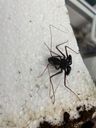
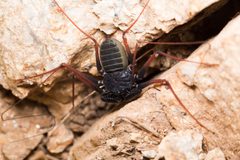
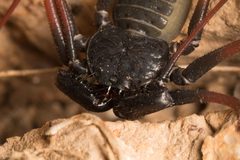
Total body length 13–20 mm. Overall coloration reddish-brown with darkened . Possesses three pairs of legs; the fourth pair modified into extremely long, thin, whip-like antenniform legs bearing sensory structures for detecting odors, objects, mates, and prey. These whips can be 3–6 times the body length and move in an almost complete circle. bear hinged, spiny appendages used to capture prey.
Habitat
Tropical and subtropical forest environments. , resting on tree trunks during the day. Specific microhabitat preferences not well documented.
Distribution
Mexico: recorded from Sonora, Michoacán, and Morelos. Formerly thought to range into Arizona and California, but these are now assigned to Paraphrynus tokdod.
Diet
Smaller arthropods detected using antenniform legs. Observed prey includes crickets, , spiders, and ; small lizards and fish have been recorded for the .
Life Cycle
Females lay 10–90 . Young hatch and are carried on the mother's back for several weeks. In captivity, females of related continue interacting with offspring for months after they leave the back, including mutual stroking with whip-like legs.
Behavior
sit-and-wait . Uses elongated antenniform legs to detect prey, mates, and danger in complete darkness. strike rapidly to capture prey, ensnaring victims in comb-like spines. Exhibits strong homing ability; some individuals can locate their after displacement of more than 30 feet. Extremely rapid escape response when disturbed.
Ecological Role
of small arthropods in forest . Specific ecological role not well studied.
Human Relevance
Harmless to humans despite fearsome appearance. Subject of scientific research on arachnid sensory systems, navigation, and social .
Similar Taxa
- Paraphrynus tokdodDescribed in 2025 from formerly assigned to P. carolynae in Arizona and California; distinguished by molecular and morphological data
- Paraphrynus mexicanusFormerly included now assigned to P. carolynae; separated by morphological differences in 2012
- Phrynus marginemaculatusSimilar body plan and ; Florida used as model for maternal care studies in captivity, but larger and geographically distinct
More Details
Taxonomic history
Originally part of Paraphrynus mexicanus; separated by de Armas (2012) based on morphological differences. Further split in 2025 when integrative ( + molecular data) revealed the northern represented a distinct , Paraphrynus tokdod.
Etymology
The specific epithet carolynae honors Carolyn L. Mullinex, an arachnologist.
Sources and further reading
- BugGuide
- Wikipedia
- GBIF taxonomy match
- iNaturalist taxon
- NCBI Taxonomy
- Catalogue of Life
- Wicked spines and long legs spell trouble at night for creatures in the rainforest: Whip spider, Paraphrynus spp. — Bug of the Week
- Archive — Bug of the Week
- Integrative Systematics Reveals Cryptic Diversity in Paraphrynus Whip Spiders (Amblypygi: Phrynidae) from Southwestern North America