
Phrynus marginemaculatus
C.L. Koch, 1840
spotted tailless whip scorpion, Florida tailless whipscorpion
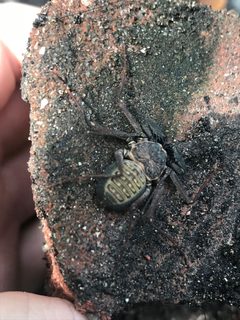
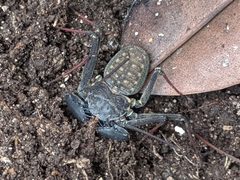
Phrynus marginemaculatus is an amblypygid arachnid native to southern Florida, the Bahamas, Cuba, and Hispaniola. It is the only amblypygid in the US east of the Mississippi River and the most commonly studied whip spider species. This possesses extraordinarily elongated first pair of legs adapted as sensory organs for detecting prey, mates, and environmental features in darkness. The species exhibits complex navigational abilities including multisensory configural learning for shelter recognition, and has evolved a enabling underwater breathing for up to 24 hours.
Pronunciation
How to pronounce Phrynus marginemaculatus: //ˈfrɪnəs ˌmɑːrdʒɪnɪˌmækjuˈleɪtəs//
These audio files are automatically generated. While they are not always 100% accurate, they are a good starting point.
Identification
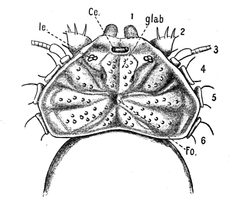
Distinguished from true scorpions by absence of tail and stinger; from spiders by use of only six legs for with first pair modified as sensory whips rather than walking legs; from other amblypygids by geographic range (only amblypygid in eastern US) and spotted body pattern. The extraordinarily long, thin front legs (antenniform legs) that can move in nearly complete circle around body are diagnostic of amblypygids generally.
Images
Habitat
Upland including pine rockland and hammock (rockland) formations; hides under debris, especially limestone rocks, during daylight hours. Not found in intertidal habitats such as mangrove swamps or floodplains. In Florida Keys, highest habitat suitability occurs in Lower Keys. Suitable habitat is limited and threatened by urban development; remaining pockets tend to occur in parks and protected areas.
Distribution
Southern Florida (mainland and Florida Keys archipelago), the Bahamas, Cuba, Jamaica, and Hispaniola. Historical records indicate presence as far north as Martin County, Florida, though recent records from this area are absent. Clear genetic structure between localities with Lower Keys genetically isolated from other regions.
Seasonality
Nocturnally active; hides in retreats during daylight hours. Activity pattern tied to darkness rather than specific seasonal timing.
Diet
Life Cycle
develop in over three-month period; female carries first instars on back for approximately ten days until they . Young reach adulthood in about two years; life expectancy two to three additional years. Females lay 12-20 eggs per brood sac.
Behavior
sit-and-wait . Uses elongated first pair of legs (whips) to detect odors and objects including prey, mates, offspring, and danger; whips can move in almost complete circle around body. Moves sideways using three pairs of legs in crab-like fashion. Exhibits ritualized agonistic displays with stereotyped sequences between opponents. Demonstrates notable navigational abilities including homing after displacement of more than 30 feet from . In captivity, females engage in extended maternal care: after young depart from mother's back, mothers continue to interact with offspring for several months, moving between small clusters of young and engaging in gentle mutual stroking with whip-like legs. Can learn to navigate mazes using tactile cues. Multisensory configural learning demonstrated for shelter recognition: requires paired olfactory and tactile stimuli, failing to recognize shelter when either stimulus presented alone.
Ecological Role
Human Relevance
Non-venomous and harmless to humans despite formidable appearance. Sometimes kept in captivity by arachnid enthusiasts. Subject of extensive behavioral and neurobiological research due to complex navigational and learning abilities. Conservation concern in Florida due to loss from urban development; suitable habitat increasingly restricted to protected areas.
Similar Taxa
- Phrynus whiteiAnother Phrynus found in Central America (Honduras); similar and , but distinguished by geographic range and specific pattern differences
- true scorpions (order Scorpiones)Superficially similar arachnid with pincers, but possess segmented tail with stinger and use all four leg pairs for
- spiders (order Araneae)Use all eight legs for rather than modifying first pair as sensory organs; lack spined for prey capture
Misconceptions
Despite 'whip scorpion' and 'tailless whip scorpion,' this is not closely related to true scorpions and lacks venom entirely. The name refers only to superficial resemblance in body form and shape.
Sources and further reading
- BugGuide
- Wikipedia
- GBIF taxonomy match
- iNaturalist taxon
- NCBI Taxonomy
- Catalogue of Life
- An Arachnid Kind of Day | Bug Squad
- Wicked spines and long legs spell trouble at night for creatures in the rainforest: Whip spider, Paraphrynus spp. — Bug of the Week
- Whips in Xibalba: Whip spiders, Amblypygi — Bug of the Week
- At night in the rainforest: Whip spiders, Amblypygi — Bug of the Week
- At night in the rainforest with scary whip spiders: Amblypygids — Bug of the Week
- Eight weird and wonderful species to celebrate World Animal Day
- Multisensory Configural Learning of a Home Refuge in the Whip Spider Phrynus marginemaculatus
- Island biogeography and ecological modeling of the amblypygid Phrynus marginemaculatus in the Florida Keys archipelago
- Multisensory integration supports configural learning of a home refuge in the whip spider Phrynus marginemaculatus