
Paraphrynus
Moreno, 1940
whip spider, tailless whip scorpion
Species Guides
1- Paraphrynus carolynae(tailless whip scorpion)
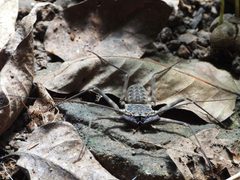
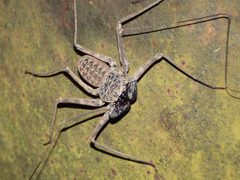
Paraphrynus is a of whip spiders (order Amblypygi) in the Phrynidae, distributed from the southwestern United States through Central America and the Caribbean. Most are to Mexico. These arachnids are characterized by extraordinarily long, sensory front legs (antenniform legs) used for navigation and prey detection, and spiny for capturing prey. Research has demonstrated remarkable homing abilities in some species, with individuals navigating back to from distances exceeding 10 meters using primarily olfactory cues detected by their antenniform legs rather than vision.
Pronunciation
How to pronounce Paraphrynus: /pærəˈfrɪnəs/
These audio files are automatically generated. While they are not always 100% accurate, they are a good starting point.
Identification
Paraphrynus is distinguished from the closely related Phrynus by the spine pattern on the tibia: Paraphrynus has two short spines between the two longest spines, whereas Phrynus has only one. The genus lacks the spines in the frontal region of the that characterize Acanthophrynus. The antenniform (whip-like) first pair of legs are three to six times the body length and bear sensory structures for detecting odors and objects. The pedipalps are with comb-like spines for grasping prey. Body length ranges approximately 3–11 mm.
Images
Habitat
Moist microenvironments in tropical and subtropical regions. Some are troglophiles (cave-dwelling but not obligate), while others are true troglobites (obligate cave-dwellers). Epigean species occupy forest , where they rest on tree trunks and vertical surfaces during the day in , emerging at night to hunt.
Distribution
Southwestern United States (Arizona, California) through Mexico and Central America to the Caribbean islands. Most are to Mexico. Specific records include Guatemala, Honduras, Belize, Rica, and various Caribbean islands.
Seasonality
activity year-round in tropical ; activity patterns tied to darkness rather than season.
Diet
Behavior
sit-and-wait that use antenniform legs to detect prey, mates, and danger. The antenniform legs can sweep in an almost complete circle, providing 360-degree sensory coverage. When prey enters range, a rapid strike of the spiny ensnares the victim. Females carry 10–90 and transport hatched young on their backs for several weeks. In captivity, mothers and offspring engage in mutual stroking with antenniform legs for months after young leave the back. Remarkable homing ability: displaced individuals can navigate back to from over 10 meters away without visual cues, using olfactory input from antenniform leg tips. When threatened, individuals exhibit rapid escape locomotion.
Ecological Role
controlling of insects and other arthropods in tropical forest and cave . Some serve as prey for vertebrates including bats.
Human Relevance
Harmless to humans despite formidable appearance. Subject of scientific research on navigation and sensory . Occasionally encountered by ecotourists and researchers during nighttime rainforest excursions.
Similar Taxa
- PhrynusClosely related in Phrynidae; distinguished by tibia spine pattern (one spine between longest spines vs. two in Paraphrynus)
- AcanthophrynusPhrynidae distinguished by presence of spines in frontal region of , absent in Paraphrynus
- HeterophrynusRemaining member of Phrynidae; not sympatric with Paraphrynus
Sources and further reading
- BugGuide
- Wikipedia
- GBIF taxonomy match
- iNaturalist taxon
- NCBI Taxonomy
- Catalogue of Life
- Wicked spines and long legs spell trouble at night for creatures in the rainforest: Whip spider, Paraphrynus spp. — Bug of the Week
- Archive — Bug of the Week
- Microhabitat use in the amblypygid Paraphrynus laevifrons
- Integrative Systematics Reveals Cryptic Diversity in Paraphrynus Whip Spiders (Amblypygi: Phrynidae) from Southwestern North America
- The true identity and distribution of Paraphrynus maya (Amblypygi: Phrynidae), with the first record from Honduras
- Importance of the antenniform legs, but not vision, for homing by the neotropical whip spider,Paraphrynus laevifrons
- Deep mtDNA Sequence Divergences and Possible Species Radiation of Whip Spiders (Arachnida, Amblypygi, Phrynidae, Phrynus/Paraphrynus) among Caribbean Oceanic and Cave Islands
- Arachnids that feed on vertebrate carrion: necrophagy by the whip spider Paraphrynus raptator (Amblypygi: Phrynidae) and its relation to the feeding behavior of the woolly false vampire bat Chrotopterus auritus (Chiroptera: Phyllostomidae).