
Labiduridae
Verhoeff, 1902
striped earwigs
Genus Guides
1- Labidura(striped earwigs)
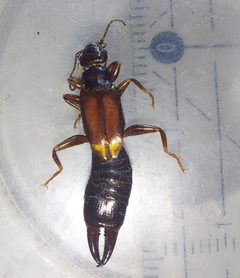
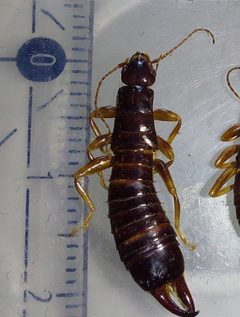
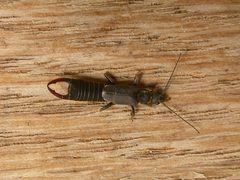
is a of commonly known as striped earwigs, containing approximately 72 across seven in three . Members are moderate to large in size with cylindrical bodies, well-developed wings, and notably long . The family exhibits distribution and includes well-known species such as Labidura riparia (tawny earwig) and Nala lividipes. Many species display subsocial maternal care and predatory habits, with some serving as agents of agricultural pests.
Pronunciation
How to pronounce Labiduridae: //læbɪˈdʊərɪdeɪ//
These audio files are automatically generated. While they are not always 100% accurate, they are a good starting point.
Identification
Distinguished from other by the combination of cylindrical body shape, well-developed wings, and especially long . Males possess two (right and left), a characteristic shared with Diplatyidae, Pigidicranidae, Anisolabididae, and , but differing from single-penis families (Spongipohridae, Chelisochidae, Forficulidae). Forceps and male genitalia structure provide -level diagnostic characters, particularly in Nala.
Images
Habitat
Diverse including riparian zones, coastal and inland dunes, sandy areas, and agricultural fields. Labidura riparia is specifically associated with riparian and moist environments near water bodies. Some colonize secondary habitats such as open cast lignite mines, sand pits, and military training areas. Nala lividipes occurs in cornfields. Primary habitats for some species include xerothermophilous and psammophilous environments.
Distribution
distribution with found worldwide. Documented occurrences include: North America (Louisiana, Colorado), Europe (Germany, Sweden, Denmark), Asia (Israel, India, Nepal, Myanmar, China, Philippines), South America (Brazil, Colombia), and Australia. Two extinct species described from Cretaceous Burmese amber (Myanmar).
Seasonality
Activity patterns vary by and climate. Labidura riparia and related species show temperature-dependent development: incubation 6-22 days at 18-34°C, nymphal development 30-280 days depending on temperature. In seasonal climates, egg-laying ceases in winter and resumes in spring; some species produce multiple annually (up to 4 generations in warm conditions), with final generation as nymphs.
Diet
Predominantly predatory. Labidura riparia preys on and larvae of insects such as (cotton leaf worm). Nala lividipes preys on Ostrinia furnacalis (Asian corn borer). Anisolabis (Euborellia) annulipes feeds on peanut pods, causing agricultural damage. Some show under starvation conditions.
Host Associations
- Spodoptera littoralis - preyCotton leaf worm; and larvae consumed by Labidura riparia
- Ostrinia furnacalis - preyAsian corn borer; prey of Nala lividipes
- Arachis hypogaea - food plantPeanut; pods damaged by Anisolabis (Euborellia) annulipes in Israel
Life Cycle
Hemimetabolous development with and nymphal stages. Females lay 50-150 eggs (rarely up to 250). Egg temperature-dependent: 5.9-9.9 days at 22-34°C for Labidura riparia; 6-22 days at 18-34°C for Anisolabis annulipes. Four nymphal instars observed in some (duration 10, 10, 16, 16 days at 28-30°C). Development threshold approximately 12.5-16.2°C. Nymphs leave maternal nest 2-5 days after hatching. lifespan 50-320 days depending on temperature.
Behavior
Subsocial maternal care is well-documented: females guard throughout incubation, bring food to newly hatched nymphs in tunnels, and defend offspring against conspecifics. Females recognize their own chambers through individual-specific but cannot distinguish own from offspring. Mating occurs in shallow tunnels or on soil surface. Tunnelling observed in soil. Labidura riparia males exhibit 'right-handedness' in use during copulation, predominantly using the right penis despite both being functional. occurs primarily under starvation conditions, more frequent when sexes are separated than when mixed. Both sexes climb vegetation (observed up to 35 cm on cotton plants) to forage.
Ecological Role
of agricultural pest insects, particularly lepidopteran and larvae. Labidura riparia and Nala lividipes function as agents. Some can be agricultural pests (Anisolabis annulipes damaging peanuts). Role in soil through tunnelling activities. Prey for other organisms not documented.
Human Relevance
Mixed economic impact: beneficial as of cotton leaf worm and Asian corn borer, potentially valuable for ; detrimental when damaging peanut crops. Subject of entomological research due to subsocial , genital asymmetry, and maternal care. Some colonize disturbed secondary , indicating to anthropogenic landscape modification.
Similar Taxa
- AnisolabididaeBoth have males with two ; distinguished by body shape ( more cylindrical) and length (Labiduridae with especially long antennae)
- ForficulidaeCommon earwig ; distinguished by Forficulidae having single in males versus two penises in , and generally different body proportions
- ChelisochidaeAnother with single in males; distinguished by two penises and more elongate, cylindrical form
More Details
Genital asymmetry
Labidura riparia exhibits behavioral asymmetry in use: males predominantly use the right penis for insemination despite no detectable morphological difference between right and left penises. This 'right-handedness' develops without mating experience and is manifested in resting postures. Surgical ablation of the right penis does not impair insemination capacity, indicating the left penis functions as a spare. This behavioral asymmetry may represent an evolutionary precursor to the degeneration of the left penis observed in single-penis .
Fossil record
documented from Cretaceous amber: Myrrholabia and Zigrasolabis from Cenomanian-aged Burmese amber (approximately 100 million years old). Additional fossil include Caririlabia from Aptian Crato Formation (Brazil) and Labiduromma from Eocene Florissant (Colorado).
Genetic structure
Studies of Labidura riparia in Germany show higher genetic variation in secondary (post-mining, military training) than in primary dune habitats. Secondary habitat represent admixtures from multiple inland dune source populations, suggesting multiple events and hybridization.
Sources and further reading
- BugGuide
- Wikipedia
- GBIF taxonomy match
- iNaturalist taxon
- NCBI Taxonomy
- Catalogue of Life
- Biology of the Predaceous Earwig Labidura riparia (Dermaptera: Labiduridae)1,2
- Ecology and Control of the Striped Earwig, Labidura Riparia, (Labiduridae: Dermptera) in Louisiana.
- Biology of Two Species of Predatory Earwigs Nala lividipes (Dufour) (Dermaptera: Labiduridae) and Euborellia (Euborellia) annulata (Fabricius) (Dermaptera: Carcinophoridae)
- New records of two riparian species of Labiduridae (Insecta, Dermaptera) from Guizhou Province, China
- Taxonomy of the genus <i>Nala Zacher</i>, 1910 (Dermaptera: Labiduridae) from India
- Maternal Behaviour and Nest Recognition in the Subsocial Earwig Labidura riparia Pallas (Dermaptera: Labiduridae)
- Right‐handed penises of the earwig Labidura riparia (Insecta, Dermaptera, Labiduridae): Evolutionary relationships between structural and behavioral asymmetries
- Life History Characteristics of Ringlegged Earwig (Dermaptera: Labiduridae): Emphasis on Ovarian Development
- Colonisation of secondary habitats in mining sites by Labidura riparia (Dermaptera: Labiduridae) from multiple natural source populations
- Studies on the behaviour and biology of the earwig Labidura riparia Pallas (Derm., Labiduridae)
- Bionomics and Ecology of the Earwig Anisolabis (Euborellia) annulipes Luc. (Labiduridae‐Dermaptera) in Israel1