
Forficula auricularia
Linnaeus, 1758
European earwig, common earwig
is an native to Europe, western Asia, and North Africa, now across North America, Australia, and New Zealand. It is recognized by forceps-like —curved in males, straight in females—and concealed hindwings that unfold to resemble human ears, inspiring both its and specific epithet. The exhibits extended maternal care, with females guarding and nymphs in underground nests. vary geographically: temperate typically produce one annually, while warmer regions may support two broods.
Pronunciation
How to pronounce Forficula auricularia: /fɔrˈfɪk.jʊ.lə ɔːˌrɪk.jʊˈlɛə.rɪə/
These audio files are automatically generated. While they are not always 100% accurate, they are a good starting point.
Identification
Distinguished from other earwigs by: (1) second tarsal segment lobed and extending below third segment; (2) male strongly curved with basal broadening and crenulate teeth versus straight female cerci; (3) 11–14 segmented ; (4) chemistry (2-methyl-1,4-benzoquinone). In North America, distinguished from native earwigs by its larger size and more robust male forceps. Note: F. auricularia is now recognized as a including F. dentata, F. mediterranea, and F. aeolica, which are morphologically indistinguishable but genetically distinct and reproductively isolated.
Images
Appearance
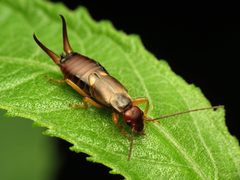
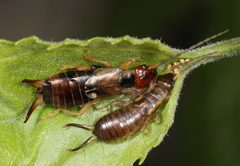
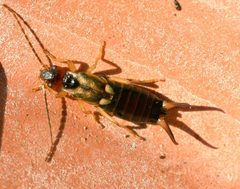
Reddish-brown, flattened elongated body approximately 12–15 mm long. Shield-shaped pronotum covers the . Two pairs of wings: hardened forewings () protect delicate, fan-shaped hindwings that fold beneath. slender, 11–14 segmented. Prominent (forceps) at tip—large, curved, and robust in males with crenulate teeth; straight, slender, and less robust in females, approximately 3 mm long. Second tarsal segment lobed, extending distally below third segment. Nymphs resemble but lighter in color with reduced or absent wings.
Habitat
Cool, moist microhabitats with mean temperatures around 24°C. Occupies soil crevices, bark cracks, mulch, hollow flower stems, and protected plant parts such as dried curled leaves. In agricultural settings, shelters under trunk wraps and cardboard guards on young trees. Prefers well-drained slopes, southern exposures to avoid excessive moisture. Aggregates in dark, humid daytime shelters at densities of 50–100 individuals per square meter. Hibernates approximately 5 mm below soil surface.
Distribution
Native to Europe, western Asia, and North Africa. Introduced to North America (early 20th century, now widespread except far southeastern states), New Zealand (European settlers), and Australia (present >170 years, expanding in grain-growing regions). Occurs in temperate to semi-arid climates with high winter rainfall and pronounced temperature seasonality. Human influence strongly correlates with distribution limits in invaded ranges.
Seasonality
Primarily year-round. In temperate regions: active May–November in tree shelters; immatures October–June in ground shelters. One annually in cold continental climates; two broods in warmer regions. Mating peaks August–September. Hibernation occurs in adult or nymphal stages depending on climate. Mediterranean show different with nymphs hibernating rather than adults.
Diet
, functioning as and scavenger. Consumes living and dead plant material (flowers, green foliage, seedlings, soft fruits), small insects (aphids, spiders, insect ), and dead insects. Documented feeding on: common hedge mustard (Sisymbrium officinale), white clover (Trifolium repens), dahlia (Dahlia variabilis), molasses, lichens, . Prefers meat or sugar to natural plant material when available. consume more insects than nymphs; nymphs feed more heavily on plant material. Practices , consuming maternal and sibling .
Host Associations
- damson-hop aphid (Phorodon humuli) - prey
- apple aphid - prey
- woolly apple aphid (Eriosoma lanigerum) - preySignificant agent in apple orchards
- green apple aphid (Aphis pomi) - prey
- pear psyllid - prey
- azalea lace bug - preyObserved consuming nymphs
Life Cycle
Hemimetabolous development with four nymphal instars. Females lay ~50 pale yellow to cream-colored elliptical in underground autumn nests. Extended maternal care: female guards eggs, cleans them with mouthparts and forceps to remove fungal spores, applies cuticular hydrocarbons for chemical protection, and relocates clutch under stress. Eggs hatch in spring; mother continues care through first instar, providing protection, , food, and temperature regulation. Nymphs remain in nest until after first moult, then accompany mother on foraging excursions. maintained through maternal care period (~1 month to maturity). Two distinct phases: nesting phase (family units with maternal care) and free-foraging phase (nymphs independent, may produce second in favorable conditions).
Behavior
forager, shelter-seeker. Aggregates in groups of 50–100 individuals per square meter using (2-methyl-1,4-benzoquinone/toluquinone from and tibial glands), with stage-specific components attracting different age classes. Courtship involves mutual tactile stimulation: males wave or bob , stroke and encircle female body with forceps; females respond with arching, bobbing, twisting. Copulation occurs with male and female facing opposite directions, surfaces in contact, pairs remaining joined for hours. Females feed during copulation. occurs through three mechanisms: inter- dispersal by females, nymphal dispersal associated with heightened locomotory activity (
Ecological Role
contributing to of agricultural pests, particularly aphids in orchards. Documented suppression of woolly apple aphid and green apple aphid . Also functions as and scavenger. facilitates transfer of beneficial gut bacteria and serves as food source. possess antimicrobial properties protecting nest from . In high densities, can become pest causing damage to seedlings, soft fruits, flowers, and corn silks. influenced by climate suitability and human activity.
Human Relevance
Agricultural impact: pest of seedlings, soft fruits (strawberries, raspberries, blackberries, stone fruits), sweet corn (silks), flowers (dahlias, zinnias, marigolds, carnations, roses), and potentially citrus; also agent reducing in orchards. Household pest in North America, invading crevices and consuming pantry foods. Control methods include natural enemies (tachinid flies Triarthria setipennis, Ocytata pallipes; fly Bigonicheta spinipenni; fungi Erynia forficulae, Metarhizium anisopliae; Mermis nigrescens; birds), physical traps (rolled newspaper, bamboo tubes, wooden boards, oil baits), and (diazinon, ). Subject to insecticide resistance/ development in conventional orchards. Research model for maternal care, , and sociality studies.
Similar Taxa
- Forficula dentataPart of F. auricularia ; morphologically indistinguishable, reproductively isolated, distinguished by mitochondrial and geographic distribution (British Isles, Western Europe, warmer climates with two )
- Forficula mediterraneaPart of F. auricularia ; morphologically indistinguishable, genetically distinct member
- Forficula aeolicaPart of F. auricularia ; morphologically indistinguishable, genetically distinct member
- Forficula pubescensCo-occurs in Mediterranean apple orchards; distinguished by year-round presence and different (nymphs April–June)
- Native North American earwigsGenerally smaller with less robust male forceps than F. auricularia
Misconceptions
Name '' and urban legend of crawling into human ears derive from resemblance of unfolded hindwings to human ears, not actual . While two documented cases of earwigs entering human ears exist, this is extremely rare and not representative behavior. used for defense, courtship, and prey capture—not aggressive clasping during copulation. Often incorrectly blamed for apple damage; field studies show no correlation between earwig and fruit damage, with earwigs typically sheltering in pre-existing damage rather than causing it.
More Details
Aggregation Pheromone
Produces 2-methyl-1,4-benzoquinone (toluquinone) from tibial glands and ; attracts all developmental stages with stage-specific components (benzoquinones attract but not nymphs). Detection via olfaction, not contact chemoreception.
Insecticide Resistance
in conventional orchards show developed to (chlorpyriphos-ethyl) through elevated glutathione-S-transferase and carboxylesterase activity, plus reduced acetylcholinesterase sensitivity. Females more than males. Associated costs: smaller body size in conventional orchard populations.
Genomic Resources
High-quality assembly available (1.06 Gb, 31.03% GC, N50 12.55 Mb, 12,876 protein-coding genes); isolate belongs to B of two known genetic subspecies.
Altruistic Maternal Behavior
Females apply -specific cuticular hydrocarbon bouquets to enabling kin recognition, yet do not reject foreign eggs and provide equivalent care—demonstrating altruistic without kin .
Sources and further reading
- BugGuide
- Wikipedia
- GBIF taxonomy match
- iNaturalist taxon
- NCBI Taxonomy
- Catalogue of Life
- Hanna Kahl's Exit Seminar: European Earwigs! | Bug Squad
- Ode to an Earwig | Bug Squad
- Amanda Hodson Seminar: Do You Know Where Your Nematodes Are? | Bug Squad
- Always a surprise: European earwig, Forficula auricularia — Bug of the Week
- European Earwig: Fruit Pest, Potential Ally, or Both?
- The European Earwig Could Be a New Serious Citrus Pest
- Forficula auricularia . [Distribution map].
- European Earwig Forficula auricularia Linnaeus (Insecta: Dermaptera: Forficulidae)
- Une phéromone d'agrégation chez Forficula auricularia
- The Overwintering biology of the European earwig Forficula auricularia Linnaeus (Insecta: Dermaptera: Forficulinae).
- Phenology and interspecific association of Forficula auricularia and Forficula pubescens in apple orchards
- DISPERSAL BY NESTING EARWIGS, FORFICULA AURICULARIA (DERMAPTERA: FORFICULIDAE)
- A high-quality genome assembly and annotation of the European earwig Forficula auricularia
- Acquisition d’une tolérance aux insecticides en vergers de pommiers et ses conséquences chez une espèce auxiliaire, le forficule Forficula auricularia L
- Tissue distribution, characterization and in vitro inhibition of B-esterases in the earwig Forficula auricularia
- Climate, human influence, and the distribution limits of the invasive European earwig, Forficula auricularia , in Australia
- Techniques for rearing tachinid parasitoids of the European EarwigForficula auricularia