
Phorodon humuli
(Schrank, 1801)
hop aphid, damson-hop aphid
Phorodon humuli is an and the primary pest of cultivated hops (Humulus lupulus). It exhibits a , alternating between Prunus species as winter primary and hop plants as summer secondary hosts. The species causes direct damage through phloem feeding and can reduce hop yields substantially. show cultivar-specific susceptibility patterns and have developed resistance in agricultural settings.
Pronunciation
How to pronounce Phorodon humuli: //ˌfɔːrəˈdɒn ˈhjuːmjʊlaɪ//
These audio files are automatically generated. While they are not always 100% accurate, they are a good starting point.
Identification
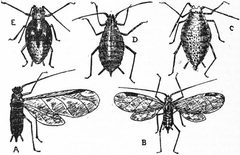
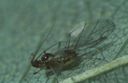
Winged migrants () colonize hop plants in spring; forms establish dense colonies on young tissues near bine apices. Smaller body size and specific association with Humulus lupulus distinguishes it from aphids in agricultural settings. Morphological studies document multiple forms with measurable differences between morphs.
Images
Habitat
Agricultural hop gardens and wild hop stands; also Prunus-dominated hedgerows and orchards during winter phase. concentrated on young tissues near bine apices with plant size and wind shelter influencing local distribution patterns.
Distribution
Europe (including Belgium, Germany, UK); recorded from São Miguel (Azores). Agricultural distribution centered in traditional hop-growing regions.
Seasonality
Spring by from Prunus primary to Humulus secondary hosts occurs during June; development continues through summer growing season.
Diet
Phloem sap feeding on Humulus lupulus during summer; Prunus (P. domestica, P. spinosa, P. padus, P. cerasifera) during winter. plant suitability varies significantly between hop cultivars.
Host Associations
- Humulus lupulus - secondary (summer)primary agricultural ; cultivar-specific susceptibility documented
- Humulus japonicus - secondary (summer)documented summer
- Urtica dioica - secondary (summer)documented summer
- Prunus domestica - primary (winter) ; site of
- Prunus spinosa - primary (winter)
- Prunus padus - primary (winter)
- Prunus cerasifera - primary (winter)
Life Cycle
Heteroecious with obligate alternation. Sexual phase and production on Prunus primary hosts during winter; fundatrix produces migrants that colonize Humulus secondary hosts in spring. Parthenogenetic continues on hops through summer. Return to Prunus occurs in autumn.
Behavior
migrants do not exhibit trivial between leaves on the primary ; their first flight is directly migratory. On less susceptible hop cultivars, alates display increased motile patterns and reduced settling. Spring migrants show enhanced of plants treated with (Z)-jasmone, contrasting with repellent effects observed in other . Wind shelter and plant architecture strongly influence landing and establishment patterns.
Ecological Role
Agricultural pest causing direct feeding damage to hop ; high can compromise yields. Serves as prey for natural enemy in hop agroecosystems.
Human Relevance
Major economic pest of hop production with documented 80-90% yield loss potential in untreated northeastern U.S. hop yards. Subject of resistance management concerns; associated with elevated esterase activity. Research on resistant hop cultivars (e.g., accession 58016) aims to reduce inputs and protect beneficial insect populations.
Similar Taxa
- Phorodon cannabiscongeneric ; primary pest of hemp (Cannabis sativa) rather than Humulus lupulus; similar but distinct specialization
- Rhopalosiphum rufiabdominale (rice root aphid)both colonize Cannabis-related crops but R. rufiabdominale is a root-feeding with distribution, whereas P. humuli is a shoot-feeding on Humulus
Sources and further reading
- BugGuide
- Wikipedia
- GBIF taxonomy match
- iNaturalist taxon
- NCBI Taxonomy
- Catalogue of Life
- A New Pest Management Resource for Hop Farmers in the Northeastern U.S.
- Phorodon humuli Archives - Entomology Today
- Phorodon cannabis Archives - Entomology Today
- IPM in Hemp: Managing Pests in a "New" Crop
- Rice Root Aphid: An Insect Surprise on Indoor-Grown Cannabis
- cannabis aphid on hemp - Entomology Today
- Susceptibility of hop to Phorodon humuli
- Studies On The Morphology Of Damson-Hop Aphid, Phorodon humuli Schrank, 1801
- Behavior and Population Development of Phorodon humuli (Schrank) (Homoptera: Aphididae) on Two Hop Cultivars of Different Susceptibility
- Treating hop plants with (Z)-jasmone increases colonization by Phorodon humuli (Hemiptera: Aphididae) spring migrants
- Esterase activity and associated insecticide resistance in the damson-hop aphid,Phorodon humuli(Schrank) (Hemiptera: Aphididae)
- Large‐scale radiophosphorus marking of the hop aphid (Phorodon humuli Schrank) in situ on the primary host
- Distribution of damson‐hop aphid (Phorodon humuli) migrants on hops in relation to hop variety and wind shelter