
Phorodon
Passerini, 1860
Species Guides
2- Phorodon cannabis(Cannabis Aphid)
- Phorodon humuli(hop aphid)
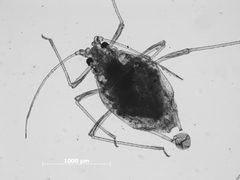
Phorodon is a of aphids in the Aphididae containing at least two economically significant : Phorodon humuli (damson-hop ) and Phorodon cannabis (cannabis aphid). The genus exhibits specialization, with P. humuli feeding on hop (Humulus lupulus) and P. cannabis restricted to hemp and cannabis (Cannabis sativa). Both species are recognized agricultural pests in their respective cropping systems. P. humuli has been extensively studied for resistance mechanisms involving elevated esterase activity, while P. cannabis has emerged as a concern in the expanding North American hemp industry following legalization.
Pronunciation
How to pronounce Phorodon: /ˌfɔːrəˈdɒn/
These audio files are automatically generated. While they are not always 100% accurate, they are a good starting point.
Identification
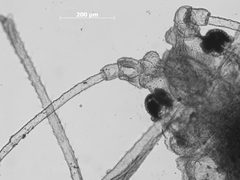
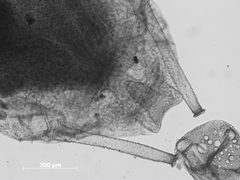
within Phorodon can be distinguished by association: P. humuli is found on hop plants, while P. cannabis occurs exclusively on Cannabis sativa. Morphological differentiation requires examination of or forms under magnification; detailed morphological studies of P. humuli have documented external body structure, mouthparts, , legs, and abdominal . For accurate species identification, host plant verification combined with microscopic examination of diagnostic characters is necessary.
Images
Habitat
Agricultural and cultivated environments. P. humuli occurs in hop yards and hop-growing regions. P. cannabis inhabits field and glasshouse hemp and cannabis cultivations. Both thrive in settings with their specific plants present.
Distribution
Europe and Northern America. Distribution records from GBIF include Denmark, Norway, and Sweden. P. cannabis has been documented in Asia and Europe historically, with as a pest in North America following recent hemp legalization. P. humuli occurs in hop-growing regions including northeastern United States and European hop areas.
Seasonality
P. humuli exhibits spring to hop plants during June, with migrant accumulation on young tissues near bine apices. P. cannabis development has been documented across constant temperatures from 20 to 30°C, with optimal development at 25°C.
Diet
Phloem sap from plants. P. humuli feeds on hop (Humulus lupulus). P. cannabis feeds on hemp and cannabis (Cannabis sativa) and is described as monophagous.
Host Associations
- Humulus lupulus - Primary for P. humuli; commercial hop cultivars show varying susceptibility
- Cannabis sativa - Exclusive for P. cannabis; includes hemp and cannabis cultivars grown for fiber, grain, and CBD production
Life Cycle
Holocyclic with alternation inferred from typical aphidid , though specific primary and secondary host relationships for P. humuli involve between Prunus (primary host, inferred from 'damson-hop ') and Humulus lupulus (secondary host). P. cannabis appears to remain on Cannabis sativa year-round in settings. Developmental stages include fundatrix, and females, and sexual morphs. At 25°C, P. cannabis has been observed to live 25 days and reproduce for 15 days with average of 7.5 nymphs per day.
Behavior
P. humuli spring migrants colonize hop plants with preference for wind-sheltered locations and larger plants; 100% more migrants found on 2-bine than single-bine strings, with positive correlation between bine height and numbers. Leeward-oriented strings support higher than windward strings. P. cannabis demonstrates feeding plasticity across 20-30°C temperature range, with altered feeding observed following herbicide exposure—aphids move from actively growing tips on treated plants compared to untreated plants. Both are sedentary feeders on phloem tissue.
Ecological Role
Herbivore and agricultural pest. P. humuli and P. cannabis cause direct damage through phloem feeding, with potential for yield reduction in hop and hemp crops respectively. P. humuli can reach economically damaging levels, with natural enemy populations capable of suppressing in some regions. P. cannabis has been identified as capable of causing economic loss for hemp growers in some U.S. regions.
Human Relevance
Significant agricultural pest of commercial crops. P. humuli is a major pest of hop production, with yield losses up to 80-90% reported in some northeastern U.S. hop yards; management complicated by development of resistance involving elevated esterase activity. P. cannabis is the most common in hemp crops and recognized as capable of causing economic loss; management options include natural enemies, removal of volunteer hemp plants, and crop . Concern exists that aphid feeding may stimulate increased tetrahydrocannabinol (THC) production in hemp, potentially causing crops to exceed the 0.3% THC legal threshold. No are broadly labeled for hemp aphid control in the U.S., creating reliance on cultural, mechanical, and methods.
Similar Taxa
- Rhopalosiphum rufiabdominaleAlso occurs on Cannabis sativa in indoor production facilities; distinguished by root-feeding habit and distribution on diverse including grains and sedges, rather than specialization on Cannabis
- Aculops cannibicolaHemp russet mite, another pest of Cannabis sativa; distinguished as an eriophyid mite rather than an , with different and damage
- Myzus persicae that may occur on hemp; distinguished by broad range and lack of specialization on Cannabis compared to P. cannabis
More Details
Insecticide Resistance in P. humuli
of P. humuli from cultivated hops show generalized resistance to foliar compared to wild populations from uncultivated hops. Resistance is associated with elevated total esterase activity and complex esterase isoenzyme bands II-V. Selection experiments demonstrate resistance can be lost over six when esterase activity is selected against, with concurrent loss of resistance to methomyl and methidathion.
Host Plant Resistance
Hop germplasm accessions show varying to P. humuli. Accession 58016 demonstrated resistance requiring 24 days to reach 100 aphids per leaf from a single nymph, compared to 17 days on susceptible commercial cultivar Cascade. Commercial hop varieties with such resistance could reduce applications and protect beneficial insects.
Semiochemical Responses
Unlike some where (Z)-jasmone reduces , treatment of hop plants with this compound increases colonization by P. humuli spring migrants. Significantly more migrants were found on treated plants during initial five-day assessment periods in both 2002 and 2003, with increases of 23% and 44% respectively.
Hormesis Under Stress
P. cannabis exhibits mild hormetic response to abiotic stress. Exposure to quizalofop-P-tefuryl herbicide increases activity of superoxide dismutase, catalase, β-glucosidase, S-glutathione transferase, oxidoreductive peroxidase, and polyphenol oxidase on certain days after treatment, correlating with higher rates.
Sources and further reading
- BugGuide
- Wikipedia
- GBIF taxonomy match
- iNaturalist taxon
- NCBI Taxonomy
- Catalogue of Life
- Phorodon cannabis Archives - Entomology Today
- Phorodon humuli Archives - Entomology Today
- IPM in Hemp: Managing Pests in a "New" Crop
- Rice Root Aphid: An Insect Surprise on Indoor-Grown Cannabis
- A New Pest Management Resource for Hop Farmers in the Northeastern U.S.
- cannabis aphid on hemp - Entomology Today
- Phorodon cannabis Passerini. [Distribution map].
- Susceptibility of hop to Phorodon humuli
- Studies On The Morphology Of Damson-Hop Aphid, Phorodon humuli Schrank, 1801
- Mild Abiotic Stress Affects Development and Stimulates Hormesis of Hemp Aphid Phorodon cannabis
- Treating hop plants with (Z)-jasmone increases colonization by Phorodon humuli (Hemiptera: Aphididae) spring migrants
- Behavior and Population Development of Phorodon humuli (Schrank) (Homoptera: Aphididae) on Two Hop Cultivars of Different Susceptibility
- Esterase activity and associated insecticide resistance in the damson-hop aphid,Phorodon humuli(Schrank) (Hemiptera: Aphididae)
- Distribution of damson‐hop aphid (Phorodon humuli) migrants on hops in relation to hop variety and wind shelter