
Labidura riparia
(Pallas, 1773)
shore earwig, tawny earwig, striped earwig, riparian earwig
Labidura riparia is a found primarily in tropical to subtropical regions. It exhibits complex subsocial with maternal care of and young. The species is a valued for biological pest control, with documented on Lepidoptera larvae, insect eggs, and crop pests including the Asian corn borer and Mediterranean fruit fly pupae. Males possess two functional but show a 90% preference for the right penis during copulation, a behavioral asymmetry unique among earwigs.
Pronunciation
How to pronounce Labidura riparia: //læˈbɪdjʊrə rɪˈpeɪriə//
These audio files are automatically generated. While they are not always 100% accurate, they are a good starting point.
Identification
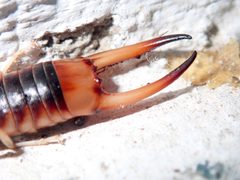
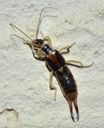
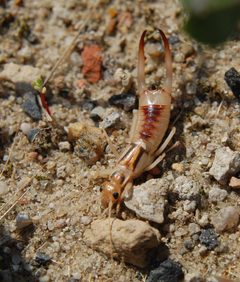
Light tan body with two dark longitudinal stripes on the pronotum, giving the "striped ." Body length ranges from 16–30 mm with 10 abdominal segments. Males have large, strongly curved cercal forceps; females have smaller, straighter forceps with only slight curvature. Modified function as forceps. Distinguished from the Labidura riparia japonica (restricted to Japan, India to Papua New Guinea) by geographic range.
Images
Habitat
Dark, moist environments with shelter for daytime hiding. Found in diverse including cultivated and uncultivated farmlands, woodlands, and margins of ponds and lakes. Occupies abandoned burrows for nests to conserve energy.
Distribution
distribution primarily in tropical to subtropical regions. Records from Azores (Faial, Graciosa, São Miguel, Terceira), Baja California, and documented in Louisiana, Egypt, and across Asia.
Seasonality
activity with hunting primarily just after sunset. Two to three per year in temperate regions, with the last generation hibernating underground through winter. live 2–3 months.
Diet
feeding exclusively on insects and scavenged meat. Preference for Lepidoptera larvae and insect . Prey includes larger insects killed and immobilized using long, powerful . Documented on Asian corn borer (Ostrinia furnacalis) and Mediterranean fruit fly pupae. of nymphs and eggs occurs when food is scarce.
Life Cycle
Six instars before adulthood. Females lay 60–100 in nests dug under rocks or tree bark. Maternal care includes cleaning eggs of fungi and dirt, guarding for 10 days until hatching, then feeding and young for 2–5 days until they leave the nest. Females may produce up to three , sometimes simultaneously. Nymphs dig individual molting nests, taking 4–50 days between instars.
Behavior
Subsocial with complex maternal habits. Females become hostile to males in chambers. Nest recognition via individual-specific transferred to nest substratum; females cannot distinguish own from offspring but discriminate their own nests. occurs after disturbance to find new nests when waterlogged or destroyed. Orientation using moonlight leads to attraction to artificial light. Males court by antennal contact and mutual abdominal grasping with forceps.
Ecological Role
contributing to of agricultural and forest pests. influenced by on , with reciprocal predation on ant eggs. Repugnatory glands secrete foul-smelling (described as decomposition-like) for predator deterrence.
Human Relevance
Regarded as efficient agent in agricultural settings. Used or encouraged for pest management against lepidopteran crop pests and fruit fly pupae. No documented negative economic impacts.
Similar Taxa
- Labidura riparia japonica formerly misidentified as separate Labidura japonica; restricted to Japan, India to Papua New Guinea versus range of nominate subspecies
- Forficula speciesOther lack paired dark pronotal stripes and show different forceps ; Forficulidae have single versus two in Labiduridae
Sources and further reading
- BugGuide
- Wikipedia
- GBIF taxonomy match
- iNaturalist taxon
- NCBI Taxonomy
- Catalogue of Life
- UC Davis Students Carry on Legacy of Walnut Twig Beetle Expert Steve Seybold | Bug Squad
- New Guide Outlines Management for Mediterranean Fruit Fly in Egypt
- Could poison ivy ward off exotic invaders? | Blog
- The idiochromosomes of an earwig, Labidura riparia
- Biology of the Predaceous Earwig Labidura riparia (Dermaptera: Labiduridae)1,2
- Biology of Labidura riparia (Pallas) and Its Predatory Capacity on the Asian Corn Borer
- Ecology and Control of the Striped Earwig, Labidura Riparia, (Labiduridae: Dermptera) in Louisiana.
- Activity of corpora allata, endocrine balance and reproduction in female Labidura riparia (Dermaptera)
- Maternal Behaviour and Nest Recognition in the Subsocial Earwig Labidura riparia Pallas (Dermaptera: Labiduridae)
- Right‐handed penises of the earwig Labidura riparia (Insecta, Dermaptera, Labiduridae): Evolutionary relationships between structural and behavioral asymmetries
- Normal and experimentally induced changes in hormonal hemolymph titers during parental behavior of the earwig Labidura riparia