
Labidura
Leach, 1815
striped earwigs
Species Guides
1- Labidura riparia(shore earwig)
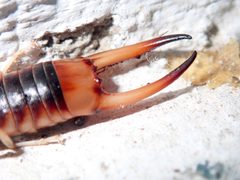
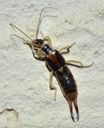
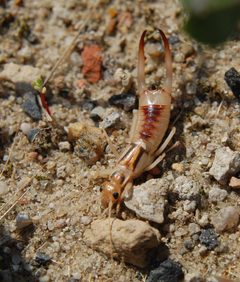
Labidura is a of in the Labiduridae, established by Leach in 1815. The genus includes approximately nine , with Labidura riparia being the most widespread and member. Labidura riparia is notable as a of agricultural pests, including the Asian corn borer and Mediterranean fruit fly pupae. The Saint Helena earwig (Labidura herculeana), now possibly extinct, was the largest known earwig species. Several Labidura species exhibit subsocial maternal care of and young.
Pronunciation
How to pronounce Labidura: /læbɪˈdjʊrə/
These audio files are automatically generated. While they are not always 100% accurate, they are a good starting point.
Images
Habitat
within this occupy diverse . Labidura riparia has been documented in riparian areas, agricultural fields (particularly corn fields), and coastal plain environments. The species shows habitat flexibility, occurring in both natural and cultivated landscapes.
Distribution
Labidura riparia is in distribution. Labidura herculeana was to Saint Helena in the South Atlantic Ocean. Other have more restricted ranges: Labidura japonica in Japan, Labidura orientalis described from Steinmann's work, and Labidura dharchulensis from India. Distribution records from GBIF include Denmark and Sweden.
Behavior
Labidura riparia exhibits subsocial maternal including care and defense of newly hatched larvae. Females provide food to young and defend chambers against conspecifics. Females recognize their own brood chambers through individual-specific transferred to nest substratum, though they cannot distinguish own from offspring. Larvae depart the nest 2–5 days after hatching and do not return after their first excursion. The is primarily with documented diel periodicity patterns.
Ecological Role
Labidura riparia functions as a agent in agricultural . It preys upon the Asian corn borer (Ostrinia furnacalis), a major pest of corn in the Philippines. In Egypt, it attacks pupae of the Mediterranean fruit fly (Ceratitis capitata) in soil and under fallen infested fruits. Members of this contribute to natural pest suppression in fruit groves and agricultural systems.
Human Relevance
Labidura riparia is recognized as a beneficial in programs. Its on economically important pests such as the Mediterranean fruit fly and Asian corn borer provides natural , reducing reliance on synthetic . The has been studied for its potential in sustainable agriculture and pest management strategies.
Sources and further reading
- BugGuide
- Wikipedia
- GBIF taxonomy match
- iNaturalist taxon
- NCBI Taxonomy
- Catalogue of Life
- New Guide Outlines Management for Mediterranean Fruit Fly in Egypt
- The story so far - Buglife Blog - Buglife
- The idiochromosomes of an earwig, Labidura riparia
- Biology of Labidura riparia (Pallas) and Its Predatory Capacity on the Asian Corn Borer
- Ecology and Control of the Striped Earwig, Labidura Riparia, (Labiduridae: Dermptera) in Louisiana.
- Activity of corpora allata, endocrine balance and reproduction in female Labidura riparia (Dermaptera)
- Biology of the Predaceous Earwig Labidura riparia (Dermaptera: Labiduridae)1,2
- Maternal Behaviour and Nest Recognition in the Subsocial Earwig Labidura riparia Pallas (Dermaptera: Labiduridae)
- Seasonal Abundance, Diel Periodicity and Habitat Preference of the Striped Earwig Labidura riparia1 in the Coastal Plain of South Carolina2