
Anisolabis
Fieber, 1853
Species Guides
1- Anisolabis maritima(maritime earwig)
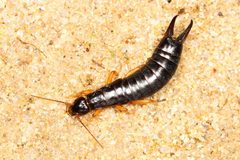
Anisolabis is a of earwigs in the Anisolabidinae, with most occurring in Asia. The genus name derives from the asymmetrical male , with the right cercus more acute than the left. The best-studied species is Anisolabis maritima, the maritime , which has been extensively researched for its social , , and maternal care. Other species such as A. annulipes are known agricultural pests.
Pronunciation
How to pronounce Anisolabis: //ˌænɪˈsoʊˌlæbɪs//
These audio files are automatically generated. While they are not always 100% accurate, they are a good starting point.
Identification
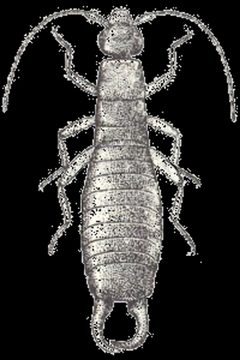
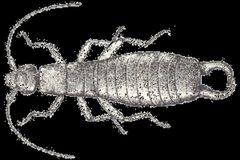
Males possess asymmetrical with the right cercus more acute than the left, the diagnostic feature for which the is named. Females have straight, symmetrical forceps. in forcep is pronounced: female forceps are straight and used lethally to strike and cut opponents, while male forceps are curved and used non-lethally to squeeze rivals.
Images
Habitat
Coastal beaches at or above the high tide line for A. maritima; terrestrial environments including agricultural fields for other such as A. annulipes. A. maritima aggregates under driftwood or seaweed in temperate and tropical shorelines.
Distribution
Primarily Asian distribution for most ; A. maritima occurs worldwide on temperate and tropical beaches.
Diet
Small arthropods for A. maritima; peanuts and other plant material for A. annulipes, which gnaws holes in peanut pods causing agricultural damage.
Life Cycle
Four nymphal instars observed in A. annulipes, with development times varying strongly with temperature (30–280 days at 18–34°C). At 28–30°C, instars last approximately 10, 10, 16, and 16 days respectively. Females of A. maritima lay in soil burrows and provide to nymphs. Multiple per year possible under favorable conditions; in Israel, A. annulipes produces four generations annually with three maturing before winter and the fourth as nymphs.
Behavior
foraging activity. Extensive maternal care including guarding and of nymphs; mothers recognize offspring presence and hunger level, adjusting food delivery accordingly. Females more aggressive than males in pairwise encounters. Intrasexual aggression strongly size-based in both sexes. Social dynamics alter with group composition: males form while females maintain uniform spacing indicative of territoriality; mixed-sex groups show uniform distribution during active nocturnal periods but become clumped when settled during daytime.
Human Relevance
A. annulipes is an agricultural pest of peanuts in Israel, causing economic damage by gnawing holes in pods. A. maritima serves as a model organism for research on , social , and the evolution of maternal care in insects.
Similar Taxa
- EuborelliaFormerly treated as subgenus; A. annulipes has been classified as Anisolabis (Euborellia) annulipes in older literature. Distinguished by consistent generic-level separation in modern .
- ForficulaBoth are with forceps-like , but Forficula males typically have more symmetrical, robust forceps and lack the pronounced cercal asymmetry diagnostic of Anisolabis.
Sources and further reading
- BugGuide
- Wikipedia
- GBIF taxonomy match
- iNaturalist taxon
- NCBI Taxonomy
- Catalogue of Life
- Two’s company, three’s a crowd: Social situations alter group dynamics in the maritime earwig (Anisolabis maritima)
- Physiological cost of maternal care? Effect of pre- and post-hatching care on the clutch size in the earwig Anisolabis maritima
- Brood size manipulation reveals cost on the size of the second clutch in the earwig Anisolabis maritime
- Big wigs and small wigs: Time, sex, size and shelter affect cohabitation in the maritime earwig (Anisolabis maritima)
- The origin and distribution of periodic acid‐Schiff‐positive substances in the oocyte of the earwig, Anisolabis maritima (Géné)
- Distribution and ultrastructure of sensillae on legs and anal cerci in earwig Anisolabis maritima (Dermaptera: Carcinophoridae)
- Bionomics and Ecology of the Earwig Anisolabis (Euborellia) annulipes Luc. (Labiduridae‐Dermaptera) in Israel1
- Provisioning control during maternal care by the earwigAnisolabis maritima(Dermaptera: Anisolabididae): Do mothers adjust provisioning according to offspring need?
- Weaponry, size, and sex ratio affect spatial distribution within small and large groups of the maritime earwig (Anisolabis maritima)