
Acroceridae
small-headed flies, hunch-back flies, spider flies
Genus Guides
7- Acrocera(small-headed flies)
- Eulonchus(North American jewelled spider flies)
- Lasia
- Ocnaea
- Ogcodes(small-headed flies)
- Pterodontia(small-headed flies)
- Turbopsebius
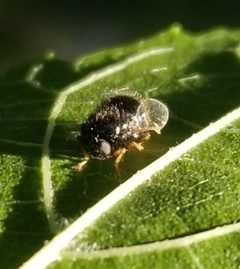
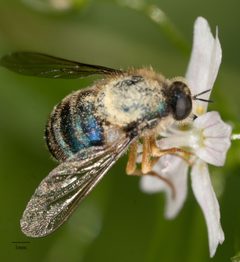
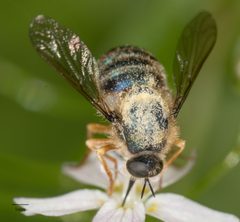
Acroceridae are a small of approximately 520 in 50 , characterized by their distinctive hump-backed and disproportionately small . are primarily nectar feeders with exceptionally long , while larvae are obligate endoparasitoids of spiders. Many species exhibit or mimicry. The family is but nowhere abundant, with most species known from fewer than 10 specimens.
Pronunciation
How to pronounce Acroceridae: /æˌkroʊˈsɛrɪdaɪ/
These audio files are automatically generated. While they are not always 100% accurate, they are a good starting point.
Identification
Distinguished from similar by combination of: hump-backed with small ; in both sexes (unusual among Diptera); large squamae covering ; long carried beneath body rather than projecting forward; and globular . Resembles Bombyliidae and Nemestrinidae in general form but differs in head structure and proboscis carriage. mimics may be confused with actual Hymenoptera but lack constricted waist and have single pair of wings.
Images
Habitat
Most commonly encountered in semiarid tropical locations. often found on flowers, particularly in July and August in Palearctic region. Larvae occur wherever spiders are present. Appear episodically; rarely observed in most locations despite distribution.
Distribution
in distribution but nowhere abundant. Documented from all major biogeographic regions including Palearctic, Nearctic, Neotropical, Afrotropical, Oriental, and Australasian realms. Specific records include Chile (33 ), Brazilian Atlantic Forest, and Schleswig-Holstein (Germany).
Seasonality
most commonly observed in July and August in . Activity patterns elsewhere poorly documented due to rarity of encounters.
Diet
feed on floral nectar using exceptionally long . Some are specialized , showing high floral constancy and effective pollen transport.
Host Associations
- Araneae - endoparasitoidAll known are internal of true spiders. specificity varies; some records include Amaurobius erberi, Clubiona leucaspis, Evarcha jucunda, Pardosa alacris, and Atypoides riversi.
- Acari - unsuccessful First-instar larvae of Pterodontia flavipes have been observed on mites but cannot complete development due to small size.
Life Cycle
Hypermetamorphic development. Females lay up to 5,000 on ground or vegetation. First-instar larvae () actively seek spider using looping movement or leaping several millimetres into air. Upon contact, planidium crawls up spider's legs, penetrates body wall at , and lodges near book lung where it may remain in for months to years. Subsequent larval instars develop rapidly, consuming host's liquid contents. Mature larva emerges posteriorly from host, attaches to spider silk for . emerge in 7–10 days.
Behavior
do not seek ; host location is entirely larval responsibility. When feeding, adults extend to access nectar; when not feeding, proboscis is concealed lengthwise beneath body. Mating occurs within flower patches in at least some . Females visit more individual flowers and forage more slowly than males, apparently related to mating .
Ecological Role
As of spiders, regulate spider . function as in some , with Eulonchus sapphirinus documented as visitor to Geranium robertianum flowers in Olympic National Park. Compete with certain for endoparasitic in spiders.
Human Relevance
Similar Taxa
- BombyliidaeSimilar -mimic appearance and long , but Acroceridae have in both sexes, hump-backed , and carry proboscis beneath body rather than projecting forward.
- NemestrinidaeRelated with similar nectar-feeding habits and hypermetamorphic larvae, but Acroceridae distinguished by small , hump-backed profile, and spider-specific .
More Details
Taxonomic uncertainty
Placement within Diptera remains unresolved; studies suggest closest relationship to Nemestrinidae and Bombyliidae, while morphological analyses indicate possible sister group relationship to Asiloidea and . Phylogenomic analyses yield conflicting topologies depending on versus coding.
Rarity in collections
Of more than 500 described , most are known from fewer than 10 specimens, making this one of the most poorly represented dipteran in entomological collections despite distribution.
Classification history
2019 revision based on phylogenetic studies recognized five extant and one extinct subfamily containing Archocyrtus from Late Jurassic Karabastau Formation of Kazakhstan.
Sources and further reading
- BugGuide
- Wikipedia
- GBIF taxonomy match
- iNaturalist taxon
- NCBI Taxonomy
- Catalogue of Life
- Jessica Gillung: Amazing Entomologist | Bug Squad
- Bohart Museum Open House: From Wasps to Nematodes to Flies to Pop-Up Cards | Bug Squad
- 'Dr. Jessicles' Heading for Cornell | Bug Squad
- Jessica Gillung's Research on Spider Flies: A Tale of Conflict and Uncertainty | Bug Squad
- Parasitoid Palooza! Or What Ate My Caterpillar or Chrysalis | Bug Squad
- Jessica Gillung: Absolute Dynamo | Bug Squad
- A catalog of Acroceridae (Diptera) from Chile
- New host records of West Palaearctic spider flies (Diptera: Acroceridae)
- The Biology of Acroceridae (Diptera): True Endoparasitoids of Spiders
- Ein neuer Nachweis der regional seltenen Kugelfliege Acrocera orbiculus (Fabricius, 1787) (Dipt. Acroceridae) in Schleswig-Holstein
- Family Acroceridae (Insecta: Diptera) as Parasitoids of Spiders (Arthropoda: Arachnida)
- New species and new records of Exetasis Walker (Diptera: Acroceridae) from protected areas of the Brazilian Atlantic Forest
- Ein seltener Parasitoid der WolfspinnePardosa alacris(Araneae: Lycosidae):Ogcodes gibbosus(Diptera: Acroceridae).
- New host records for European Acroceridae (Diptera), with discussion of species limits of Acrocera orbiculus (Fabricius) based on DNA-barcoding
- OVIPOSITION BEHAVIOR AND THE EGG OF ACROCERA ORBICULA (FAB.) (DIPTERA: ACROCERIDAE)
- New spider host associations for three acrocerid fly species (Diptera, Acroceridae)
- Flower-visiting and mating behaviour of Eulonchus sapphirinus (Diptera: Acroceridae)