
Nemestrinidae
tangle-veined flies
Genus Guides
3- Hyrmophlaeba
- Neohirmoneura
- Neorhynchocephalus(tangle-veined flies)
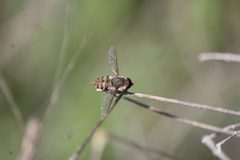
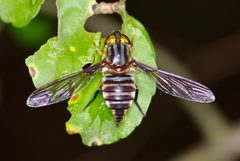
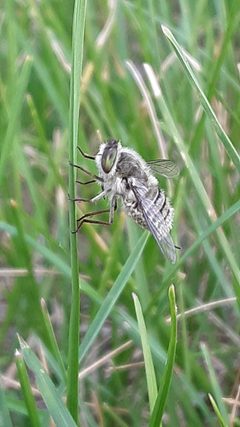
Nemestrinidae, commonly called tangle-veined flies, is a of brachyceran flies comprising approximately 300 in 34 . The family is distributed worldwide but is most diverse in the southern hemisphere. are characterized by distinctive wing venation with numerous crossveins creating a tangled appearance, and many species possess exceptionally long adapted for nectar feeding from tubular flowers. Larvae are endoparasitoids, with Trichopsideinae parasitizing grasshoppers and Hirmoneurinae parasitizing scarab beetles.
Pronunciation
How to pronounce Nemestrinidae: /nɛˌmɛsˈtrɪnɪˌdaɪ/
These audio files are automatically generated. While they are not always 100% accurate, they are a good starting point.
Identification
Distinguished from other Diptera by the combination of: numerous transverse wing creating a tangled, reticulate pattern; well-developed typically longer than the ; free R3+4 and R5 veins; free M1 and M2 veins; and stout body form. Resembles bee flies (Bombyliidae) in general appearance but differs in wing venation details and head structure. Long-proboscid may be confused with other nectar-feeding flies but are distinguished by the unique wing venation and suction pump anatomy.
Images
Habitat
Diverse including grasslands, savannas, shrublands, and open woodlands. Long-proboscid in South Africa occur in most provinces and habitats except closed- forest. Some such as Stenobasipteron occur in closed-canopy forest. In arid regions, found in desert wadis, agricultural areas, and semi-urban localities. Associated with flowering vegetation due to nectar-feeding .
Distribution
Worldwide distribution with approximately 300 in 34 . Most diverse in the southern hemisphere, particularly in South Africa (43 described species), Chile (37 species), and other southern temperate regions. Only six species in three genera occur in the Nearctic region. Present in the Afrotropical, Australasian, Neotropical, Oriental, and Palaearctic regions. Fossil records from Russia, Kazakhstan, Mongolia, Western Europe, North America, China, and Myanmar dating from Middle-Upper Jurassic to recent.
Seasonality
activity varies by region and . Spring-active clades occur in the Greater Cape Floristic Region of South Africa. Egyptian specimens predominantly collected March-April. Adults of -associated present during grasshopper activity periods, typically summer months in temperate regions.
Diet
feed on nectar from flowers, with many showing specialization for long-tubed flowers. Larvae are endoparasitoids that consume tissues; Trichopsideinae larvae feed on and soft tissues, while Hirmoneurinae larvae parasitize scarab beetles.
Host Associations
- grasshoppers (Orthoptera: Acrididae) - endoparasitoid for Trichopsideinae larvae; larvae penetrate body wall and consume and soft tissues
- scarab beetles (Coleoptera: Scarabaeidae) - endoparasitoid for Hirmoneurinae larvae
Life Cycle
Females lay thousands of on elevated objects such as tall weeds or fenceposts. Larvae hatch and are dispersed by wind. Upon contacting a suitable , larvae penetrate the body wall and develop as endoparasitoids. Larvae can survive up to 14 days without encountering a host. Development occurs within the host, with larvae consuming reproductive tissues and soft body parts. Host death typically results. occurs in soil.
Behavior
are flower visitors, often observed on flowers feeding on nectar. Long-proboscid use a two-part suction pump in the to create pressure gradients for efficient nectar uptake, allowing them to empty flowers rapidly. Larval is passive via wind. Some can encapsulate entering larvae, sealing them off and preventing successful .
Ecological Role
Important , particularly in the Greater Cape Floristic Region of South Africa where long-proboscid serve as keystone pollinators for multiple plant including Iridaceae. Five distinct pollination guilds center on long-proboscid Nemestrinidae in this region. agents for ; rates up to 80% have been recorded in some years for specific species.
Human Relevance
Some considered important for of pests in agricultural and rangeland settings. Studied as model systems for of length and floral tube length. Of interest in pollination research due to specialized mutualisms with long-tubed flowers.
Similar Taxa
- Bombyliidae (bee flies)Similar -like appearance and flower-visiting ; distinguished by wing venation (Nemestrinidae have more numerous crossveins creating tangled pattern) and structure
- Acroceridae (small-headed flies)Related in superfamily Nemestrinoidea; differ in having extremely small and different wing venation, larvae are of spiders rather than orthopterans or beetles
More Details
Fossil record
Oldest described fossils from Middle-Upper Jurassic Karabastau Formation of Kazakhstan and Daohugou Bed of China. Extinct Archinemestriinae known from Jurassic and Cretaceous deposits.
Proboscis adaptation
In Prosoeca, longer correlate with more efficient two-part suction pumps, countering the expectation that longer mouthparts would reduce feeding . This allows exploitation of nectar from long-tubed flowers that other cannot access.
Taxonomic diversity
South African fauna includes six : Moegistorhynchus (4 , west coast restricted), Prosoeca (35 species, genus), Stenobasipteron (1 described species, forest ), Atriadops (1-2 species), Nycterimyia (1 species), and Trichopsidea (1 species).
Sources and further reading
- BugGuide
- Wikipedia
- GBIF taxonomy match
- NCBI Taxonomy
- Catalogue of Life
- Bug Eric: Blue-legged Grasshopper
- Nemestrinidae Archives - Entomology Today
- Long-proboscid Flies Use Suction Pumps to Increase Flow of Nectar
- Remarkable sexual dimorphism in the Afrotropical species Nycterimyia capensis Bezzi, 1924 (Diptera: Nemestrinidae), and its taxonomic implications
- A review of tangle-veined flies (Nemestrinidae, Diptera) in Egypt
- The first species of Nemestrinidae (Diptera) endemic to Madagascar: A remarkable new species of Atriadops Wandolleck, 1897
- A catalog of Nemestrinidae (Diptera: Brachycera: Nemestrinoidea) from Chile
- Diversity, distribution and floral specificity of tangle-veined flies (Diptera: Nemestrinidae) in north west Patagonia, Argentina
- An overview of the South African tangle-veined flies (Diptera: Nemestrinidae), with an annotated key to the genera and a checklist of species
- Pollination syndrome accurately predicts pollination by tangle‐veined flies (Nemestrinidae: Prosoeca s.s.) across multiple plant families
- A revision of a spring-active clade of Prosoeca Schiner, 1867 (Diptera, Nemestrinidae), keystone pollinators from the Greater Cape Floristic Region in South Africa, with descriptions of three new species.