
Eulonchus sapphirinus
Osten Sacken, 1877
Sapphire spider fly
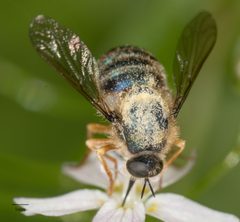
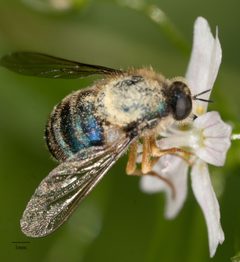
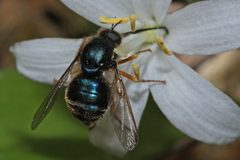
Eulonchus sapphirinus is a of small-headed fly in the Acroceridae, commonly known as the sapphire spider fly. are metallic blue in coloration and are specialized flower visitors, particularly abundant on Geranium robertianum in Olympic National Park, Washington. The species exhibits sexually dimorphic flower-visiting related to mating, with females moving more slowly among flowers than males. Like other members of its , the larvae are of spiders, though specific records for this species remain unconfirmed.
Pronunciation
How to pronounce Eulonchus sapphirinus: //juːˈlɔŋ.kəs sæˈfaɪ̯.rɪ.nəs//
These audio files are automatically generated. While they are not always 100% accurate, they are a good starting point.
Identification
Distinguished from other Eulonchus by its sapphire blue metallic coloration; E. tristis is green, E. smaragdus is emerald green, and E. marialiciae is purple. The elongated mouthparts, metallic coloration, and hairy separate this from other spider flies. are locally abundant in suitable , unlike the rare and restricted E. marialiciae.
Images
Habitat
Montane and forested areas of western North America; specifically documented from Olympic National Park, Washington. Associated with flowering patches of Geranium robertianum (Geraniaceae).
Distribution
Western North America; confirmed from Olympic National Park, Washington. The Eulonchus ranges from Mexico to Canada, with this likely more widespread in suitable montane of the western United States.
Diet
feed on floral nectar, specifically documented from Geranium robertianum flowers. Larvae are presumed of spiders, though specific records for this are not confirmed.
Host Associations
- Geranium robertianum - form the majority of insect visitors to flowers; both sexes carry pollen and exhibit -efficient
Life Cycle
Complete with , larva, pupa, and stages. Larvae are endoparasitoids of spiders, burrowing into the body and feeding internally around the book lungs before emerging and pupating. Specific details for E. sapphirinus are inferred from -level .
Behavior
are flower visitors with sexually dimorphic foraging patterns. Females visit more individual flowers and move more slowly than males, a difference linked to mating that occurs within flower patches. Both sexes show high floral constancy, revisiting flowers and remaining faithful to a single flowering during foraging bouts. They carry pollen on their bodies, facilitating pollination.
Ecological Role
Potentially important in certain ; documented as the most abundant insect visitor to Geranium robertianum flowers in Olympic National Park. As a spider , larvae contribute to spider . The demonstrates that acrocerid flies, often considered rare, can be locally common and functionally significant pollinators.
Human Relevance
Subject of research demonstrating the pollination importance of underappreciated fly . Contributes to understanding of in foraging and its relationship to mating systems in insects.
Similar Taxa
- Eulonchus tristisGreen rather than sapphire blue coloration; also a flower visitor but with different color morph
- Eulonchus smaragdusEmerald green coloration; similar size and preferences
- Eulonchus marialiciaePurple coloration; much rarer and known from only a few specimens in Great Smoky Mountains
More Details
Mating system
Mating occurs within flower patches, with the sexually dimorphic flower-visiting directly related to reproductive opportunities. This represents a case where foraging and mating arenas overlap.
Conservation of pollinators
This exemplifies how apparently rare fly can harbor locally abundant, functionally important , highlighting the need for broader pollinator conservation beyond bees and butterflies.