
Eulonchus
Gerstaecker, 1856
North American jewelled spider flies, sapphires, emeralds
Species Guides
5- Eulonchus marginatus(jewelled spider fly)
- Eulonchus marialiciae
- Eulonchus sapphirinus(Sapphire spider fly)
- Eulonchus smaragdinus(Jewelled spider fly)
- Eulonchus tristis(small-headed fly)
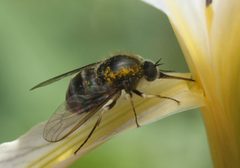
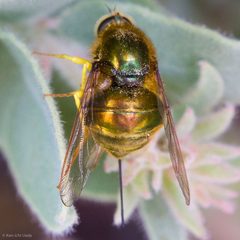
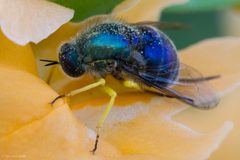
Eulonchus is a of small-headed flies in the Acroceridae, comprising six described to North America. are strikingly metallic blue, green, or purple, earning them the 'sapphires' and 'emeralds.' They are important of diverse flowering plants, with elongated mouthparts adapted for nectar feeding. Their larvae are of spiders, specifically targeting trapdoor spiders in the families Euctenizidae and Antrodiaetidae.
Pronunciation
How to pronounce Eulonchus: //juːˈlɒn.kəs//
These audio files are automatically generated. While they are not always 100% accurate, they are a good starting point.
Identification
The combination of metallic coloration, greatly elongated mouthparts, and hairy immediately distinguishes Eulonchus from other spider flies. The large, rounded, densely hairy body further separates them from related . -level identification requires examination of specific morphological characters detailed in taxonomic revisions.
Images
Appearance
have large, rounded bodies covered with dense hairs and brilliant metallic coloration ranging from green to blue to purple. The mouthparts are greatly elongated, adapted for accessing nectar from flowers. The are covered with soft hairs. The overall jewel-like appearance distinguishes them from other spider flies.
Habitat
Montane and mountainous regions of western North America, including the Sierra Nevada of California. frequent flowering plants in these . One , E. marialiciae, is restricted to the Great Smoky Mountains in North Carolina.
Distribution
North America, primarily west of the Rocky Mountains from Canada to Baja California, Mexico. Most occur in this western range; E. marialiciae is known only from a small area in the Great Smoky Mountains, North Carolina.
Diet
feed on nectar from flowers of more than 25 plant and 80 . Larval diet consists of internal tissues of spiders.
Host Associations
- Euctenizidae - spider Larval
- Antrodiaetidae - spider Larval
Life Cycle
Females lay that hatch into highly mobile, -seeking larvae. Upon contacting a spider, the larva burrows into the host's body wall and takes up residence around the book lungs, feeding internally. The larva matures inside the host, eventually emerging from the and killing the spider. It then pupates to develop into an .
Behavior
are flower visitors and effective , showing flower fidelity during foraging bouts and making few revisits to individual flowers. Mating occurs within flower patches. Females forage more slowly and visit more flowers than males, a behavioral difference linked to reproductive activity. Larvae are active -seekers that locate spiders through environmental contact.
Ecological Role
Human Relevance
Potential biocontrol agents for spider . Their striking appearance makes them subjects of natural history interest and photography.
Similar Taxa
- Other AcroceridaeEulonchus is distinguished by metallic coloration, elongated mouthparts, and hairy ; other spider flies lack this combination of traits
More Details
Pollination effectiveness
Studies of E. tristis show individuals carry large pollen loads, with 91% focal-plant pollen when visiting Brodiaea elegans versus 38% when visiting Iris douglasiana, indicating differential effectiveness across plant . E. sapphirinus has been observed as the most abundant insect visitor to Geranium robertianum flowers in Olympic National Park.
Taxonomic history
The was revised using cybertaxonomic methods in 2016, with a presented for the six recognized . The Schlinger collection at the California Academy of Sciences contains extensive material accumulated over 60 years.
Sources and further reading
- BugGuide
- Wikipedia
- GBIF taxonomy match
- iNaturalist taxon
- NCBI Taxonomy
- Catalogue of Life
- insect diversity | Blog - Part 3
- Bug Eric: Spider Sunday: Spider Enemies
- Flower-visiting and mating behaviour of Eulonchus sapphirinus (Diptera: Acroceridae)
- Distributional Patterns of Selected Western North American Insects: An Analysis of the Distribution of Eulonchus Gerstaecker (Diptera: Acroceridae)
- Pollen loads and pollen diversity on bodies of Eulonchus tristis (Diptera: Acroceridae): implications for pollination and flower visitation