
Pterodontia flavipes
Gray, 1832
small-headed fly
Pterodontia flavipes is a of small-headed fly in the Acroceridae. males measure 5.5–10.5 mm, while females are 5–9 mm. The species exhibits complete with larval development occurring in soil. Adults have been observed in grassy areas and are known for rapid, hovering .

Pronunciation
How to pronounce Pterodontia flavipes: /ˌtɛroʊˈdɒntiə ˈfleɪvaɪpiːz/
These audio files are automatically generated. While they are not always 100% accurate, they are a good starting point.
Identification
Distinguished from other Diptera by the combination of small , large humpbacked , and short . Within Acroceridae, separation from requires examination of leg coloration and male genitalia. The yellow legs (flavipes) provide a field character, though this trait alone is insufficient for definitive identification without reference to or diagnostic keys.
Images
Appearance
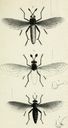
Small-headed fly with males 5.5–10.5 mm in length, females 5–9 mm. Characteristic of Acroceridae, adults possess a small, rounded on a large, globular . Legs are typically yellowish (flavipes = yellow-footed), consistent with the specific epithet. Wings are clear with reduced venation typical of the .
Habitat
Larvae develop in soil. have been observed in grassy areas and open vegetation.
Distribution
Recorded from Vermont and other locations in the United States. Distribution records are sparse in available sources.
Seasonality
emerge in spring. Specific period details are not well documented.
Diet
Larvae feed on organic matter in soil. have been observed feeding on nectar.
Host Associations
- Podothrombium - First instar larvae recorded attacking these mites
- Abrolophus - First instar larvae recorded attacking these mites
Life Cycle
Complete . are laid in soil. Larval development occurs in soil, with also taking place in soil. emerge in spring. The specific duration of developmental stages is not documented in available sources.
Behavior
exhibit rapid and have been observed hovering near grass. Males display territorial . Larvae are thought to enter spiders at leg , though this behavior requires further confirmation.
Ecological Role
Human Relevance
No documented economic or medical significance. The is of interest primarily to entomologists studying Acroceridae and .
Similar Taxa
- Other Pterodontia speciesRequire examination of leg coloration and male genitalia for separation; many lack the yellow leg character
- Other Acroceridae generaShare the small-headed, humpbacked ; distinguished by wing venation, structure, and larval
More Details
Taxonomic note
The was described by Gray in 1832. The specific epithet flavipes (yellow-footed) refers to the characteristic leg coloration.
Research gaps
details remain incompletely known. The entry of larvae and the full range of host associations require further study.
Sources and further reading
- BugGuide
- Wikipedia
- GBIF taxonomy match
- iNaturalist taxon
- NCBI Taxonomy
- Catalogue of Life
- Ice dams, wet wood, and termites - Reticulitermes flavipes — Bug of the Week
- What lies beneath the mulch? Formosan termite, Coptotermes formosanus, and Eastern subterranean termite, Reticulitermes flavipes — Bug of the Week
- How to raise a crop of termites: Eastern subterranean termites, Reticulitermes flavipes — Bug of the Week
- From the Bug of the Week mailbag, termites or ants? Eastern subterranean termites, Reticulitermes flavipes, or Citronella ants, Lasius sp. — Bug of the Week
- Polydesmida | Beetles In The Bush
- New Method Makes for Faster Genetic ID of Eastern U.S. Termites
- Observations on the Life History of Pterodontia Flavipes Gray. (Diptera.)*